
改善癌症患者心理健康的数字健康干预措施:伞状综述
Digital Health Interventions to Improve Mental Health in Patients With Cancer: Umbrella Review.
作者信息
Zhong Chuhan, Luo Xian, Tan Miaoqin, Chi Jing, Guo Bingqian, Tang Jianyao, Guo Zihan, Deng Shisi, Zhang Yujie, Wu Yanni
机构信息
Nanfang Hospital, Southern Medical University, Guangzhou, China.
School of Nursing, Southern Medical University, Guangzhou, China.
出版信息
J Med Internet Res. 2025 Feb 21;27:e69621. doi: 10.2196/69621.
BACKGROUND
Mental health plays a key role across the cancer care continuum, from prognosis and active treatment to survivorship and palliative care. Digital health technologies offer an appealing, cost-effective tool to address psychological needs.
OBJECTIVE
This umbrella review aims to summarize and evaluate the available evidence on the efficacy of digital health interventions for improving mental health and psychosocial outcomes for populations with cancer.
METHODS
Literature searches were conducted in Embase, PsycINFO, PubMed, CINAHL, the Cochrane Library, and Web of Science from their inception to February 4, 2024. Systematic reviews (with or without meta-analysis) investigating the efficacy of digital health interventions for psychosocial variables in patients with cancer were included. Quality was assessed using the Assessing the Methodological Quality of Systematic Reviews-2 tool.
RESULTS
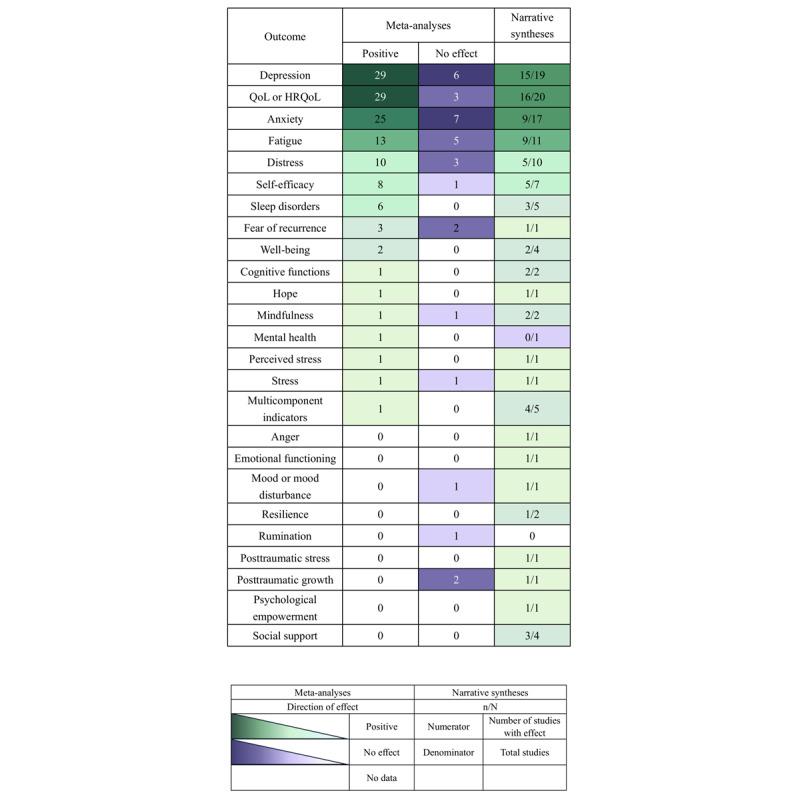
In total, 78 systematic reviews were included in this review. Among diverse delivery modalities and types of digital interventions, websites and smartphone apps were the most commonly used. Depression was the most frequently addressed, followed by quality of life, anxiety, fatigue, and distress. The qualities of the reviews ranged from critically low to high. Generally, despite great heterogeneity in the strength and credibility of the evidence, digital health interventions were shown to be effective for mental health in patients with cancer.
CONCLUSIONS
Taken together, digital health interventions show benefits for patients with cancer in improving mental health. Various gaps were identified, such as little research specifically focusing on older adult patients with cancer, a scarcity of reporting high-precision emotion management, and insufficient attention to other certain mood indicators. Further exploration of studies with standardized and rigorous approaches is required to inform practice.
TRIAL REGISTRATION
PROSPERO CRD42024565084; https://tinyurl.com/4cbxjeh9.
背景
心理健康在癌症护理的整个过程中起着关键作用,从预后和积极治疗到生存和姑息治疗。数字健康技术提供了一种有吸引力且具有成本效益的工具来满足心理需求。
目的
本综合性综述旨在总结和评估关于数字健康干预对改善癌症患者心理健康和心理社会结局有效性的现有证据。
方法
在Embase、PsycINFO、PubMed、CINAHL、Cochrane图书馆和Web of Science中进行文献检索,检索时间从各数据库建库至2024年2月4日。纳入调查数字健康干预对癌症患者心理社会变量有效性的系统评价(有或无荟萃分析)。使用“评估系统评价的方法学质量-2”工具评估质量。
结果
本综述共纳入78项系统评价。在多种交付方式和数字干预类型中,网站和智能手机应用是最常用的。抑郁症是最常涉及的问题,其次是生活质量、焦虑、疲劳和痛苦。这些综述的质量从极低到高不等。总体而言,尽管证据的强度和可信度存在很大异质性,但数字健康干预对癌症患者的心理健康显示出有效性。
结论
总体而言,数字健康干预对癌症患者改善心理健康有益。发现了各种差距,例如专门针对老年癌症患者的研究较少,报告高精度情绪管理的稀缺,以及对其他某些情绪指标的关注不足。需要进一步探索采用标准化和严格方法的研究,为实践提供信息。
试验注册
PROSPERO CRD42024565084;https://tinyurl.com/4cbxjeh9。


 Zotero 插件