
新型冠状病毒肺炎感染对儿童川崎病及免疫状态的影响
Impact of COVID-19 infection on Kawasaki disease and immune status in children.
作者信息
Gao Lichao, Xu Zhufei, Hu Jian, Zhang Qing, Fu Songling, Wang Wei, Xie Chunhong, Zhang Yiying, Wang Yujia, Gong Fangqi
机构信息
Department of Cardiology, Children's Hospital, Zhejiang University School of Medicine, National Clinical Research Center for Child Health, No. 3333 Binsheng Road, Hangzhou, 310052, People's Republic of China.
Department of Pulmonology, Children's Hospital, Zhejiang University School of Medicine, National Clinical Research Center for Child Health, Hangzhou, China.
出版信息
Sci Rep. 2025 Feb 21;15(1):6417. doi: 10.1038/s41598-025-91042-8.
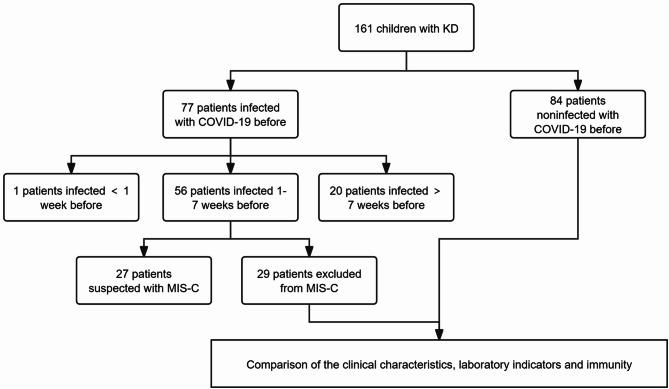
Patients infected with SARS-CoV-2 may experience acute and long-term immune disorders. Immunological factors are thought to play an important role in Kawasaki disease. To analyze the impact of COVID-19 infection on Kawasaki disease, this study retrospectively analyzed 161 children with Kawasaki disease onset during the COVID-19 pandemic. The proportion of IVIG-Resistant individuals and the rate of corticosteroid use in the 1-7 weeks from COVID-19 infection to Kawasaki disease onset were higher than that of the noninfected group, even after excluding suspected cases of multiple system inflammatory syndrome. Compared to the noninfected group, the level of CD4 was lower, and the levels of CD3CD16CD56, complement C4, TNF-α, and IFN-γ were higher in the 1-7 weeks after COVID-19 infection. In conclusion, the risk of IVIG resistance was significantly increased in children with Kawasaki disease onset 1-7 weeks after COVID-19 infection, which may be related to the long-term impact of COVID-19 on immunity.
感染新型冠状病毒的患者可能会出现急性和长期免疫紊乱。免疫因素被认为在川崎病中起重要作用。为分析新冠病毒感染对川崎病的影响,本研究回顾性分析了161例在新冠疫情期间发病的川崎病患儿。即使排除了多系统炎症综合征疑似病例,从新冠病毒感染到川崎病发病1至7周内,静脉注射免疫球蛋白无反应个体的比例和使用皮质类固醇的比率仍高于未感染组。与未感染组相比,新冠病毒感染后1至7周,CD4水平较低,而CD3CD16CD56、补体C4、肿瘤坏死因子-α和干扰素-γ水平较高。总之,新冠病毒感染后1至7周发病的川崎病患儿静脉注射免疫球蛋白无反应的风险显著增加,这可能与新冠病毒对免疫的长期影响有关。


 Zotero 插件