
转移中的循环肿瘤微环境
Circulating Tumor Microenvironment in Metastasis.
作者信息
Tang Rui, Luo Shujuan, Liu Hui, Sun Yan, Liu Manran, Li Lu, Ren Haoyu, Angele Martin K, Börner Nikolaus, Yu Keda, Guo Zufeng, Yin Guobing, Luo Haojun
机构信息
Key Laboratory of Laboratory Medical Diagnostics, Chinese Ministry of Education, Chongqing Medical University, Chongqing, China.
Department of Obstetrics, Women and Children's Hospital of Chongqing Medical University, Chongqing, China.
出版信息
Cancer Res. 2025 Apr 15;85(8):1354-1367. doi: 10.1158/0008-5472.CAN-24-1241.
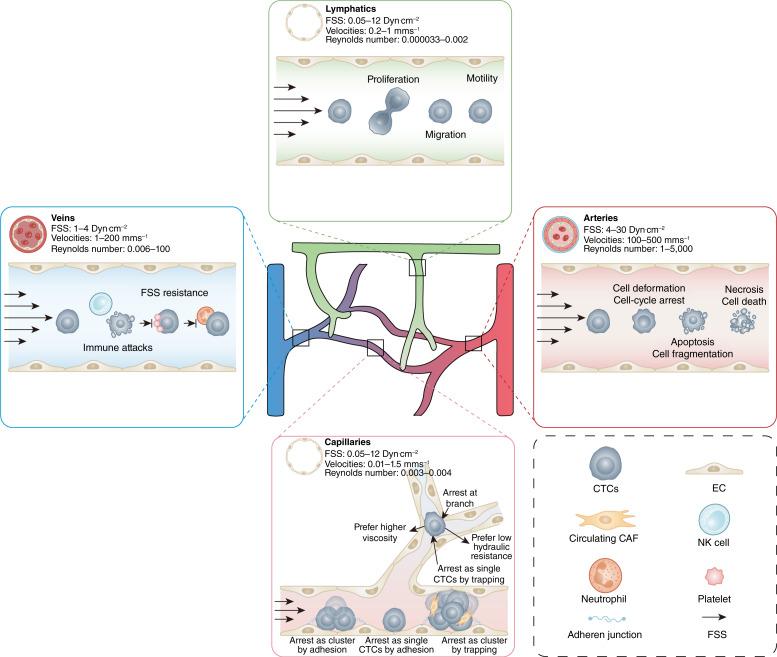
Activation of invasion and metastasis is a central hallmark of cancer, contributing to the primary cause of death for patients with cancer. In the multistep metastatic process, cancer cells must infiltrate the circulation, survive, arrest at capillary beds, extravasate, and form metastatic clones in distant organs. However, only a small proportion of circulating tumor cells (CTC) successfully form metastases, with transit of CTCs in the circulation being the rate-limiting step. The fate of CTCs is influenced by the circulating tumor microenvironment (cTME), which encompasses factors affecting their biological behaviors in the circulation. This liquid and flowing microenvironment differs significantly from the primary TME or the premetastatic niche. This review summarizes the latest advancements in identifying the biophysical cues, key components, and biological roles of the cTME, highlighting the network among biophysical attributes, blood cells, and nonblood factors in cancer metastasis. In addition to the potential of the cTME as a therapeutic target for inhibiting metastasis, the cTME could also represent as a biomarker for predicting patient outcomes and developing strategies for treating cancer.
侵袭和转移的激活是癌症的一个核心标志,是癌症患者主要的死亡原因。在多步骤转移过程中,癌细胞必须浸润进入循环系统、存活、在毛细血管床处滞留、外渗,并在远处器官形成转移克隆。然而,只有一小部分循环肿瘤细胞(CTC)能成功形成转移灶,其中CTC在循环系统中的转运是限速步骤。CTC的命运受循环肿瘤微环境(cTME)影响,cTME包含影响其在循环系统中生物学行为的各种因素。这种液体流动的微环境与原发性肿瘤微环境或转移前生态位有显著差异。本综述总结了在识别cTME的生物物理线索、关键成分和生物学作用方面的最新进展,强调了癌症转移过程中生物物理属性、血细胞和非血液因子之间的网络关系。除了cTME作为抑制转移的治疗靶点的潜力外,cTME还可作为预测患者预后和制定癌症治疗策略的生物标志物。

 Zotero 插件