
硼氢化物氧化作为还原电合成中的逆反应
Borohydride Oxidation as Counter Reaction in Reductive Electrosynthesis.
作者信息
Kuzmin Julius, Lill Malin, Ahumada Guillermo, Goossens Ellymay, Kjær Steffensen Astrid, Riisager Anders, Lundberg Helena
机构信息
Department of Chemistry, KTH Royal Institute of Technology, 10044, Stockholm, Sweden.
Department of Chemistry, Technical University of Denmark, Kgs., Lyngby, Denmark.
出版信息
Angew Chem Int Ed Engl. 2025 May 12;64(20):e202501653. doi: 10.1002/anie.202501653. Epub 2025 Apr 3.
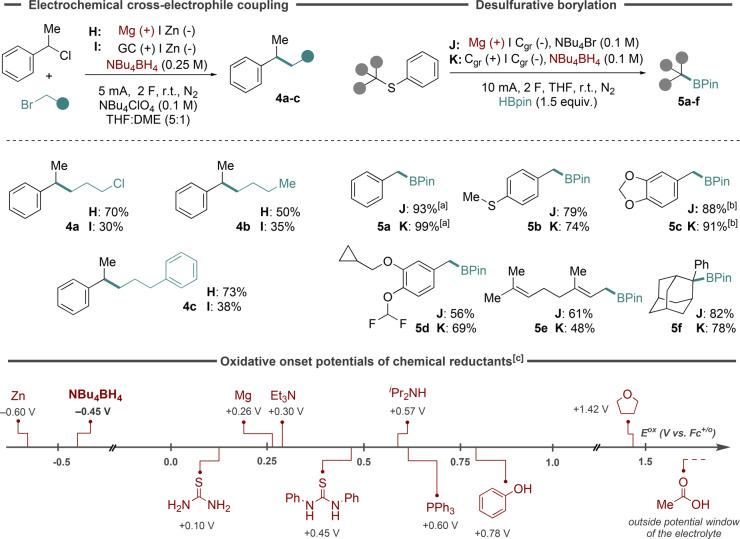
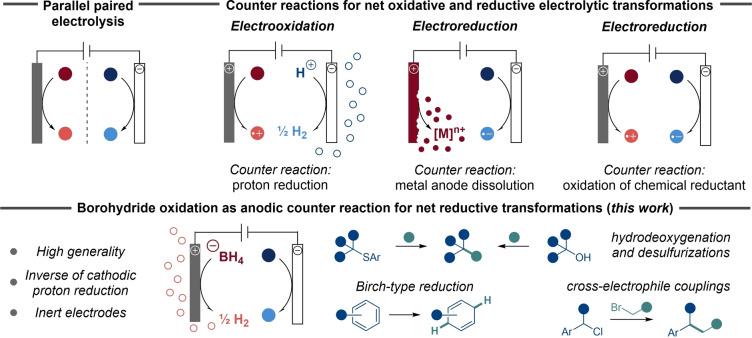
An efficient reaction at the counter electrode is of key importance for the success of net oxidative and net reductive electrochemical transformations. For electrooxidative processes, cathodic proton reduction to H serves as the benchmark counter reaction. In contrast, net reductive electrochemical transformations have less attractive oxidative counter reactions to choose from and commonly rely on dissolution of a sacrificial anode that effectively results in stoichiometric metal consumption for the processes. In this study, we demonstrate that anodic borohydride oxidation has great potential to successfully replace the use of such sacrificial anodes for a variety of electroreductive organic transformations. This anodic transformation effectively serves as the inverse of cathodic proton reduction, producing H using inert carbon-based electrode materials.
对电极上的高效反应对于净氧化和净还原电化学转化的成功至关重要。对于电氧化过程,阴极质子还原为氢气是基准的对反应。相比之下,净还原电化学转化可供选择的氧化对反应吸引力较小,通常依赖于牺牲阳极的溶解,这实际上导致了该过程中化学计量的金属消耗。在本研究中,我们证明阳极硼氢化物氧化对于成功替代各种电还原有机转化中此类牺牲阳极的使用具有巨大潜力。这种阳极转化有效地作为阴极质子还原的逆反应,使用惰性碳基电极材料产生氢气。

 Zotero 插件