
拇外翻与内生致病因素之间的因果关系:一项双样本孟德尔随机化研究。
The causal relationship between hallux valgus and endogenous pathogenic factors: A 2-sample Mendelian randomization.
作者信息
Xie Yuan Lei, Liang Jia Yuan, Du Gen Fa, Lu Hui Jun, Luo Wei Jie, Wu Jia Heng, Sheng Zhao Hui
机构信息
Shenzhen Bao'an Chinese Medicine Hospital, The Seventh Clinical College of Guangzhou University of Chinese Medicine, Shenzhen, Guangdong, China.
出版信息
Medicine (Baltimore). 2025 Feb 21;104(8):e41647. doi: 10.1097/MD.0000000000041647.
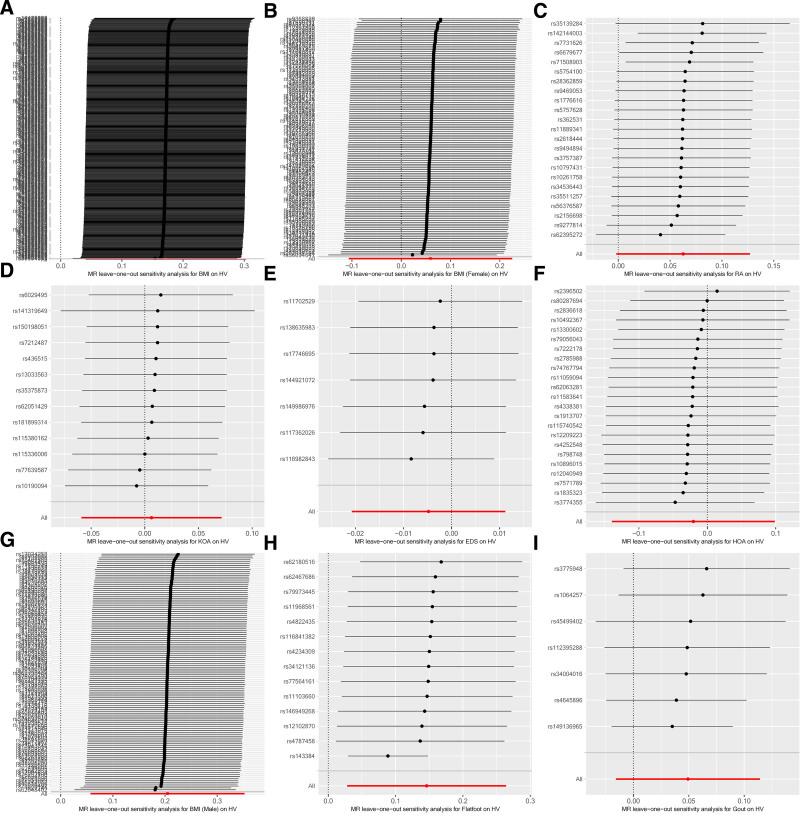
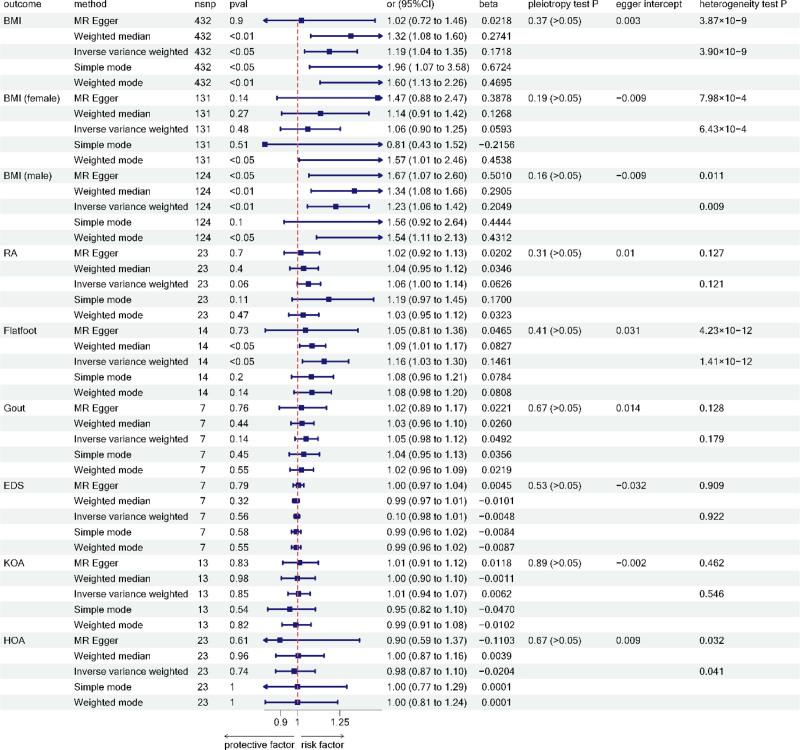
Notably, several factors are associated with hallux valgus (HV); however, their causal relationship remains unclear. In this study, a 2-sample Mendelian randomization (MR) analysis was performed to investigate the casual relationship between 9 endogenous risk factors and HV, aiming to provide a foundation for the clinical management of HV. Exposure factors such as body mass index (BMI), BMI (male), BMI (female), acquired flatfoot, rheumatoid arthritis, gout, knee osteoarthritis, hip osteoarthritis, and Ehlers-Danlos syndrome were considered, with HV as the outcome. Exposure and outcome data were obtained from the IEU Open Genome-wide association study project, UK Biobank, and FinnGen project. Strongly correlated (P < 5×10-08/5×10-06) single nucleotide polymorphisms (SNPs) were selected from the exposure dataset, and those associated with exposure were selected from the HV dataset. The intersection of these SNPs was used as instrumental variables. Five modes were used for the analysis: inverse variance-weighted (IVW), MR-Egger regression, weighted median (WME), simple mode, and weighted mode. MR analysis results of BMI show that except for MR-Egger, the other 4 modes are significant (P < .05), and the β directions are consistent among the 5 methods. For the 4 BMI (male) methods, except for the simple mode, the P- and β-values of the other results all suggest a positive causal relationship between BMI (male) and HV. Flatfoot-IVW and WME results were <.05, indicating statistical significance, whereas MR-Egger, simple mode, and median mode had no statistical significance. However, their β-values were consistent with those of IVW and WME. Further mediation MR analysis suggested that the effect mediated by HV accounts for 13.33% [95% CI (0.03-0.24)] of the total causal effect between the BMI and flatfoot, indicating HV as a mediator of the causal relationship between the BMI and flatfoot. However, the remaining 6 factors had no direct causal association with HV (P < .05). Flatfoot in all patients and elevated BMI in males are directly associated with HV. Therefore, treating acquired flatfoot and controlling the BMI to prevent HV are recommended.
值得注意的是,有几个因素与拇外翻(HV)相关;然而,它们之间的因果关系仍不清楚。在本研究中,进行了一项双样本孟德尔随机化(MR)分析,以研究9种内源性危险因素与HV之间的因果关系,旨在为HV的临床管理提供依据。将体重指数(BMI)、男性BMI、女性BMI、后天性平足、类风湿性关节炎、痛风、膝关节骨关节炎、髋关节骨关节炎和埃勒斯-当洛综合征等暴露因素作为暴露因素,以HV作为结局。暴露和结局数据来自IEU开放全基因组关联研究项目、英国生物银行和芬兰基因项目。从暴露数据集中选择强相关(P < 5×10-08/5×10-06)的单核苷酸多态性(SNP),从HV数据集中选择与暴露相关的SNP。这些SNP的交集用作工具变量。分析采用了5种模式:逆方差加权(IVW)、MR-Egger回归、加权中位数(WME)、简单模式和加权模式。BMI的MR分析结果显示,除MR-Egger外,其他4种模式均具有显著性(P < 0.05),且5种方法的β方向一致。对于4种男性BMI方法,除简单模式外,其他结果的P值和β值均表明男性BMI与HV之间存在正因果关系。平足-IVW和WME结果<0.05,具有统计学意义,而MR-Egger、简单模式和中位数模式无统计学意义。然而,它们的β值与IVW和WME的β值一致。进一步的中介MR分析表明,HV介导的效应占BMI与平足之间总因果效应的13.33% [95% CI(0.03 - )],表明HV是BMI与平足之间因果关系的中介。然而,其余6个因素与HV无直接因果关联(P < 0.05)。所有患者的平足和男性BMI升高与HV直接相关。因此,建议治疗后天性平足并控制BMI以预防HV。

 Zotero 插件