
缺氧诱导因子-1α与锌在糖尿病肾病发病机制中的研究进展
Research progress of hypoxia-inducible factor-1α and zinc in the mechanism of diabetic kidney disease.
作者信息
Qin Wei, Nie Ping, Hui Xuejun, Chen Fei, Hu Xingbao, Shi Wenjiao, Luo Manyu, Li Bing
机构信息
Department of Nephropathy, The Second Hospital of Jilin University, Changchun, Jilin, China.
出版信息
Front Pharmacol. 2025 Feb 10;16:1537749. doi: 10.3389/fphar.2025.1537749. eCollection 2025.
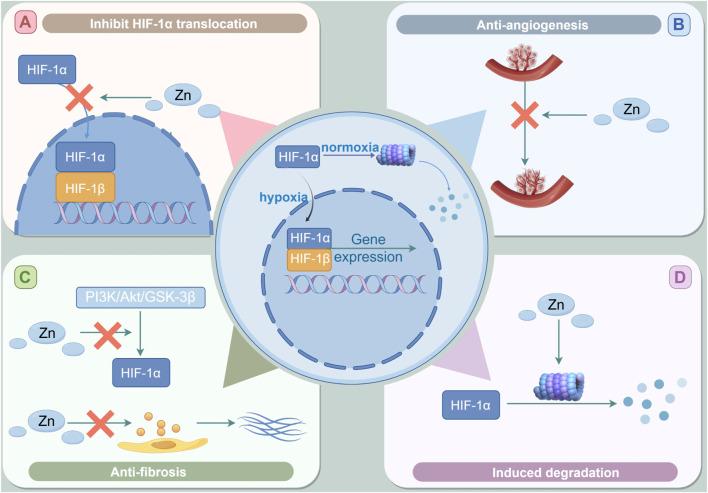
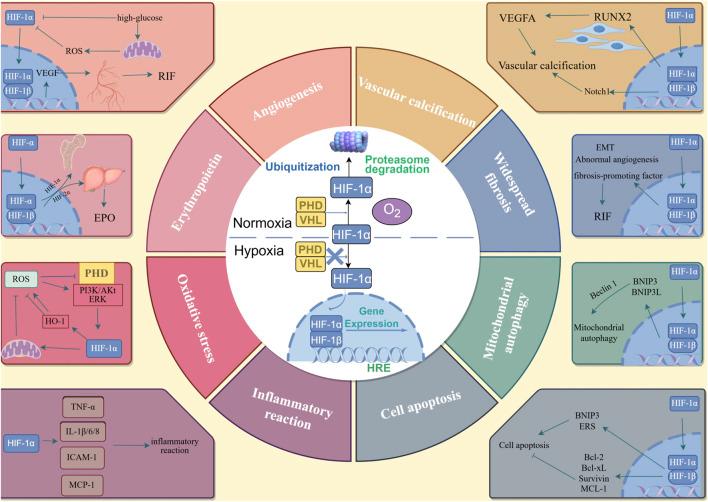
Diabetic kidney disease is one of the common complications in diabetic patients and has gradually become an important pathogenic factor in chronic kidney disease. Therefore, studying the mechanisms of its occurrence and development is of great significance for the prevention and treatment of diabetic kidney disease. Some researchers have pointed out that there is a phenomenon of hypoxia in diabetic kidney tissue and believe that hypoxia-inducible factor-1α is closely related to the occurrence and progression of diabetic kidney disease. Additionally, the homeostasis of zinc plays a key role in the body's adaptation to hypoxic environments. However, the specific relationship among these three factors remains unclear. This article provides a detailed review of the multiple roles of hypoxia-inducible factor-1α in the pathogenesis of diabetic kidney disease, including: regulating angiogenesis, increasing the expression of erythropoietin, modulating oxidative stress through the PI3K/AKT and HIF-1α/HO-1 pathways, promoting inflammatory cell infiltration and the release of inflammatory factors to induce inflammatory responses, facilitating epithelial-mesenchymal transition, pathological angiogenesis, and promoting the release of fibrotic factors, ultimately leading to renal fibrosis. Furthermore, HIF-1α also participates in the occurrence and development of diabetic kidney disease through mechanisms such as regulating apoptosis, inducing mitochondrial autophagy, and vascular calcification. At the same time, this article clarifies the regulatory role of the trace element zinc on hypoxia-inducible factor-1α in diabetic kidney disease. This article provides references and insights for further research on the pathogenesis and progression of diabetic kidney disease.
糖尿病肾病是糖尿病患者常见的并发症之一,且已逐渐成为慢性肾脏病的重要致病因素。因此,研究其发生发展机制对糖尿病肾病的防治具有重要意义。一些研究者指出,糖尿病肾组织存在缺氧现象,并认为缺氧诱导因子-1α与糖尿病肾病的发生发展密切相关。此外,锌的稳态在机体适应缺氧环境中起关键作用。然而,这三个因素之间的具体关系仍不清楚。本文详细综述了缺氧诱导因子-1α在糖尿病肾病发病机制中的多重作用,包括:调节血管生成、增加促红细胞生成素的表达、通过PI3K/AKT和HIF-1α/HO-1途径调节氧化应激、促进炎症细胞浸润和炎症因子释放以诱导炎症反应、促进上皮-间质转化、病理性血管生成以及促进纤维化因子释放,最终导致肾纤维化。此外,HIF-1α还通过调节细胞凋亡、诱导线粒体自噬和血管钙化等机制参与糖尿病肾病的发生发展。同时,本文阐明了微量元素锌对糖尿病肾病中缺氧诱导因子-1α的调节作用。本文为进一步研究糖尿病肾病的发病机制和进展提供了参考和见解。


 Zotero 插件