
深度洞察:基于纳米工程凝胶的局部药物递送用于关节炎治疗
Deep-insights: Nanoengineered gel-based localized drug delivery for arthritis management.
作者信息
Sriram Anitha, Ithape Harshada, Singh Pankaj Kumar
机构信息
Department of Pharmaceutics, National Institute of Pharmaceutical Education and Research (NIPER), Telangana 500037, India.
出版信息
Asian J Pharm Sci. 2025 Feb;20(1):101012. doi: 10.1016/j.ajps.2024.101012. Epub 2024 Dec 19.
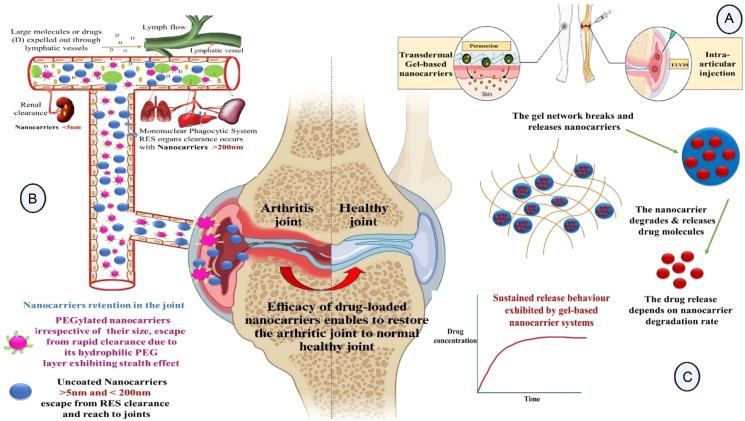
Arthritis is an inflammatory joint disorder that progressively impairs function and diminishes quality of life. Conventional therapies often prove ineffective, as oral administration lacks specificity, resulting in off-target side effects like hepatotoxicity and GIT-related issues. Intravenous administration causes systemic side effects. The characteristic joint-localized symptoms such as pain, stiffness, and inflammation make the localized drug delivery suitable for managing arthritis. Topical/transdermal/intra-articular routes have become viable options for drug delivery in treating arthritis. However, challenges with those localized drug delivery routes include skin barrier and cartilage impermeability. Additionally, conventional intra-articular drug delivery also leads to rapid clearance of drugs from the synovial joint tissue. To circumvent these limitations, researchers have developed nanocarriers that enhance drug permeability through skin and cartilage, influencing localized action. Gel-based nanoengineered therapy employs a gel matrix to incorporate the drug-encapsulated nanocarriers. This approach combines the benefits of gels and nanocarriers to enhance therapeutic effects and improve patient compliance. This review emphasizes deep insights into drug delivery using diverse gel-based novel nanocarriers, exploring their various applications embedded in hyaluronic acid (biopolymer)-based gels, carbopol-based gels, and others. Furthermore, this review discusses the influence of nanocarrier pharmacokinetics on the localization and therapeutic manipulation of macrophages mediated by nanocarriers. The ELVIS (extravasation through leaky vasculature and inflammatory cell-mediated sequestration) effect associated with arthritis is advantageous in drug delivery. Simply put, the ELVIS effect refers to the extravasation of nanocarriers through leaky vasculatures, which finally results in the accumulation of nanocarriers in the joint cavity.
关节炎是一种炎症性关节疾病,会逐渐损害关节功能并降低生活质量。传统疗法往往效果不佳,因为口服给药缺乏特异性,会导致如肝毒性和胃肠道相关问题等脱靶副作用。静脉给药会引起全身副作用。疼痛、僵硬和炎症等典型的关节局部症状使得局部给药适合用于治疗关节炎。局部/经皮/关节内给药途径已成为治疗关节炎药物递送的可行选择。然而,这些局部给药途径面临的挑战包括皮肤屏障和软骨不渗透性。此外,传统的关节内给药还会导致药物从滑膜关节组织中快速清除。为了克服这些限制,研究人员开发了纳米载体,可增强药物透过皮肤和软骨的渗透性,从而影响局部作用。基于凝胶的纳米工程疗法采用凝胶基质来包裹载药纳米载体。这种方法结合了凝胶和纳米载体的优点,以增强治疗效果并提高患者的依从性。本综述着重深入探讨使用各种基于凝胶的新型纳米载体进行药物递送的情况,探索它们在基于透明质酸(生物聚合物)的凝胶、卡波姆基凝胶等中的各种应用。此外,本综述还讨论了纳米载体药代动力学对纳米载体介导的巨噬细胞定位和治疗调控的影响。与关节炎相关的ELVIS(通过渗漏血管外渗和炎症细胞介导的滞留)效应在药物递送中具有优势。简而言之,ELVIS效应是指纳米载体通过渗漏血管外渗,最终导致纳米载体在关节腔内积聚。




 Zotero 插件