
1990 - 2021年25种风险因素所致缺血性心脏病的全球、区域和国家负担及其在204个具有不同社会人口指数水平国家的综合暴露值:一项系统固定效应分析和比较研究
Global, Regional, and National Burden of Ischemic Heart Disease Attributable to 25 Risk Factors and Their Summary Exposure Value Across 204 Countries With Different Socio-Demographic Index Levels, 1990-2021: A Systematic Fixed-Effects Analysis and Comparative Study.
作者信息
Tan Juntao, Xue Min, Li Huanyin, Liu Yang, He Yuxin, Liu Jing, Liu Jie, Tang Luojia, Lin Jixian
机构信息
College of Medical Informatics, Chongqing Medical University, Chongqing, 400016, People's Republic of China.
Department of Respiratory, Minhang Hospital, Fudan University, Shanghai, 201101, People's Republic of China.
出版信息
Clin Epidemiol. 2025 Feb 20;17:105-129. doi: 10.2147/CLEP.S510347. eCollection 2025.
BACKGROUND
A systematic relational assessment of the global, regional, and national Ischemic heart disease (IHD) burden and its attributable risk factors is essential for developing more targeted prevention and intervention strategies.
METHODS
The GBD 2021 comparative risk assessment framework was employed to evaluate stroke burden attributable to environmental, behavioral, metabolic, and dietary risk factors, and a total of 25 risk factors were included. Specifically, we used the joinpoint regression model, decomposition analysis, and systematic fixed-effects analysis to reveal the global, regional, and national burden of IHD attributable to these 25 risk factors and their exposure value across 204 countries and territories with different socio-demographic index (SDI) levels from different perspectives.
RESULTS
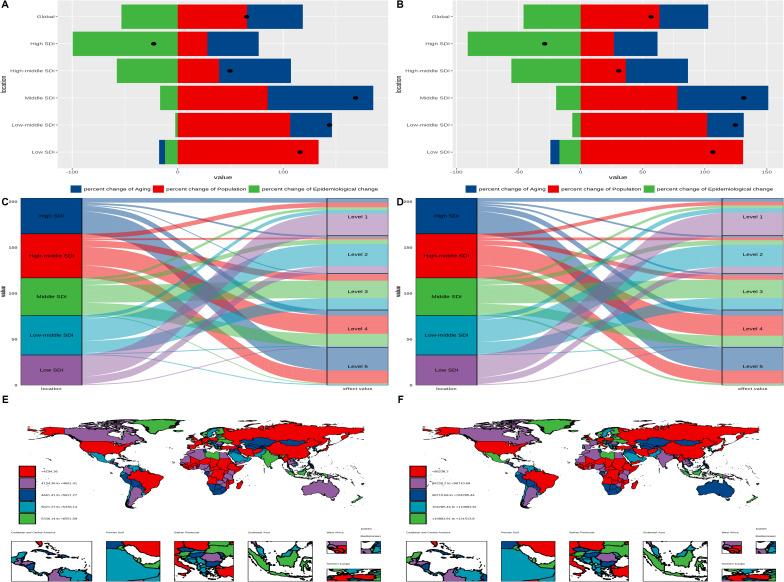
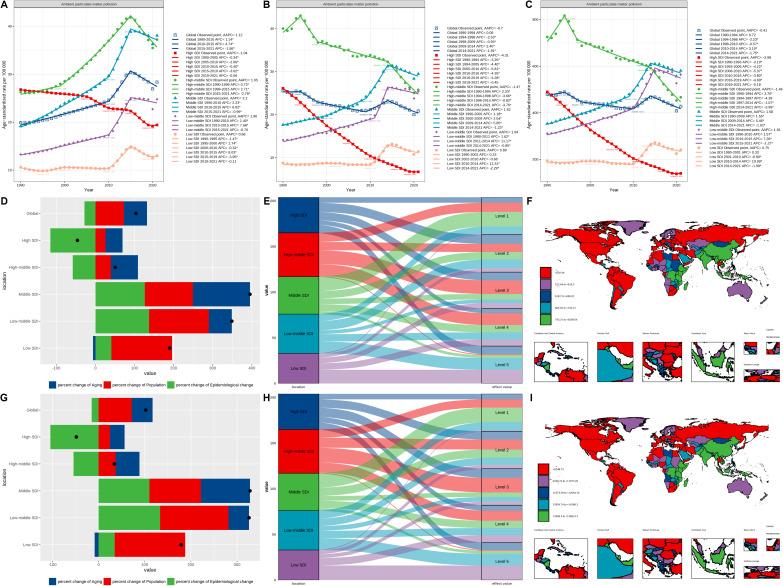
Joinpoint regression revealed similar trends in summary exposure value (SEV) and attributable burdens for 25 IHD risk factors. From 1990 to 2021, SEV rankings increased for 12/25 risk factors, decreased for 10/25, and remained unchanged for 3/25. Decomposition analysis indicated that from 1990 to 2021, low SDI countries experienced the most significant increase in IHD burden attributable to 25 risk factors due to population growth, while upper-middle and high SDI countries were most affected by population aging, and high SDI countries demonstrated the greatest reduction in IHD burden attributed to epidemiological changes. Panel data analysis elucidated the impact of SEV, SDI, and quality-of-care index (QCI) on attributable IHD burden.
CONCLUSION
This study emphasizing the critical role of risk factor control. Tailored interventions and exploration of country-specific factors are crucial for effectively reducing the global IHD burden.
背景
对全球、区域和国家缺血性心脏病(IHD)负担及其可归因风险因素进行系统的关联评估,对于制定更具针对性的预防和干预策略至关重要。
方法
采用全球疾病负担研究(GBD)2021比较风险评估框架,评估环境、行为、代谢和饮食风险因素导致的中风负担,共纳入25个风险因素。具体而言,我们使用连接点回归模型、分解分析和系统固定效应分析,从不同角度揭示这25个风险因素及其暴露值在204个具有不同社会人口指数(SDI)水平的国家和地区中导致的全球、区域和国家IHD负担。
结果
连接点回归显示25个IHD风险因素的汇总暴露值(SEV)和归因负担呈现相似趋势。从1990年到2021年,25个风险因素中12个的SEV排名上升,10个下降,3个保持不变。分解分析表明,从1990年到2021年,低SDI国家由于人口增长,25个风险因素导致的IHD负担增加最为显著,而中高和高SDI国家受人口老龄化影响最大,高SDI国家因流行病学变化导致的IHD负担下降幅度最大。面板数据分析阐明了SEV、SDI和医疗质量指数(QCI)对IHD归因负担的影响。
结论
本研究强调了风险因素控制的关键作用。量身定制干预措施并探索特定国家因素对于有效减轻全球IHD负担至关重要。




 Zotero 插件