
法西珠单抗在膝或髋骨关节炎所致疼痛患者的非甾体抗炎药对照研究中的疗效与安全性。
Efficacy and safety of fasinumab in an NSAID-controlled study in patients with pain due to osteoarthritis of the knee or hip.
作者信息
DiMartino Stephen J, Gao Haitao, Eng Simon, Valenzuela Guillermo, Fuerst Thomas, Emeremni Chetachi, Ho Tina, Hassan Hazem E, Turner Kenneth C, Davis John D, Zaim Souhil, Chao Jesse, Patel Yamini, Brener Lillian, Trinh Ngan, Manvelian Garen, Fetell Michael, Braunstein Ned, Geba Gregory P, Dakin Paula
机构信息
Regeneron Pharmaceuticals, Inc., 777 Old Saw Mill River Road, Tarrytown, NY, 10591, USA.
Integral Rheumatology & Immunology Specialists, Plantation, FL, USA.
出版信息
BMC Musculoskelet Disord. 2025 Feb 25;26(1):192. doi: 10.1186/s12891-025-08402-8.
OBJECTIVE
Osteoarthritis (OA) causes significant musculoskeletal pain. This study assessed the efficacy and safety of fasinumab, an investigational nerve growth factor inhibitor, in patients with moderate-to-severe OA pain of the knee/hip.
METHODS
In this Phase 3, randomized, double-blind, placebo- and non-steroidal anti-inflammatory drug (NSAID)-controlled study, patients with OA (Kellgren-Lawrence grade ≥ 2; Western Ontario and McMaster Universities Arthritis Index [WOMAC] pain score ≥ 4) received (2:1:1:1) fasinumab 1 mg every 4 weeks, diclofenac 75 mg twice daily, celecoxib 200 mg daily, or placebo for 24 weeks. Co‑primary endpoints were change in WOMAC pain and physical function scores to Week 24 versus placebo. For safety, joints were imaged in all patients at pre‑specified times, regardless of symptoms.
RESULTS
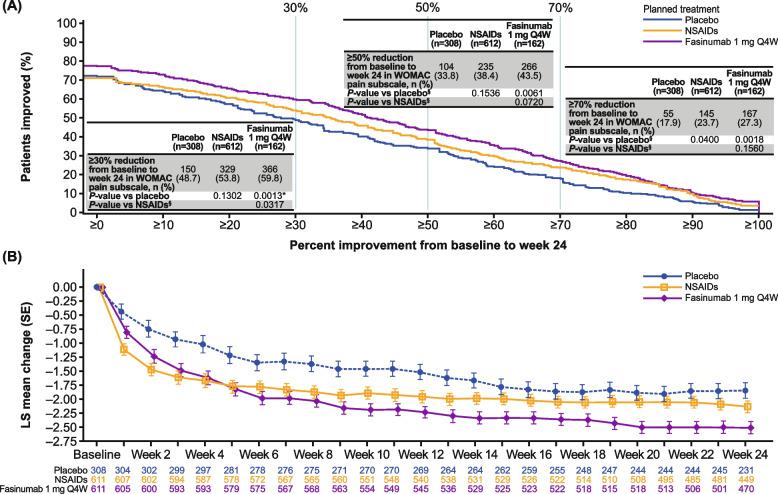
Of 4531 patients screened, 1650 were randomized. At Week 24, greater improvements were observed for fasinumab versus placebo; least-squares mean difference: -0.63 (p = 0.0003) for WOMAC pain and -0.64 (p = 0.0003) for physical function. Improvements were numerically greater for fasinumab versus NSAIDs for physical function (-0.64 versus -0.31; nominal p < 0.05) and pain (-0.63 versus - 0.39; p = NS). Adjudicated arthropathies occurred in 1.6% of placebo-treated, 1.5% of NSAID-treated, and 5.6% of fasinumab-treated patients; joint replacements occurred in 3.6% of placebo-treated, 4.8% of NSAID-treated, and 3.4% of fasinumab-treated patients.
CONCLUSION
Fasinumab significantly improved WOMAC pain and physical function scores versus placebo in < 24 weeks in difficult-to-treat patients with pain due to OA of the knee/hip. Adjudicated arthropathies were more frequent with fasinumab; there were no differences in the proportions of patients with joint replacements.
TRIAL REGISTRATION
Clinicaltrials.gov NCT03304379. Date of first registration: October 2, 2017.
目的
骨关节炎(OA)会导致严重的肌肉骨骼疼痛。本研究评估了一种研究性神经生长因子抑制剂法西珠单抗在中重度膝/髋OA疼痛患者中的疗效和安全性。
方法
在这项3期、随机、双盲、安慰剂和非甾体抗炎药(NSAID)对照研究中,OA患者(Kellgren-Lawrence分级≥2;西安大略和麦克马斯特大学关节炎指数[WOMAC]疼痛评分≥4)接受(2:1:1:1)每4周一次的1mg法西珠单抗、每日两次的75mg双氯芬酸、每日200mg塞来昔布或安慰剂治疗24周。共同主要终点是与安慰剂相比至第24周时WOMAC疼痛和身体功能评分的变化。为评估安全性,在预先指定的时间对所有患者的关节进行成像,无论其症状如何。
结果
在4531例筛查患者中,1650例被随机分组。在第24周时,与安慰剂相比,法西珠单抗有更大改善;WOMAC疼痛的最小二乘均数差异为-0.63(p = 0.0003),身体功能的最小二乘均数差异为-0.64(p = 0.0003)。与NSAIDs相比,法西珠单抗在身体功能(-0.64对-0.31;名义p < 0.05)和疼痛(-0.63对-0.39;p = 无统计学意义)方面的数值改善更大。经判定的关节病在接受安慰剂治疗的患者中发生率为1.6%,接受NSAID治疗的患者中为1.5%,接受法西珠单抗治疗的患者中为5.6%;关节置换在接受安慰剂治疗的患者中发生率为3.6%,接受NSAID治疗的患者中为4.8%,接受法西珠单抗治疗的患者中为3.4%。
结论
在膝/髋OA疼痛的难治性患者中,法西珠单抗在不到24周的时间内与安慰剂相比显著改善了WOMAC疼痛和身体功能评分。经判定的关节病在法西珠单抗治疗组中更常见;关节置换患者比例无差异。
试验注册
Clinicaltrials.gov NCT03304379。首次注册日期:2017年10月2日。
 Zotero 插件