
评估731种免疫表型与结直肠癌风险之间的因果关联:一项孟德尔随机化研究。
Assessing the causal association between 731 immunophenotypes and the risk of colorectal cancer: a Mendelian randomization study.
作者信息
Gao Fei, Zhang Qiaoli, Teng Fei, Li Liling, Jiang Honglin, Li Wenna, Hu Chenxi, Lu Zhongwen, Wan Yuxiang, Huang Jinchang
机构信息
The Third Affiliated Hospital, Beijing University of Chinese Medicine, Beijing, 100029, China.
出版信息
BMC Cancer. 2025 Feb 25;25(1):335. doi: 10.1186/s12885-025-13701-3.
BACKGROUND
Emerging research suggested a potential role of immune cells in colorectal cancer (CRC) development. However, the causal relationship between immune phenotypes and CRC remains elusive. Hence, this two-sample Mendelian randomization (MR) study aimed to explore the causal association.
METHODS
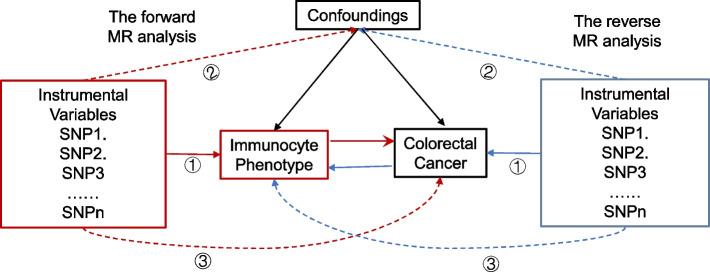
In this study, a bidirectional, two-sample MR analysis and multivariate MR was conducted, leveraging public genetic data. Four types of immune phenotypes were employed. A comprehensive sensitivity analysis was carried out to validate the robustness, heterogeneity, and horizontal pleiotropy of the results, with Bonferroni correction applied for accurate interpretation.
RESULTS
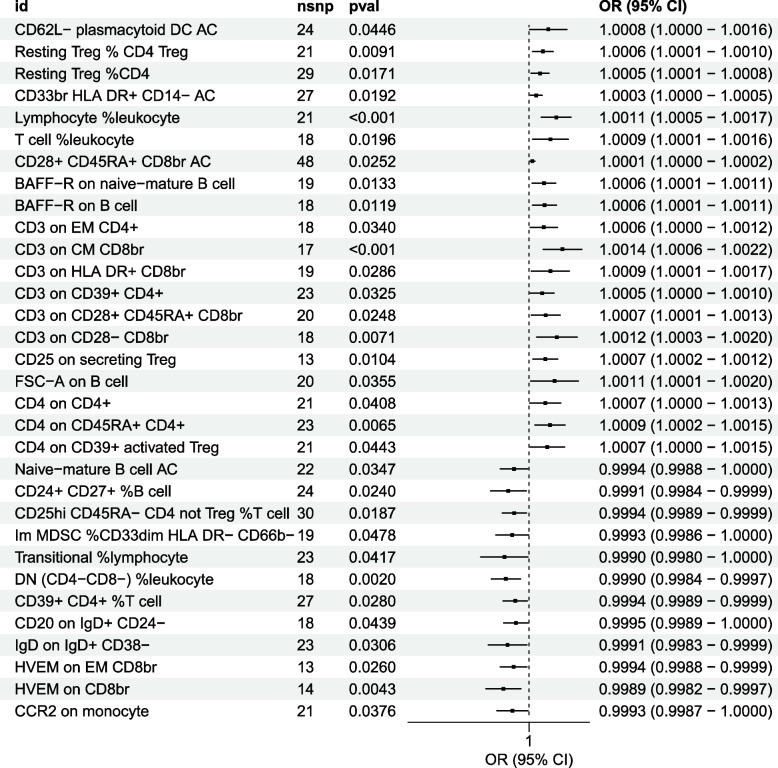
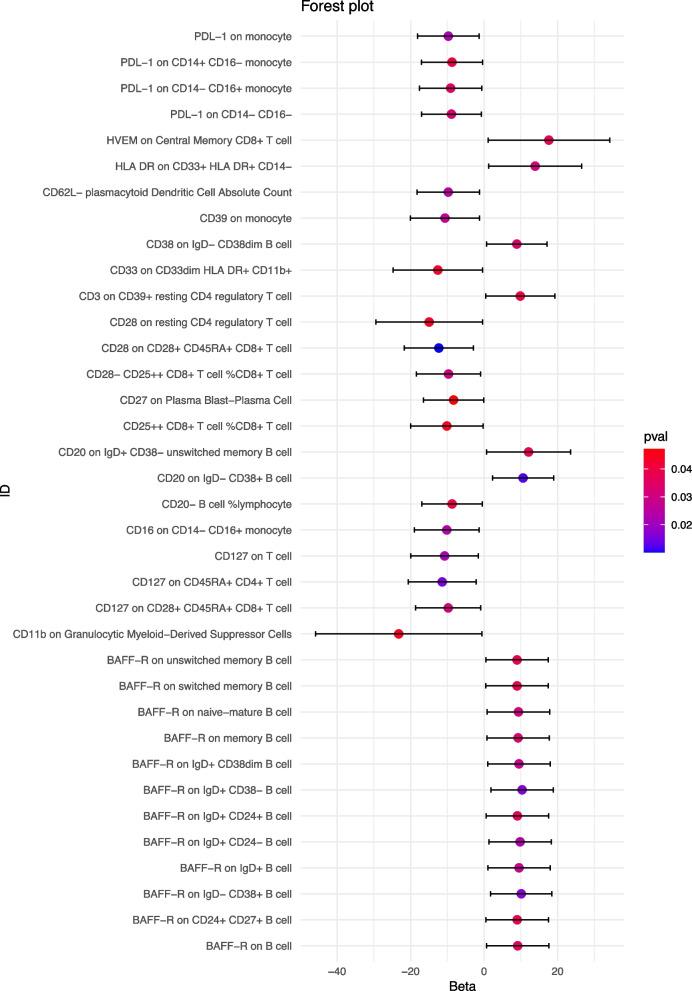
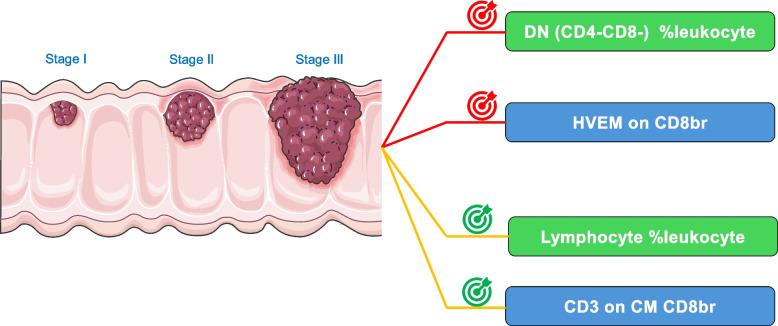
It was revealed that four immune cell phenotypes were significantly associated with CRC risk. Specifically, lymphocyte % leukocyte in the T-cell/B-cell/NK-cell (TBNK) group (odds ratio (OR) = 1.0013, 95% confidence interval (CI): 1.0005-1.0017, P = 0.0003, P = 0.011) and CD3 on CM CD8br in the maturation stages of T cell group (OR = 1.0014, 95% CI: 1.0006-1.0022, P = 0.0007, P = 0.023) were positively correlated with the risk of CRC. Conversely, DN (CD4CD8) %leukocyte in the TBNK group (OR = 0.9990, 95% CI: 0.9984-0.9997, P = 0.0020, P = 0.063) and herpesvirus entry mediator (HVEM) on CD8br in the maturation stages of T cell group (OR = 0.9989, 95% CI: 0.9982-0.9997, P = 0.00431, P = 0.137) exhibited a negative association with the risk of CRC. This study did not detect any statistically significant impact of CRC on immune phenotypes.
CONCLUSIONS
This study inferred an association between immune cells and CRC risk. Nevertheless, further clinical and experimental studies are warranted to validate these findings and elucidate the underlying mechanisms.
背景
新出现的研究表明免疫细胞在结直肠癌(CRC)发展中可能发挥作用。然而,免疫表型与CRC之间的因果关系仍不明确。因此,这项两样本孟德尔随机化(MR)研究旨在探索因果关联。
方法
在本研究中,利用公开的遗传数据进行了双向、两样本MR分析和多变量MR。采用了四种免疫表型。进行了全面的敏感性分析,以验证结果的稳健性、异质性和水平多效性,并应用Bonferroni校正进行准确解释。
结果
结果显示,四种免疫细胞表型与CRC风险显著相关。具体而言,T细胞/B细胞/NK细胞(TBNK)组中淋巴细胞占白细胞的百分比(优势比(OR)=1.0013,95%置信区间(CI):1.0005 - 1.0017,P = 0.0003,P = 0.011)以及T细胞成熟阶段CM CD8br上的CD3(OR = 1.0014,95%CI:1.0006 - 1.0022,P = 0.0007,P = 0.023)与CRC风险呈正相关。相反,TBNK组中DN(CD4CD8)占白细胞的百分比(OR = 0.9990,95%CI:0.9984 - 0.9997,P = 0.0020,P = 0.063)以及T细胞成熟阶段CD8br上的疱疹病毒进入介质(HVEM)(OR = 0.9989,95%CI:0.9982 - 0.9997,P = 0.00431,P = 0.137)与CRC风险呈负相关。本研究未检测到CRC对免疫表型有任何统计学上的显著影响。
结论
本研究推断免疫细胞与CRC风险之间存在关联。然而,仍需进一步的临床和实验研究来验证这些发现并阐明潜在机制。


 Zotero 插件