
利用橄榄实蝇生态学实现可持续害虫管理。
Utilizing Olive Fly Ecology Towards Sustainable Pest Management.
作者信息
Stavrianakis Giorgos, Sentas Efstratios, Zafeirelli Sofia, Tscheulin Thomas, Kizos Thanasis
机构信息
Rural Geography & Precision Farming Systems Lab, Department of Geography, University of the Aegean, Mytilene 81100, Greece.
Biogeography & Ecology Lab, Department of Geography, University of the Aegean, Mytilene 81100, Greece.
出版信息
Biology (Basel). 2025 Jan 25;14(2):125. doi: 10.3390/biology14020125.
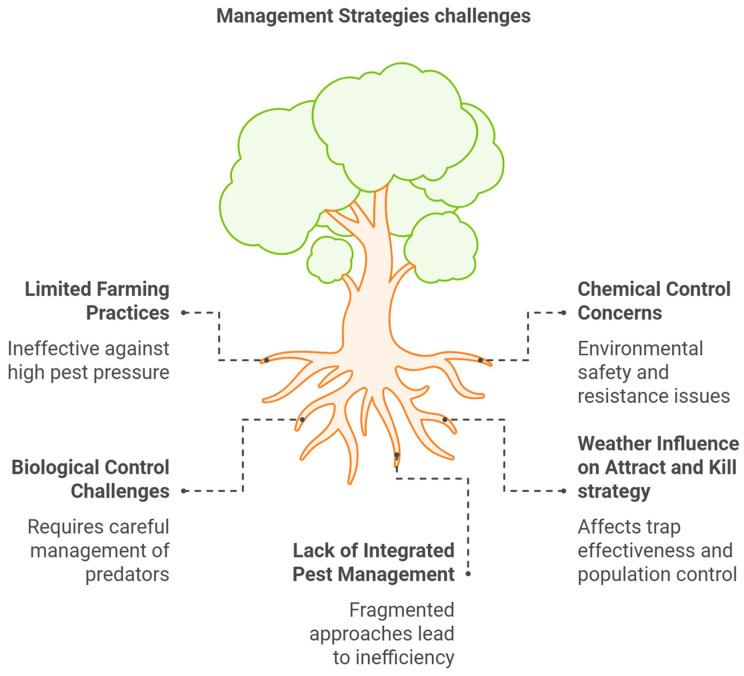
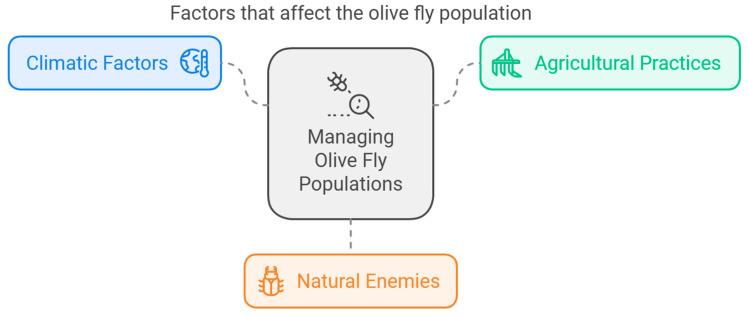
The olive fly (, OLF) is a major pest of global significance that occurs in places where olive cultivation thrives. This paper highlights the economic and environmental damage caused by OLF infestations, including reduced olive oil yield and quality, disrupted supply chains, and ecosystem imbalances due to heavy insecticide use. Understanding olive fly ecology is crucial for developing effective control strategies. The review explores the fly's life cycle, its relationship with olive trees, and how environmental factors like temperature and humidity influence population dynamics. Additionally, studying the role of natural enemies and agricultural practices can pave the way for sustainable control methods that minimize environmental harm. Climate change, intensive cultivation, and the development of resistance to insecticides necessitate a shift towards sustainable practices. This includes exploring alternative control methods like biological control with natural enemies and attract-and-kill strategies. Furthermore, a deeper understanding of OLF ecology, including its response to temperature and its ability to find refuge in diverse landscapes, is critical for predicting outbreaks and implementing effective protection strategies. By employing a holistic approach that integrates ecological knowledge with sustainable control methods, we can ensure the continued viability of olive cultivation, protect the environment, and produce high-quality olive oil.
橄榄实蝇(Olea europaea L.,OLF)是一种具有全球重要性的主要害虫,出现在橄榄种植繁荣的地区。本文强调了橄榄实蝇侵扰所造成的经济和环境破坏,包括橄榄油产量和质量下降、供应链中断以及因大量使用杀虫剂导致的生态系统失衡。了解橄榄实蝇生态学对于制定有效的防治策略至关重要。该综述探讨了这种实蝇的生命周期、它与橄榄树的关系,以及温度和湿度等环境因素如何影响种群动态。此外,研究天敌的作用和农业实践可为最大限度减少环境危害的可持续防治方法铺平道路。气候变化、集约化种植以及对杀虫剂抗性的发展使得有必要转向可持续实践。这包括探索替代防治方法,如利用天敌进行生物防治和诱捕杀灭策略。此外,更深入地了解橄榄实蝇生态学,包括其对温度的反应及其在不同景观中寻找避难所的能力,对于预测虫害爆发和实施有效的保护策略至关重要。通过采用将生态知识与可持续防治方法相结合的整体方法,我们可以确保橄榄种植的持续可行性,保护环境,并生产出高质量的橄榄油。


 Zotero 插件