
常染色体显性多囊肾病建模的进展与挑战:聚焦肾类器官
Advances and Challenges in Modeling Autosomal Dominant Polycystic Kidney Disease: A Focus on Kidney Organoids.
作者信息
Gu Jinglan, Liu Fei, Li Lu, Mao Jianhua
机构信息
Department of Nephrology, Children's Hospital, Zhejiang University School of Medicine, National Clinical Research Center for Child Health, Hangzhou 310058, China.
出版信息
Biomedicines. 2025 Feb 19;13(2):523. doi: 10.3390/biomedicines13020523.
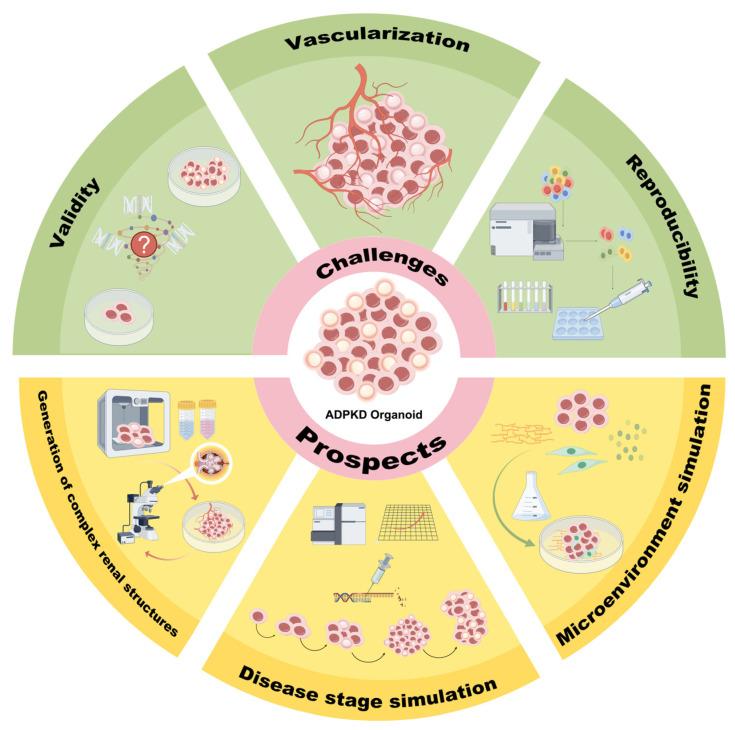
Autosomal dominant polycystic kidney disease (ADPKD) is a prevalent hereditary disorder characterized by distinct phenotypic variability that has posed challenges for advancing in-depth research. Recent advancements in kidney organoid construction technologies have enabled researchers to simulate kidney development and create simplified in vitro experimental environments, allowing for more direct observation of how genetic mutations drive pathological phenotypes and disrupt physiological functions. Emerging technologies, such as microfluidic bioreactor culture systems and single-cell transcriptomics, have further supported the development of complex ADPKD organoids, offering robust models for exploring disease mechanisms and facilitating drug discovery. Nevertheless, significant challenges remain in constructing more accurate ADPKD disease models. This review will summarize recent advances in ADPKD organoid construction, focusing on the limitations of the current techniques and the critical issues that need to be addressed for future breakthroughs. This review presents recent advancements in ADPKD organoid construction, particularly iPSC-derived models, offering new insights into disease mechanisms and drug discovery. It focuses on challenges such as limited vascularization and maturity, proposing potential solutions through emerging technologies. The ongoing optimization of ADPKD organoid models is expected to enhance understanding of the disease and drive breakthroughs in disease mechanisms and targeted therapy development.
常染色体显性多囊肾病(ADPKD)是一种常见的遗传性疾病,其具有明显的表型变异性,这给深入研究带来了挑战。肾脏类器官构建技术的最新进展使研究人员能够模拟肾脏发育并创建简化的体外实验环境,从而更直接地观察基因突变如何驱动病理表型并破坏生理功能。微流控生物反应器培养系统和单细胞转录组学等新兴技术进一步支持了复杂ADPKD类器官的开发,为探索疾病机制和促进药物发现提供了强大的模型。然而,在构建更准确的ADPKD疾病模型方面仍然存在重大挑战。本综述将总结ADPKD类器官构建的最新进展,重点关注当前技术的局限性以及未来取得突破需要解决的关键问题。 本综述介绍了ADPKD类器官构建的最新进展,特别是诱导多能干细胞衍生的模型,为疾病机制和药物发现提供了新的见解。它关注诸如血管化和成熟度有限等挑战,通过新兴技术提出了潜在的解决方案。ADPKD类器官模型的持续优化有望增强对该疾病的理解,并推动疾病机制和靶向治疗开发方面的突破。

 Zotero 插件