
痛风患者突发感音神经性听力损失的风险:韩国国家健康筛查队列中的一项人群水平研究
Risk of Sudden Sensorineural Hearing Loss in Patients with Gout: A Population-Level Study in a South Korean National Health Screening Cohort.
作者信息
Koo Hyung-Bon, Chung Juyong
机构信息
Department of Otorhinolaryngology, Wonkwang University School of Medicine, 895 Muwang-ro, Iksan 54538, Republic of Korea.
出版信息
J Clin Med. 2025 Feb 8;14(4):1094. doi: 10.3390/jcm14041094.
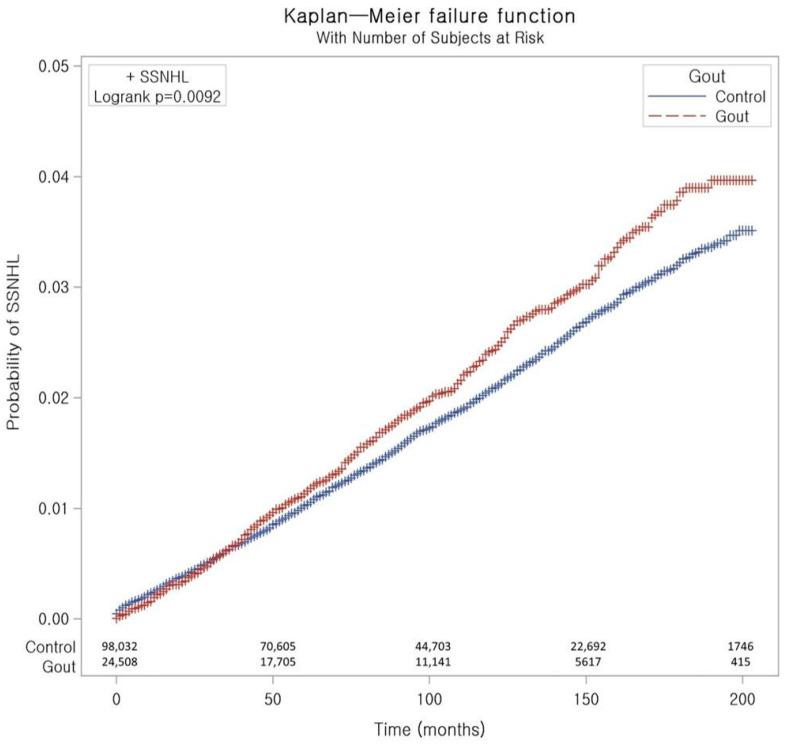
: Gout, characterized by serum uric acid accumulation, prompts inflammation, leading to tissue damage and comorbidities. Prior studies reported a higher risk of hearing loss in gout patients; however, the specific risk of sudden sensorineural hearing loss (SSNHL) remains unclear. : This population-based study assessed SSNHL incidence and risk in patients aged ≥ 40 years with or without gout, excluding those with prior SSNHL, within the Korean National Health Insurance Service Health Screening Cohort (2002-2019). A total of 24,508 gout patients were matched 1:4 with 98,032 controls by age, sex, income, and region. SSNHL incidence was compared, and Kaplan-Meier curves with log-rank tests evaluated cumulative incidence over 200 months. Hazard ratios (HRs) were calculated using stratified Cox models adjusted for patient characteristics. : SSNHL incidence was slightly higher in the gout cohort vs. controls (1.70% vs. 1.96%, SD = 0.02). Kaplan-Meier analysis revealed significantly higher cumulative SSNHL incidence in gout patients ( = 0.009). Patients with gout had a significantly higher risk of developing SSNHL in both the unadjusted (HR [95% CI]: 1.14 [1.03-1.27]; = 0.010) and adjusted Cox models (1.13 [1.02-1.26]; = 0.021). Subgroup analyses indicated higher risk in gout patients aged <60 years, males, non-smokers, non-drinkers, moderately-high income, normal BMI, Charlson Comorbidity Index score of 0, or fasting blood glucose < 100 mg/dL (all < 0.05). : Korean adults with gout, particularly younger, healthier patients, face increased SSNHL risk. Early, effective gout management may help mitigate this risk.
痛风以血清尿酸积累为特征,会引发炎症,导致组织损伤和合并症。先前的研究报告称痛风患者听力损失风险更高;然而,突发性感音神经性听力损失(SSNHL)的具体风险仍不明确。 :这项基于人群的研究评估了韩国国民健康保险服务健康筛查队列(2002 - 2019年)中年龄≥40岁、有无痛风的患者发生SSNHL的发病率和风险,排除既往有SSNHL的患者。总共24508例痛风患者按年龄、性别、收入和地区与98032例对照进行1:4匹配。比较了SSNHL发病率,并使用对数秩检验的Kaplan - Meier曲线评估200个月内的累积发病率。使用针对患者特征进行调整的分层Cox模型计算风险比(HRs)。 :痛风队列中的SSNHL发病率略高于对照组(1.70%对1.96%,标准差 = 0.02)。Kaplan - Meier分析显示痛风患者的累积SSNHL发病率显著更高( = 0.009)。痛风患者在未调整(HR [95%置信区间]:1.14 [1.03 - 1.27]; = 0.010)和调整后的Cox模型(1.13 [1.02 - 1.26]; = 0.021)中发生SSNHL的风险均显著更高。亚组分析表明,年龄<60岁、男性、不吸烟者、不饮酒者、中等高收入、BMI正常、Charlson合并症指数评分为0或空腹血糖<100 mg/dL的痛风患者风险更高(所有 < 0.05)。 :患有痛风的韩国成年人,尤其是更年轻、更健康的患者,面临的SSNHL风险增加。早期、有效的痛风管理可能有助于降低这种风险。

 Zotero 插件