
学龄前儿童24小时运动行为与健康相关生活质量(HRQoL)的关联:一项横断面研究。
Associations between 24-h movement behaviors and health-related quality of life(HRQoL) in preschool children: a cross-sectional study.
作者信息
Zhang Haowen, Lu Zhaoxu, Zhang Ting, Guo Jin, Bao Yihua, Wang Fang, Sun Haoyang, Guan Hongyan, Wu Jian
机构信息
Beijing Municipal Key Laboratory of Child Development and Nutriomics, Capital Institute of Pediatrics, Beijing, China.
School of Kinesiology and Health, Capital University of Physical Education And Sports, Beijing, China.
出版信息
Qual Life Res. 2025 May;34(5):1407-1418. doi: 10.1007/s11136-024-03883-x. Epub 2025 Feb 26.
PURPOSE
To investigate the association between preschool children's 24-h movement behaviors and health-related quality of life (HRQoL), exploring the impact of time reallocation among these behaviors and examining gender differences.
METHODS
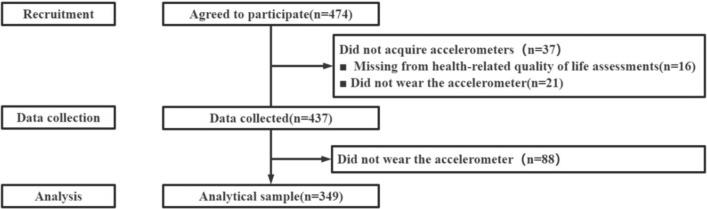
This study analysed HRQoL and 24-h movement behaviors of 349 preschool children in three kindergartens in Beijing, China, selected through convenience sampling using a cross-sectional study design. A t-test and multivariate analysis of variance methods were used to investigate gender differences. The study examined the relationship between 24-h movement behaviors and HRQoL using component data analysis and component isochronic substitution model methods, with an investigation into gender differences in the overall association.
RESULTS
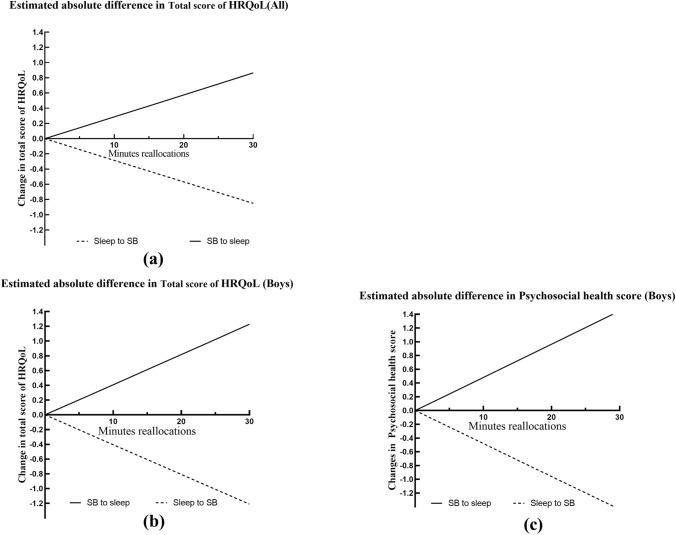
The study found a negative correlation between sedentary behavior (SB) and overall HRQoL score (γ = - 11.92, p < 0.05) in the entire sample, particularly affecting physical health score (γ = - 14.39, p < 0.01). Among boys, SB was negatively correlated with the HRQoL total score (γ = - 15.83, p < 0.05), while sleep was positively correlated with psychosocial health scores (γ = 17.814, p = 0.01). However, there was no significant association found between 24-h movement behaviors and HRQoL in girls. When using the component isochronic substitution model, reallocating 30 min from sedentary behavior to sleep increased the total HRQoL score of preschool children by 0.865 points (95% CI 0.071, 1.658). In contrast, reallocating 30 min from sleep to sedentary behavior resulted in a decrease of 0.850 points (95% CI - 1.638, - 0.062) in the total HRQoL score.
CONCLUSIONS
To improve preschool children's HRQoL, it is recommended to reduce their sedentary behavior time and increase their sleep time. Public health policymakers should consider this when developing 24-h movement behavior guidelines for preschoolers.
目的
探讨学龄前儿童24小时运动行为与健康相关生活质量(HRQoL)之间的关联,探究这些行为之间时间重新分配的影响,并检验性别差异。
方法
本研究采用横断面研究设计,通过便利抽样对中国北京三所幼儿园的349名学龄前儿童的HRQoL和24小时运动行为进行分析。采用t检验和多变量方差分析方法来研究性别差异。本研究使用成分数据分析和成分等时替代模型方法检验24小时运动行为与HRQoL之间的关系,并调查总体关联中的性别差异。
结果
研究发现,在整个样本中,久坐行为(SB)与总体HRQoL得分呈负相关(γ = -11.92,p < 0.05),尤其影响身体健康得分(γ = -14.39,p < 0.01)。在男孩中,SB与HRQoL总分呈负相关(γ = -15.83,p < 0.05),而睡眠与心理社会健康得分呈正相关(γ = 17.814,p = 0.01)。然而,在女孩中未发现24小时运动行为与HRQoL之间存在显著关联。当使用成分等时替代模型时,将30分钟从久坐行为重新分配到睡眠可使学龄前儿童的HRQoL总分提高0.865分(95%CI 0.071,1.658)。相反,将30分钟从睡眠重新分配到久坐行为会导致HRQoL总分下降0.850分(95%CI -1.638,-0.062)。
结论
为提高学龄前儿童的HRQoL,建议减少他们的久坐行为时间并增加睡眠时间。公共卫生政策制定者在制定学龄前儿童24小时运动行为指南时应考虑到这一点。
 Zotero 插件