
处方阿片类药物的使用困难:对英国英格兰初级保健患者的横断面调查
Difficulties with prescribed opioids: a cross-sectional survey of primary care patients in England, United Kingdom.
作者信息
Wilson Louise E, Knaggs Roger D, Avery Anthony J, Thornley Tracey, Moss José, Baamer Reham M, Boyd Matthew J
机构信息
Division of Pharmacy Practice and Policy, School of Pharmacy, University of Nottingham, Nottingham, United Kingdom.
Centre for Academic Primary Care, School of Medicine, University of Nottingham, Nottingham, United Kingdom.
出版信息
Pain Rep. 2025 Feb 25;10(2):e1246. doi: 10.1097/PR9.0000000000001246. eCollection 2025 Apr.
INTRODUCTION
Knowledge of the potential for harm and adverse effects from long-term opioid medicines has led to reduced prescribing in recent years. However, the number of patients receiving opioid prescriptions from primary care in England remains substantial and understanding the difficulties patients experience with these medicines is important for the provision of care.
OBJECTIVE
To understand the difficulties experienced by patients prescribed opioids for noncancer pain in primary care.
METHODS
A cross-sectional postal survey of adults prescribed an opioid medicine for noncancer pain over a period of ≥3 months from 10 general practices (n = 3077) in the East Midlands was conducted using self-completed questionnaires. Sociodemographic, pain, and opioid use information was gathered to characterise the study population. An adapted version of the 15-item Prescribed Opioids Difficulties Scale was used to assess the problems and concerns attributed to using prescribed opioids, from the time opioids were first prescribed.
RESULTS
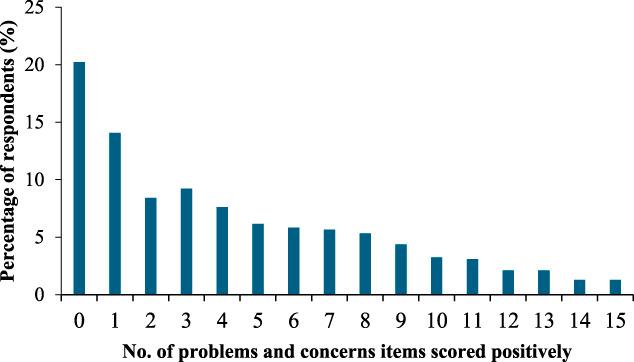
Questionnaires were received from 619 respondents (response rate = 20.1%), of whom 59.8% were female, and the median age was 64 years. Four in 5 (79.8%) had experienced at least one opioid problem or concern from the Prescribed Opioids Difficulties Scale, and one in 5 (22.8%) had experienced 8 or more. The most frequently reported difficulty was needing to increase the dose of opioids to get the same effect (46.0%). Chi-square analysis with odds ratio found respondents were 2.6 times more likely to report ≥4 difficulties if they had higher pain intensity and interference (95% CI: 1.85-3.77, < 0.001).
CONCLUSION
Opioid difficulties were common in this population and this study provides evidence for regular monitoring of problems after prescribing.
引言
近年来,由于了解到长期使用阿片类药物存在潜在危害和不良反应,其处方量有所减少。然而,在英格兰,从初级医疗保健机构接受阿片类药物处方的患者数量仍然可观,了解患者在使用这些药物时所遇到的困难对于提供护理至关重要。
目的
了解在初级医疗保健机构中因非癌性疼痛而开具阿片类药物处方的患者所面临的困难。
方法
对东米德兰兹地区10家普通诊所(n = 3077)中在≥3个月的时间段内因非癌性疼痛而开具阿片类药物处方的成年人进行了横断面邮政调查,使用自我填写问卷。收集了社会人口统计学、疼痛和阿片类药物使用信息以描述研究人群。使用15项阿片类药物处方困难量表的改编版本,从首次开具阿片类药物处方时起,评估与使用处方阿片类药物相关的问题和担忧。
结果
共收到619名受访者的问卷(回复率 = 20.1%),其中59.8%为女性,中位年龄为64岁。五分之四(79.8%)的受访者在阿片类药物处方困难量表中经历过至少一个阿片类药物问题或担忧,五分之一(22.8%)的受访者经历过8个或更多问题。最常报告的困难是需要增加阿片类药物剂量以获得相同效果(46.0%)。卡方分析及比值比显示,如果疼痛强度和干扰程度较高,受访者报告≥4个困难的可能性要高出2.6倍(95%置信区间:1.85 - 3.77,P < 0.001)。
结论
在这一人群中,阿片类药物相关困难很常见,本研究为处方后定期监测问题提供了证据。
 Zotero 插件