
生命的简单七要素及其对慢性肠道疾病的影响:一项关于美国成年人群便秘和腹泻的研究。
Life's Simple 7 and its impact on chronic bowel disorders: a study on constipation and diarrhea in the U.S. adult population.
作者信息
Sun Hongzhi, Qi Lei, Ming Yiwei, Wang Weichen, Hu Maoneng
机构信息
The Third People's Hospital of Hefei, Hefei, Anhui, China.
Hefei Third Clinical College of Anhui Medical University, Hefei, Anhui, China.
出版信息
Front Med (Lausanne). 2025 Feb 12;12:1516210. doi: 10.3389/fmed.2025.1516210. eCollection 2025.
BACKGROUND
Chronic gastrointestinal disorders, such as chronic constipation and diarrhea, pose significant public health challenges, affecting quality of life and healthcare costs. Life's Simple 7 (LS7), established by the American Heart Association, encompasses essential health behaviors that may influence bowel health.
METHODS
We utilized data from the National Health and Nutrition Examination Survey (NHANES) conducted between 2005 and 2010, focusing on adults aged 20 years and older. A total of 12,912 participants were included in the analysis. Bowel health was assessed through self-reported questionnaires, while LS7 was evaluated based on seven components: smoking status, physical activity, dietary quality, BMI, blood pressure, blood glucose, and blood cholesterol. Survey-weighted logistic regression models were employed to assess the associations between LS7 and chronic constipation and diarrhea, adjusting for various demographic and health-related covariates.
RESULTS
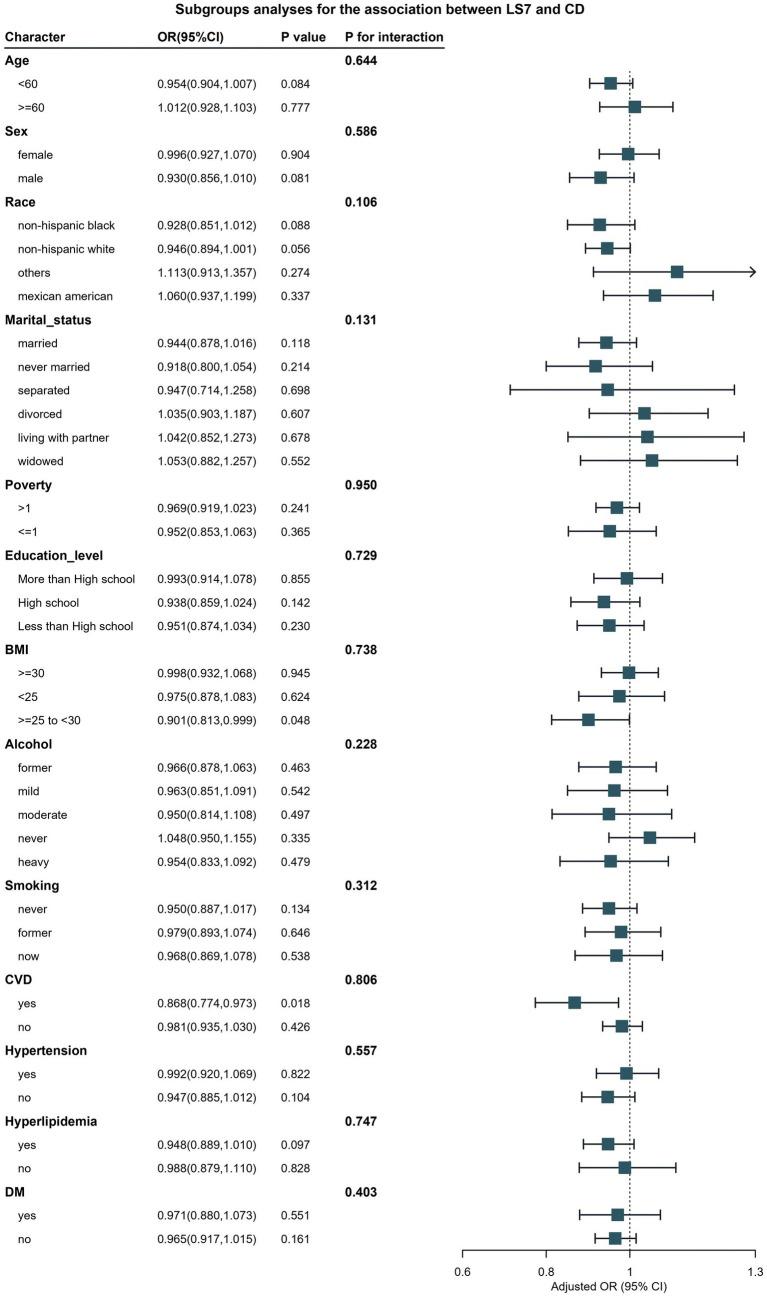
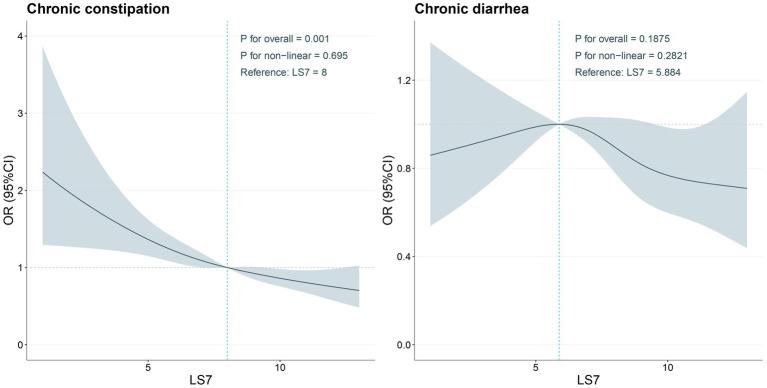
Our findings revealed a significant inverse association between LS7 adherence and the prevalence of chronic constipation (OR: 0.914, 95% CI: 0.864-0.966, = 0.003) and chronic diarrhea (OR: 0.883, 95% CI: 0.856-0.912, < 0.0001). The protective effect of LS7 was more pronounced among males and individuals with a BMI under 30 kg/m for chronic constipation, and among younger adults and those without hypertension for chronic diarrhea. Restricted cubic spline analyses indicated a dose-response relationship, particularly for chronic diarrhea.
CONCLUSION
This study highlights the protective role of LS7 in promoting bowel health and preventing chronic constipation and diarrhea. Tailoring public health interventions based on demographic and health characteristics may enhance the effectiveness of strategies aimed at improving gastrointestinal health outcomes.
背景
慢性胃肠疾病,如慢性便秘和腹泻,对公共卫生构成重大挑战,影响生活质量并增加医疗成本。美国心脏协会制定的“生活简单7要素”(LS7)涵盖了可能影响肠道健康的基本健康行为。
方法
我们利用了2005年至2010年期间进行的美国国家健康和营养检查调查(NHANES)的数据,重点关注20岁及以上的成年人。共有12912名参与者纳入分析。通过自我报告问卷评估肠道健康,而LS7则根据七个组成部分进行评估:吸烟状况、身体活动、饮食质量、体重指数、血压、血糖和血胆固醇。采用调查加权逻辑回归模型评估LS7与慢性便秘和腹泻之间的关联,并对各种人口统计学和健康相关协变量进行调整。
结果
我们的研究结果显示,LS7依从性与慢性便秘患病率(OR:0.914,95%CI:0.864-0.966,P = 0.003)和慢性腹泻患病率(OR:0.883,95%CI:0.856-0.912,P < 0.0001)之间存在显著的负相关。对于慢性便秘,LS7的保护作用在男性和体重指数低于30kg/m²的个体中更为明显;对于慢性腹泻,在年轻人和无高血压的个体中更为明显。受限立方样条分析表明存在剂量反应关系,尤其是对于慢性腹泻。
结论
本研究强调了LS7在促进肠道健康以及预防慢性便秘和腹泻方面的保护作用。根据人口统计学和健康特征制定公共卫生干预措施,可能会提高旨在改善胃肠道健康结局的策略的有效性。


 Zotero 插件