
新型PL15_3亚家族寡聚海藻酸裂解酶VBAly15A底物特异性机制的见解。
Insights into the mechanism of substrate specificity in a novel PL15_3 subfamily oligo-alginate lyase VBAly15A.
作者信息
Tang Yongqi, Song Ziyan, Xu Xiaodong, Li Yingjie, Wang Lushan
机构信息
State Key Laboratory of Microbial Technology, Shandong University, Qingdao, China.
Qingdao Vland Biotech Company Group, Qingdao, China.
出版信息
Appl Environ Microbiol. 2025 Mar 19;91(3):e0235124. doi: 10.1128/aem.02351-24. Epub 2025 Feb 27.
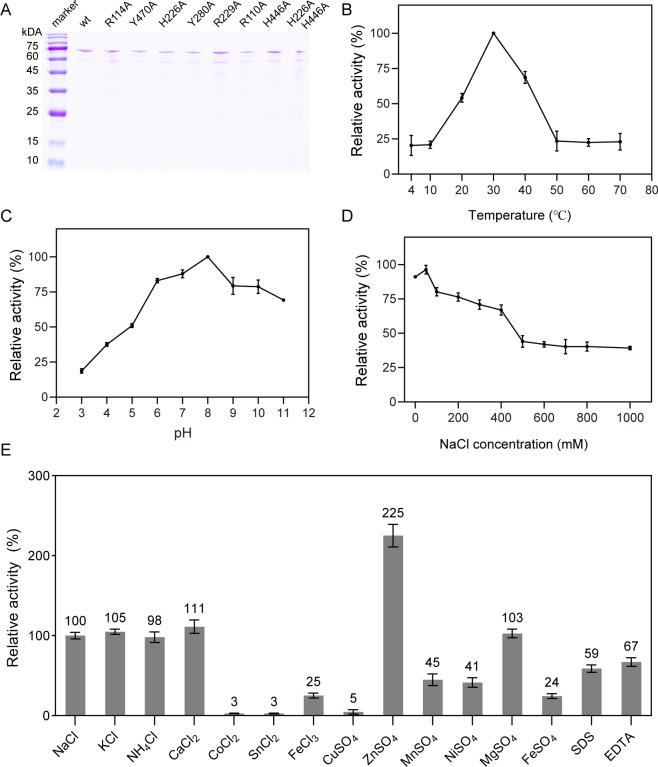
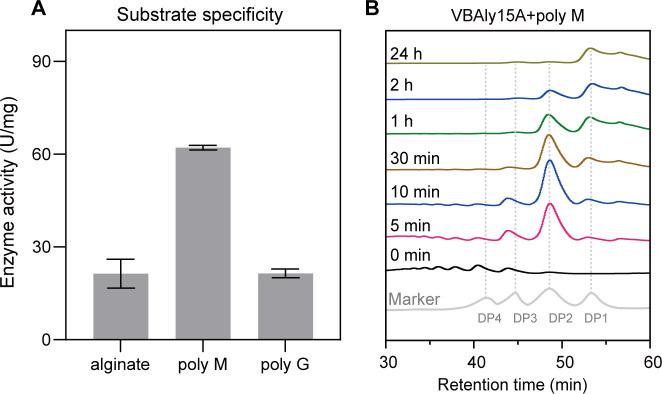
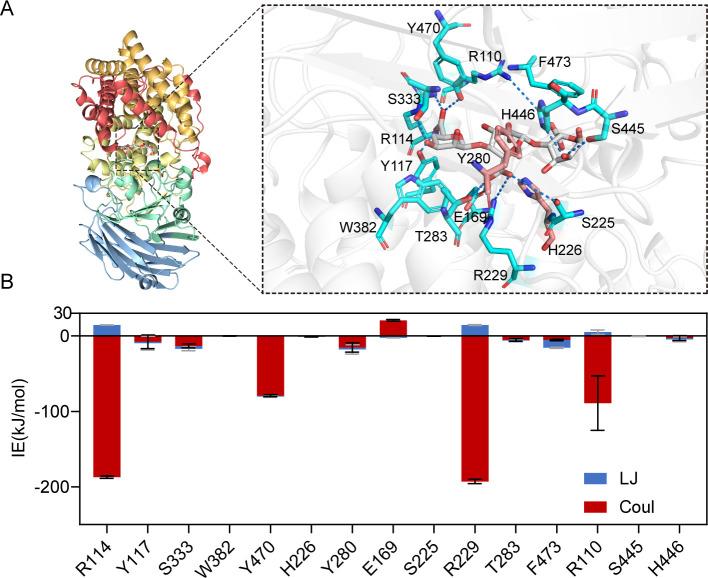
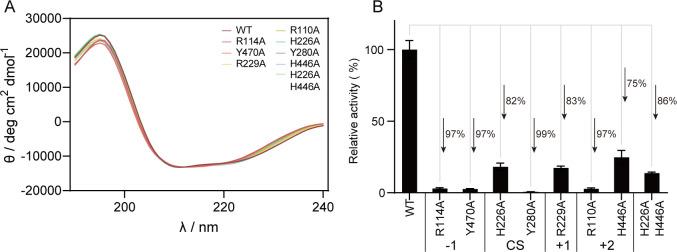
Alginate is a major component of brown algae cell walls and can be degraded via β-elimination by alginate lyases. These enzymes are classified into polysaccharide lyases and oligo-alginate lyases (Oals), with Oals mainly represented by the PL15 and PL17 families. Unlike PL17 Oals, which are widely present in alginate-degrading microorganisms, PL15 enzymes are only identified in a limited number of microorganisms, and their biochemical characteristics remain poorly understood. In this research, a novel PL15 alginate lyase, VBAly15A, from the marine bacterium, sp. B1Z05, was identified and characterized. It belongs to a new PL15_3 subfamily and exhibits high activity toward polyM substrates. VBAly15A is thermostable in medium temperatures, tolerant to alkaline up to 11.0, and polyM-specific Oal, and it can first degrade alginate polymers into disaccharides and subsequently catalyze disaccharides into monomers via an exolytic mode. Site-directed mutagenesis showed that Arg, Tyr, and Arg in the active groove are essential for the stable binding of the substrate. In addition, the amino acid His in VBAly15A, previously suggested to act as a catalytic base, is not essential for catalysis, whereas Tyr, previously proposed to act as a catalytic acid, is required for enzyme activity. Structural bioinformatic and biochemical analyses revealed that His functions as a catalytic base, specifically abstracting protons from G-type substrates, while Tyr acts as both a catalytic acid and a base. This catalytic mechanism is likely conserved in PL15 family alginate lyases.IMPORTANCEAlginate, as a renewable resource for sustainability, has great application prospects. In addition to polysaccharide lyases, Oals are critical for the full degradation of alginate, a key prerequisite for biorefinery. So far, most identified and well-characterized Oals belong to the PL17 family. However, the catalytic mechanism of PL15 Oals is limited, and even the catalytic base and acid are not fully elucidated. The significance of this study lies in discovering and characterizing a novel Oal VBAly15A that divides into a new PL15 subfamily, PL15_3. Not only are key amino acid residues involved in enzyme activity identified, but residues acting as the catalytic base and acid are also demonstrated. The distance of the catalytic residues His and Tyr to the C5 proton of the sugar ring determines the substrate specificity. Therefore, this work provides new insights into the mechanism of substrate specificity in alginate lyases.
藻酸盐是褐藻细胞壁的主要成分,可通过藻酸盐裂解酶的β-消除作用进行降解。这些酶分为多糖裂解酶和寡聚藻酸盐裂解酶(Oals),其中Oals主要由PL15和PL17家族代表。与广泛存在于藻酸盐降解微生物中的PL17 Oals不同,PL15酶仅在有限数量的微生物中被鉴定出来,其生化特性仍知之甚少。在本研究中,从海洋细菌sp. B1Z05中鉴定并表征了一种新型的PL15藻酸盐裂解酶VBAly15A。它属于一个新的PL15_3亚家族,对聚M底物表现出高活性。VBAly15A在中等温度下具有热稳定性,耐碱性高达11.0,是一种聚M特异性Oal,它可以首先将藻酸盐聚合物降解为二糖,随后通过外切模式将二糖催化为单体。定点诱变表明,活性凹槽中的精氨酸、酪氨酸和精氨酸对于底物的稳定结合至关重要。此外,VBAly15A中的组氨酸氨基酸先前被认为起催化碱的作用,但对催化并非必不可少,而先前被认为起催化酸作用的酪氨酸对于酶活性是必需的。结构生物信息学和生化分析表明,组氨酸作为催化碱,特异性地从G型底物中提取质子,而酪氨酸既作为催化酸又作为催化碱。这种催化机制可能在PL15家族藻酸盐裂解酶中保守。
重要性
藻酸盐作为一种可持续的可再生资源,具有巨大的应用前景。除了多糖裂解酶外,Oals对于藻酸盐的完全降解至关重要,这是生物炼制的关键前提。到目前为止,大多数已鉴定和表征良好的Oals属于PL17家族。然而,PL15 Oals的催化机制有限,甚至催化碱和酸都尚未完全阐明。本研究的意义在于发现并表征了一种新型的Oal VBAly15A,它分为一个新的PL15亚家族PL15_3。不仅鉴定了参与酶活性的关键氨基酸残基,还证明了作为催化碱和酸的残基。催化残基组氨酸和酪氨酸到糖环C5质子的距离决定了底物特异性。因此,这项工作为藻酸盐裂解酶的底物特异性机制提供了新的见解。



 Zotero 插件