
新冠后状况的职业和非职业因素:法国普通劳动人口的横断面调查
Occupational and non-occupational factors of post-COVID-19 condition: a cross-sectional survey in the French general working population.
作者信息
Rushyizekera Melissa, Delpierre Cyrille, Makovski Tatjana T, Coste Joël
机构信息
Public Health France, Saint-Maurice, France.
CERPOP, Toulouse, France.
出版信息
BMJ Public Health. 2025 Jan 20;3(1):e001613. doi: 10.1136/bmjph-2024-001613. eCollection 2025 Jan.
INTRODUCTION
Although the working population carries the greatest burden of long COVID, occupational and non-occupational factors of the condition have not yet been well documented in this population. The aim of this study was to investigate these factors.
METHODS
A nationwide random sampling cross-sectional survey was conducted among the adult population in mainland France after the large Omicron waves in the autumn of 2022. Post-COVID-19 condition (PCC) was defined according to the WHO. Associations of occupational and non-occupational factors with PCC were tested in a conceptual model accounting for the relationships between these factors and considering two control groups (previously infected participants without PCC and participants with no reported or diagnosed SARS-CoV-2 infection). Interactions between occupational and non-occupational factors were considered.
RESULTS
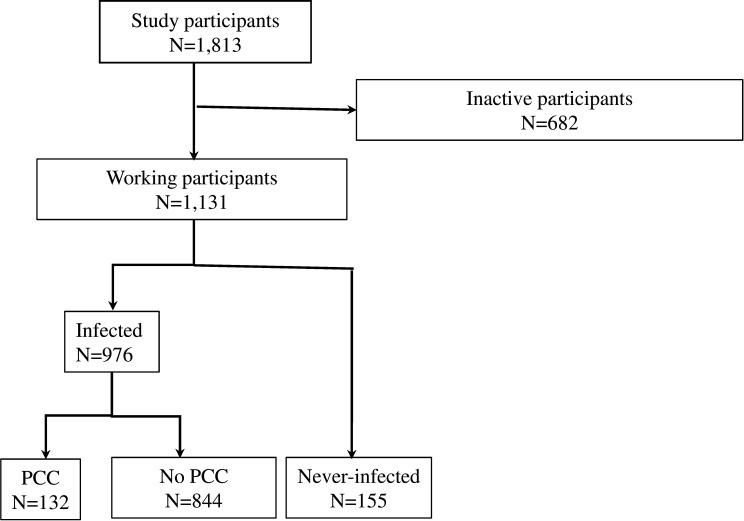
The survey included 1131 working adults. PCC was positively associated with reported infection while providing care (prevalence ratio (PR)=2.06 (95% CI 1.08 to 3.94)), being in contact with a colleague (PR=1.61 (95% CI 1.04 to 2.48)) and increased workload (PR=2.85 (95% CI 1.12 to 7.24)), whereas it was negatively associated with reported infection while being in contact with the public or clients (PR=0.23 (95% CI 0.07 to 0.76)). Several non-occupational factors were associated with PCC: sex, household size, household financial satisfaction, number of pre-existing chronic conditions, anxiety, injury sequelae and perceived SARS-CoV-2 infection severity. No interactions were found between these factors.
CONCLUSIONS
Reducing the burden of long COVID in the working population requires public health strategies that consider a wide spectrum of factors, including work conditions in a broad sense. Specific attention should be given to the most vulnerable workers accumulating such factors.
引言
尽管劳动人口承受着长期新冠的最大负担,但该人群中该病症的职业和非职业因素尚未得到充分记录。本研究的目的是调查这些因素。
方法
在2022年秋季奥密克戎大流行浪潮之后,对法国大陆成年人口进行了一项全国性随机抽样横断面调查。根据世界卫生组织的定义确定新冠后状况(PCC)。在一个概念模型中测试职业和非职业因素与PCC之间的关联,该模型考虑了这些因素之间的关系,并纳入了两个对照组(既往感染但无PCC的参与者以及未报告或诊断出感染严重急性呼吸综合征冠状病毒2的参与者)。考虑了职业和非职业因素之间的相互作用。
结果
该调查纳入了1131名在职成年人。PCC与护理期间报告的感染呈正相关(患病率比(PR)=2.06(95%置信区间1.08至3.94))、与同事接触(PR=1.61(95%置信区间1.04至2.48))以及工作量增加(PR=2.85(95%置信区间1.12至7.24)),而与接触公众或客户期间报告的感染呈负相关(PR=0.23(95%置信区间0.07至0.76))。几个非职业因素与PCC相关:性别、家庭规模、家庭财务满意度、既往慢性病数量、焦虑、损伤后遗症以及感知的严重急性呼吸综合征冠状病毒2感染严重程度。未发现这些因素之间存在相互作用。
结论
减轻劳动人口长期新冠的负担需要公共卫生策略,该策略应考虑广泛的因素,包括广义的工作条件。应特别关注积累这些因素的最脆弱工人。

 Zotero 插件