
横断面调查,旨在探究巴基斯坦普通人群中与抗生素滥用和自我药疗相关的干预项目的知识、态度、行为及影响。
Cross-sectional survey to explore knowledge, attitude, practices and impact of an intervention programme related to antibiotic misuse and self-medication among general population of Pakistan.
作者信息
Saif Arifa, Khan Tahir Mehmood, Bukhsh Allah, Yaseen Muhammad Osama, Saif Alia
机构信息
Institute of Pharmaceutical Sciences, University of Veterinary and Animal Sciences, Lahore, Pakistan.
Department of Pharmacology and Toxicology, University of Veterinary and Animal Sciences, Lahore, Pakistan.
出版信息
BMJ Public Health. 2024 Feb 5;2(1):e000758. doi: 10.1136/bmjph-2023-000758. eCollection 2024 Jun.
OBJECTIVE
The objective of this study is to observe the knowledge, attitude and practices related to antibiotic use, the prevalence of self-medication and non-adherence to the prescribed course of antibiotics across Pakistan.
METHOD
A cross-sectional quantitative study on knowledge, practices, attitude and adherence to antibiotic therapy was conducted from January 2021 to March 2022 among the adult population living in different areas across Pakistan. Individuals with poor knowledge were selected for video-based intervention programme. Video template produced by WHO to create antibiotic awareness was used for this purpose. A postintervention study was conducted to assess the improvement in their knowledge and practices regarding the use of antibiotics. Paired samples t-test was applied to assess the improvement in postintervention survey scores.
RESULTS
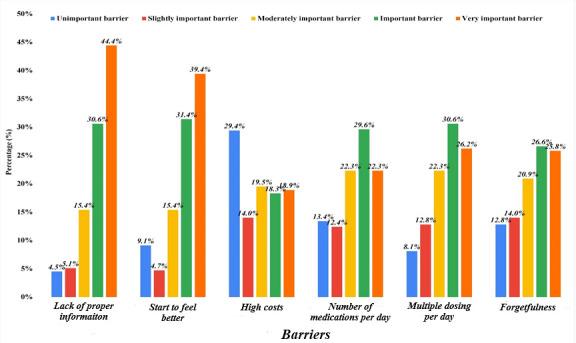
68.9% (n=340/493) of the participants were female and the majority of the sample population was from urban areas. Our study revealed that 39.2% (n=196) of individuals have undergone self-medication with antibiotics in the last 6 months and 42% (n=207) of the total participants were non-adherent to antibiotic treatment plan. Lack of proper information from healthcare professionals was observed to be the most important barrier to antibiotic treatment adherence. The interventional video was shown to 31.64% (n=156/493) of participants who lack proper knowledge about antibiotic use and its associated problems. There appeared to be a significant improvement in the postintervention mean scores of knowledge, practices, attitude and adherence related to antibiotics.
CONCLUSION
This study highlights the alarming situation of self-medication and non-adherence to antibiotic therapy. To cope with the situation, certain pertinent measures are direly needed before the precious lifesaving antibiotics become useless in eradicating various controllable microbial diseases.
目的
本研究的目的是观察巴基斯坦全国范围内与抗生素使用相关的知识、态度和行为,自我药疗的流行情况以及对抗生素规定疗程的不依从情况。
方法
2021年1月至2022年3月,对生活在巴基斯坦不同地区的成年人群开展了一项关于抗生素治疗知识、行为、态度及依从性的横断面定量研究。选择知识欠缺的个体参与基于视频的干预项目。为此使用了世界卫生组织制作的用于提高抗生素意识的视频模板。开展了一项干预后研究,以评估他们在抗生素使用知识和行为方面的改善情况。应用配对样本t检验来评估干预后调查分数的改善情况。
结果
68.9%(n = 340/493)的参与者为女性,且大多数样本人群来自城市地区。我们的研究显示,在过去6个月中,39.2%(n = 196)的个体曾自行使用抗生素,42%(n = 207)的参与者未遵守抗生素治疗方案。观察发现,医疗保健专业人员缺乏适当信息是抗生素治疗依从性的最重要障碍。向31.64%(n = 156/493)对抗生素使用及其相关问题缺乏适当知识的参与者播放了干预视频。在干预后,与抗生素相关的知识、行为、态度和依从性的平均分数似乎有显著提高。
结论
本研究突出了自我药疗和不遵守抗生素治疗的严峻情况。为应对这种情况,在这些珍贵的救命抗生素在根除各种可控微生物疾病中变得无用之前,迫切需要采取某些相关措施。


 Zotero 插件