
非囊性纤维化支气管扩张症成人患者的肺部微生物学与微生物群:一项系统评价和荟萃分析
Pulmonary microbiology and microbiota in adults with non-cystic fibrosis bronchiectasis: a systematic review and meta-analysis.
作者信息
Wang Yuanyuan, Xiao Jingmin, Yang Xiaolin, Liu Yanmin, Du Juan, Bossios Apostolos, Zhang Xi, Su Guobin, Wu Lei, Zhang Zhongde, Lundborg Cecilia Stålsby
机构信息
Department of Global Public Health, Karolinska Institutet, Stockholm, Sweden.
Key Unit of Methodology in Clinical Research, The Second Affiliated Hospital of Guangzhou University of Chinese Medicine, Guangzhou, China.
出版信息
Respir Res. 2025 Feb 28;26(1):77. doi: 10.1186/s12931-025-03140-w.
BACKGROUND
Non-cystic fibrosis bronchiectasis is associated with frequent and diverse microbial infections, yet an overall understanding of microbial presence across different disease stages is lacking.
METHODS
A meta-analysis assessed lung microbes in adults with non-CF bronchiectasis, collecting data using both culture-based and sequencing approaches through three international databases and three Chinese databases. Subgroups were categorized by disease stage: the stable group (S), the exacerbation group (E), and unclassified data consolidated into the undetermined group (U). Culture data were analysed in random-effects meta-analyses while sequencing data were processed using QIIME 2.
RESULTS
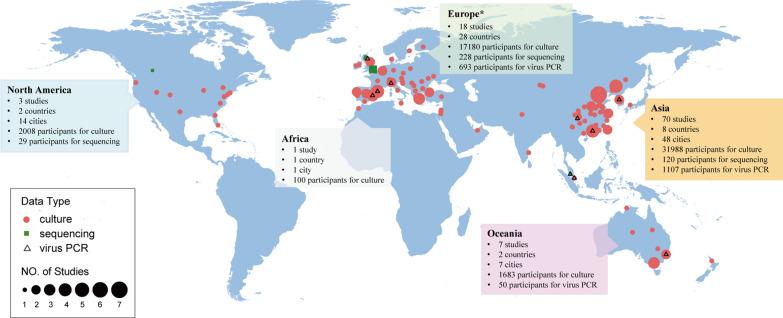
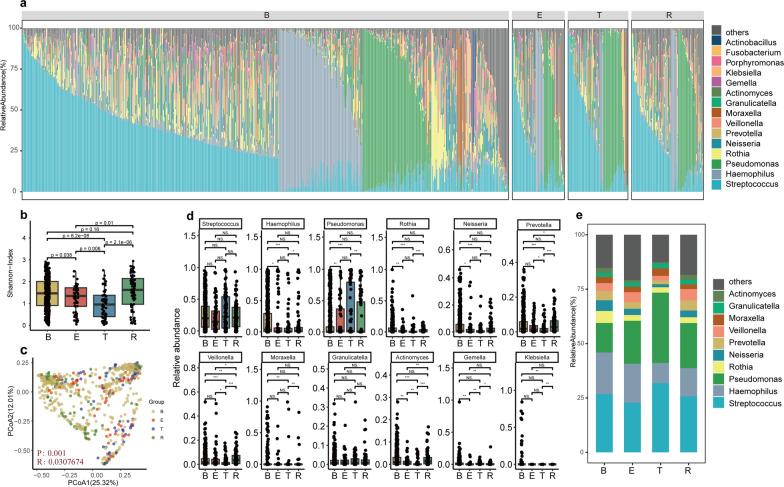
A total of 98 studies were included with data from 54,384 participants worldwide. Pseudomonas aeruginosa was the most frequently isolated bacterium (S: 26[19-34]%, E: 23[20-25]%, U: 20[16-25]%), while not specified Mycobacterium avium complex exhibited the highest mycobacterial prevalence (S: 3[1-5]%, E: 4[2-5]%, U: 15[3-27]%). Aspergillus spp. (S: 15[-10-39]%, E: 2[1-3]%, U: 10[5-15]%) and Candida spp. (S: not applicable, E: 11[2-20]%, U: 10[-8-27]%) were predominant in fungi culture with variable distributions among groups. Rhinovirus was the most commonly detected virus with varying prevalence across airway sample types rather than disease stages (S-sputum: 18[-16-53]%, S-nasopharyngeal: 4[-1-9]%, E-sputum: 22[16-29]%, E-nasopharyngeal: 6[4-8]%). Sequencing results revealed notable antibiotic persistence of Pseudomonas in 16S, and significant domination of Candida in ITS.
CONCLUSION
Our findings indicate consistent bacterial patterns throughout bronchiectasis stages in both culture and sequencing results. Viruses are extensively detected in stable patients but vary across different airway sample types. Lower bacterial diversity and higher fungal diversity may be associated with exacerbation risks.
背景
非囊性纤维化支气管扩张与频繁且多样的微生物感染相关,但目前缺乏对不同疾病阶段微生物存在情况的全面了解。
方法
一项荟萃分析评估了非囊性纤维化支气管扩张成人患者的肺部微生物,通过三个国际数据库和三个中国数据库,使用基于培养和测序的方法收集数据。亚组按疾病阶段分类:稳定组(S)、加重组(E),未分类数据合并为未确定组(U)。培养数据采用随机效应荟萃分析进行分析,而测序数据使用QIIME 2进行处理。
结果
共纳入98项研究,来自全球54384名参与者的数据。铜绿假单胞菌是最常分离出的细菌(S组:26[19 - 34]%,E组:23[20 - 25]%,U组:20[16 - 25]%),而未明确的鸟分枝杆菌复合体显示出最高的分枝杆菌患病率(S组:第3[1 - 5]%,E组:4[2 - 5]%,U组:15[3 - 27]%)。曲霉属(S组:15[-10 - 39]%,E组:2[1 - 3]%,U组:10[5 - 15]%)和念珠菌属(S组:不适用,E组:11[2 - 20]%,U组:10[-8 - 27]%)在真菌培养中占主导地位,各亚组分布不同。鼻病毒是最常检测到的病毒,在不同气道样本类型中的患病率不同,而非疾病阶段(S组痰液:18[-16 - 53]%,S组鼻咽:4[-1 - 9]%,E组痰液:22[16 - 29]%,E组鼻咽:6[4 - 8]%)。测序结果显示,在16S中铜绿假单胞菌具有显著的抗生素持久性,在ITS中念珠菌占主导地位。
结论
我们的研究结果表明,在支气管扩张各阶段,培养和测序结果中的细菌模式一致。病毒在稳定期患者中广泛检测到,但在不同气道样本类型中有所不同。较低的细菌多样性和较高的真菌多样性可能与加重风险相关。



 Zotero 插件