
海地太子港成年人中使用污染性燃料烹饪的流行情况及其与血压升高的关联:一项横断面分析
Prevalence of Cooking with Polluting Fuels and Association with Elevated Blood Pressure Among Adults in Port au Prince, Haiti: A Cross-Sectional Analysis.
作者信息
Rasul Rehana, Sufra Rodney, Pierre Marie Christine Jean, St Sauveur Reichling, Rouzier Vanessa, Inddy Joseph, Hilaire Erline, Preval Fabiola, Yan Lily D, Mourra Nour, Ogyu Anju, Pierre Daniella M, Pape Jean William, Nash Denis, McNairy Margaret L
机构信息
Department of Epidemiology and Biostatistics, Graduate School of Public Health and Health Policy, City University of New York, NY 10027, USA.
Institute of Implementation Science in Population Health, City University of New York, NY 10027, USA.
出版信息
Glob Heart. 2025 Feb 28;20(1):22. doi: 10.5334/gh.1405. eCollection 2025.
BACKGROUND
Cooking with polluting fuels is common in low- and middle-income countries and may impact blood pressure, yet data on this association in urban Haiti is limited. This study describes the prevalence of polluting fuel use and indoor cooking, evaluates their associations with blood pressure, and evaluates whether effects are heterogeneous by sex in urban Haiti.
METHODS
Using cross-sectional data from the Haiti Cardiovascular Disease Cohort study, prevalence of polluting fuel use and indoor cooking was estimated. The associations between polluting fuel use and indoor cooking with systolic blood pressure (SBP), diastolic blood pressure (DBP) and hypertension (HTN) (mean SBP ≥140 mmHg or mean DBP ≥90 mmHg) were estimated using generalized estimating equations. The interaction between polluting fuel use and sex was also evaluated.
RESULTS
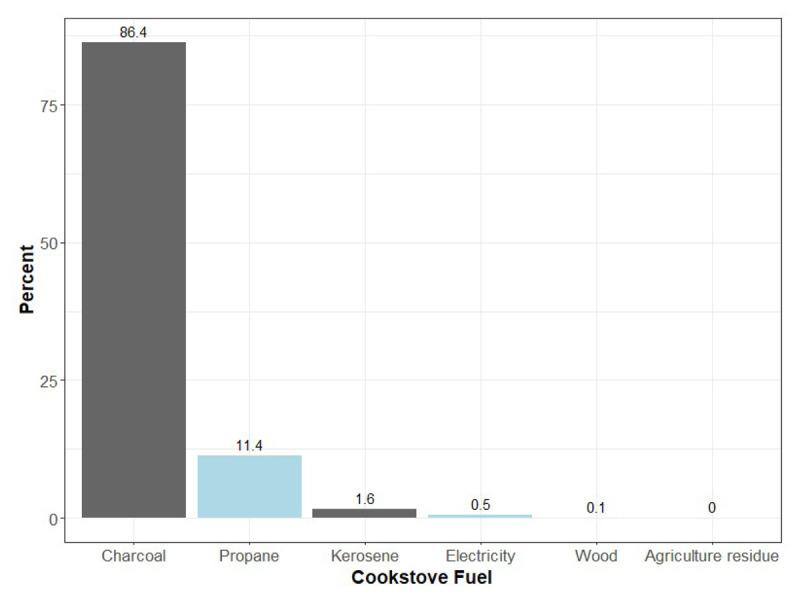
Among 2,931 participants, 58.2% were female and the mean age was 42.0 (SD = 15.9) years. The majority (88.2%) primarily cooked with polluting fuels. Polluting vs clean fuel users tended to have less than a high school education (38.0% vs 22.8%), earn ≤ 1 USD/day (70.5% vs 67.4%), and have high food insecurity (85.0% vs 64.3%). Polluting vs clean fuel users had similar HTN prevalence (adjusted prevalence ratio [aPR] = 0.94, 95% CI: 0.80, 1.10). Average SBP was similar for women (0.99 mmHg, 95% CI: -1.46, 3.44) and lower for men (-4.80 mmHg, 95% CI: -8.24, -1.37) who used polluting vs clean fuels. Cooking indoors vs outdoors was associated with higher HTN prevalence (aPR = 1.12, 95% CI: 1.00, 1.25) and higher average SBP (1.67 mmHg, 95% CI: 0.15, 3.20).
CONCLUSIONS
This study demonstrates that most Haitians in Port-au-Prince cook with polluting fuels and often indoors. Those with higher poverty are more exposed, with mixed results in their association with blood pressure. Longitudinal studies are needed to clarify causal relationships and inform interventions promoting clean fuel use. (ClinicalTrials.gov Identifier: NCT03892265).
背景
在低收入和中等收入国家,使用污染性燃料做饭很常见,这可能会影响血压,但海地城市地区关于这种关联的数据有限。本研究描述了污染性燃料使用和室内烹饪的流行情况,评估了它们与血压的关联,并评估了在海地城市地区这种影响是否因性别而异。
方法
利用海地心血管疾病队列研究的横断面数据,估计了污染性燃料使用和室内烹饪的流行情况。使用广义估计方程估计污染性燃料使用和室内烹饪与收缩压(SBP)、舒张压(DBP)和高血压(HTN)(平均SBP≥140 mmHg或平均DBP≥90 mmHg)之间的关联。还评估了污染性燃料使用与性别的相互作用。
结果
在2931名参与者中,58.2%为女性,平均年龄为42.0(标准差=15.9)岁。大多数(88.2%)主要使用污染性燃料做饭。使用污染性燃料与清洁燃料的人群相比,受教育程度低于高中的比例更高(38.0%对22.8%),日收入≤1美元的比例更高(70.5%对67.4%),粮食不安全程度高的比例更高(85.0%对64.3%)。使用污染性燃料与清洁燃料的人群高血压患病率相似(调整患病率比[aPR]=0.94,95%置信区间:0.80,1.10)。使用污染性燃料与清洁燃料的女性平均SBP相似(0.99 mmHg,95%置信区间:-1.46,3.44),男性平均SBP更低(-4.80 mmHg,95%置信区间:-8.24,-1.37)。在室内做饭与在室外做饭相比,高血压患病率更高(aPR=1.12,95%置信区间:1.00,1.25),平均SBP更高(1.67 mmHg,95%置信区间:0.15,3.20)。
结论
本研究表明,太子港的大多数海地人使用污染性燃料做饭,且经常在室内。贫困程度较高的人接触污染性燃料的机会更多,其与血压的关联结果不一。需要进行纵向研究以阐明因果关系,并为促进清洁燃料使用的干预措施提供依据。(ClinicalTrials.gov标识符:NCT03892265)
 Zotero 插件