
绿色合成的银纳米颗粒而非白蛋白纳米颗粒可诱导骨髓细胞凋亡并使其细胞周期停滞。
Apoptosis and cell cycle arrest of bone marrow cells by green-synthesized silver but not albumin nanoparticles.
作者信息
Eldabousy Ehdaa, Habbak Lotfy, Hyder Ayman
机构信息
Faculty of Science, Damietta University, New Damietta 34517, Egypt.
出版信息
Toxicol Rep. 2025 Feb 13;14:101960. doi: 10.1016/j.toxrep.2025.101960. eCollection 2025 Jun.
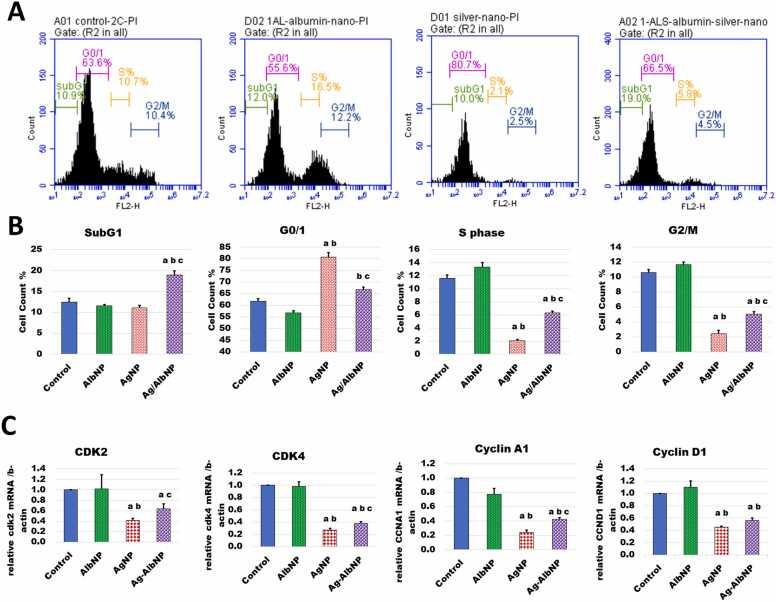
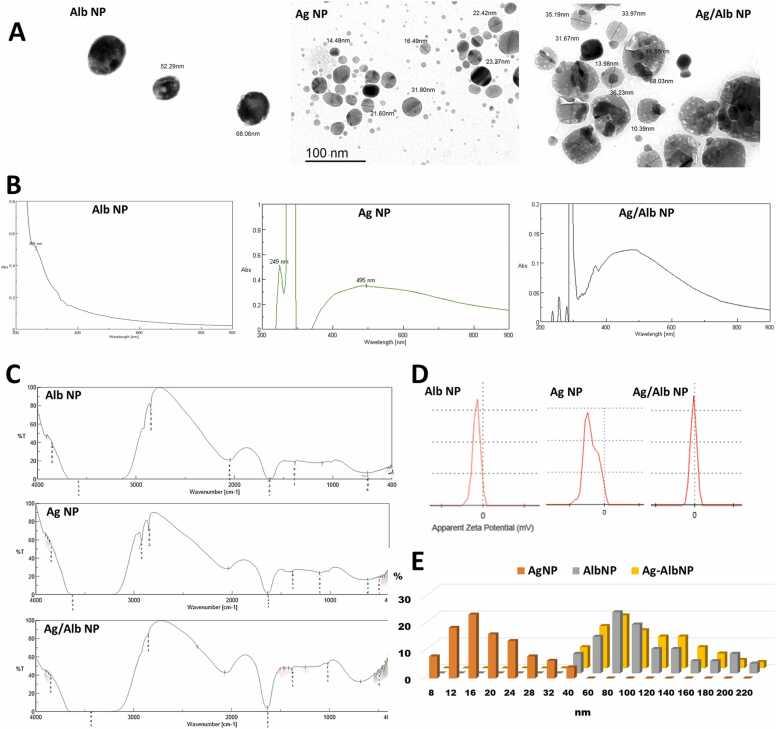
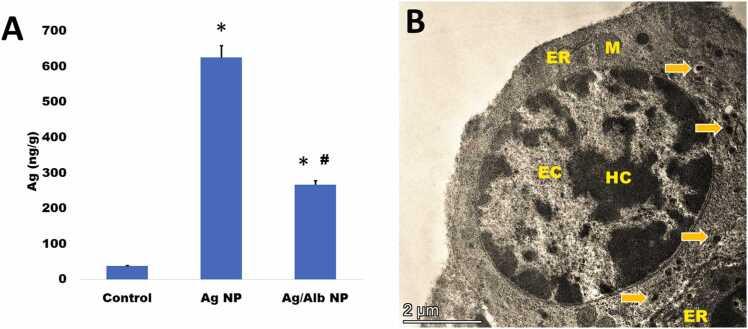
Metallic nanoparticles (NPs) made by traditional means have a deleterious effect on bone marrow (BM) cells. Alternatively, green-synthesized NPs are cost-effective, ecofriendly, and may be less toxic. Also, albumin is a biocompatible blood protein involved in several physiological processes, employed in drug delivery without posing adverse effects, and is thought to be ideal NPs or coating for reducing the metallic NP's toxicity. We prepared albumin NPs (AlbNPs), biosynthesized silver NPs (AgNPs) using the metabolite of the D8 strain and coated them with albumin (Ag/AlbNPs). These NPs were characterized and intraperitoneally administered to rats to compare their effect on rat BM cells. The flow cytometry results revealed that AgNPs significantly reduced viability, increased apoptosis, downregulated the antiapoptotic gene expression, and upregulated the apoptotic genes and in BM cells, while treatment with AlbNPs maintained these parameters. Principally, AgNPs caused significant DNA fragmentation, since all parameters observed by the comet assay (tail length, tail DNA content, tail moment, and olive moment) were significantly higher in AgNP-treated groups than in control and AlbNP-treated groups. Investigation of the cell cycle revealed that treatment with AgNP, but not AlbNPs, downregulated the expression of the regulatory genes , and the cyclins A1 () and D1 (), which resulted in the arrest of the progression of the cell cycle at GO/G1, as demonstrated by flow cytometry. Coating AgNPs with albumin increased their size, and decreased their intracellular concentration, resulting in reduced apoptosis and cell cycle arrest. However, these results for the Ag/AlbNP-treated group were still not comparable to those treated with pure AlbNPs. In conclusion, in contrast to AlbNPs, green AgNPs are toxic to bone marrow cells. Their coating with albumin, however, reduces this toxicity. To avoid this metal NP toxicity, it is recommended to use compatible degradable NPs instead of metal NPs for medication delivery to BM.
传统方法制备的金属纳米颗粒(NPs)对骨髓(BM)细胞具有有害影响。相比之下,绿色合成的NPs具有成本效益、生态友好,且毒性可能较小。此外,白蛋白是一种生物相容性血液蛋白,参与多种生理过程,可用于药物递送而无不良影响,被认为是降低金属NP毒性的理想NPs或涂层。我们制备了白蛋白NPs(AlbNPs),使用D8菌株的代谢产物生物合成了银NPs(AgNPs),并用白蛋白对其进行包被(Ag/AlbNPs)。对这些NPs进行了表征,并腹腔注射给大鼠,以比较它们对大鼠BM细胞的影响。流式细胞术结果显示,AgNPs显著降低了细胞活力,增加了细胞凋亡,下调了抗凋亡基因表达,并上调了BM细胞中的凋亡基因和,而用AlbNPs处理则维持了这些参数。主要地,AgNPs导致了显著的DNA片段化,因为彗星试验观察到的所有参数(尾长、尾DNA含量、尾矩和橄榄矩)在AgNP处理组中均显著高于对照组和AlbNP处理组。细胞周期研究表明,用AgNP而非AlbNPs处理下调了调节基因以及细胞周期蛋白A1()和D1()的表达,如流式细胞术所示,这导致细胞周期在GO/G1期停滞。用白蛋白包被AgNPs增加了其尺寸,并降低了其细胞内浓度,从而减少了细胞凋亡和细胞周期停滞。然而,Ag/AlbNP处理组的这些结果仍与纯AlbNPs处理组的结果不可比。总之,与AlbNPs相比,绿色AgNPs对骨髓细胞有毒性。然而,用白蛋白包被可降低这种毒性。为避免这种金属NP毒性,建议使用相容性可降解NPs而非金属NPs用于向BM给药。


 Zotero 插件