
二甲双胍调节葡萄糖从循环系统到肠腔的通量。
Metformin-regulated glucose flux from the circulation to the intestinal lumen.
作者信息
Sakaguchi Kazuhiko, Sugawara Kenji, Hosokawa Yusei, Ito Jun, Morita Yasuko, Mizuma Hiroshi, Watanabe Yasuyoshi, Kimura Yuichi, Aburaya Shunsuke, Takahashi Masatomo, Izumi Yoshihiro, Bamba Takeshi, Komada Hisako, Yamada Tomoko, Hirota Yushi, Yoshida Masaru, Nogami Munenobu, Murakami Takamichi, Ogawa Wataru
机构信息
Division of Diabetes and Endocrinology, Department of Internal Medicine, Kobe University Graduate School of Medicine, Kobe, Japan.
Division of Community Medicine and Medical Education, Department of Social/Community Medicine and Health Science, Kobe University Graduate School of Medicine, Kobe, Japan.
出版信息
Commun Med (Lond). 2025 Mar 3;5(1):44. doi: 10.1038/s43856-025-00755-4.
BACKGROUND
Through a retrospective analysis of existing FDG PET-MRI images, we recently demonstrated that metformin increases the accumulation of FDG in the intestinal lumen, suggesting that metformin stimulates glucose excretion into the intestine. However, the details of this phenomenon remain unclear. We here investigate the detailed dynamics of intestinal glucose excretion, including the rate of excretion and the metabolism of excreted glucose, in both the presence and absence of metformin.
METHODS
We quantified intestinal glucose excretion using newly developed FDG PET-MRI-based bioimaging in individuals with type 2 diabetes, both treated and untreated with metformin. The metabolism of excreted glucose was analyzed through mass spectrometry of fecal samples from mice intravenously injected with C-labeled glucose.
RESULTS
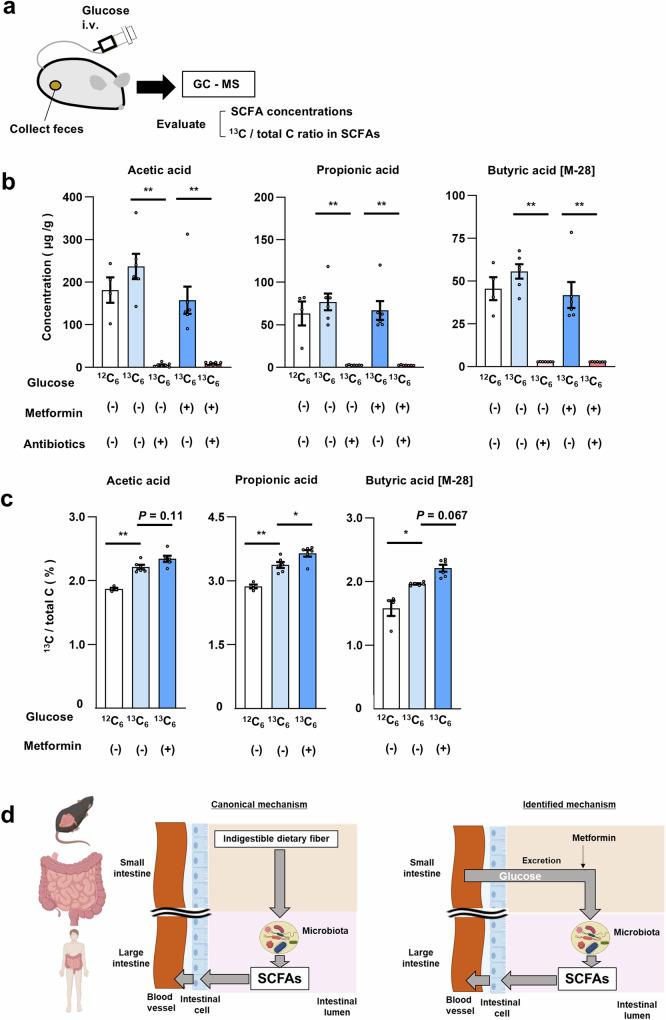
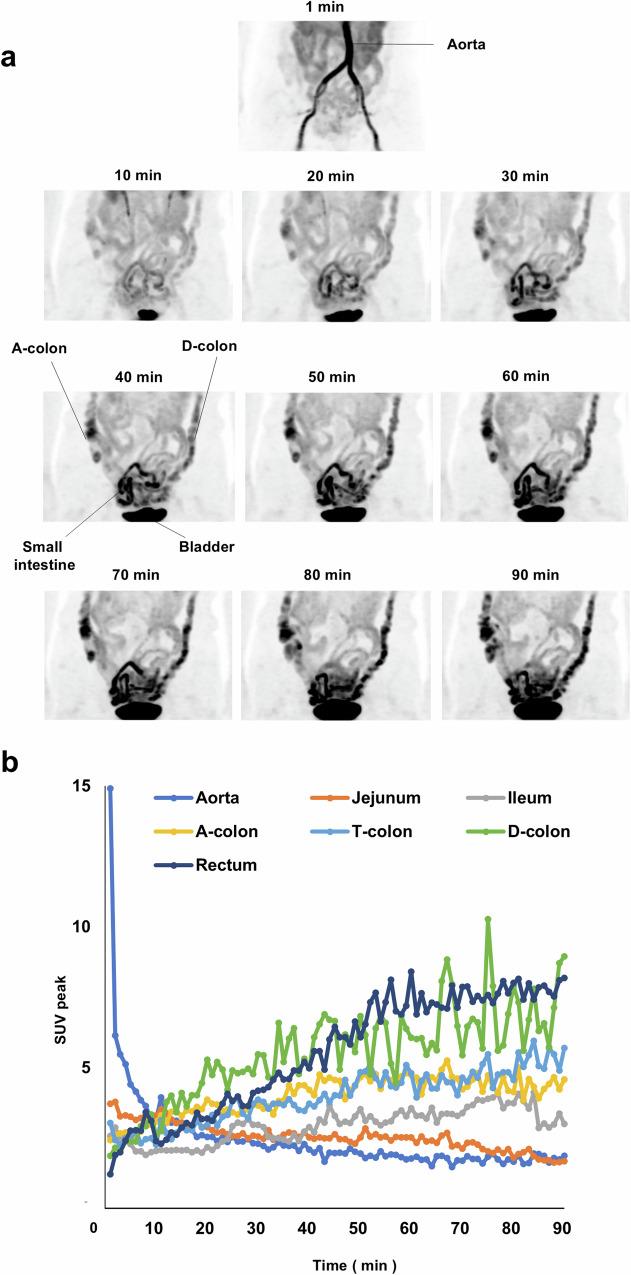
Continuous FDG PET/MRI image taking reveals that FDG is initially observed in the jejunum, suggesting its involvement in FDG excretion. Metformin-treated individuals excrete a significant amount of glucose (1.65 g h per body) into the intestinal lumen. In individuals not receiving metformin, a certain amount of glucose (0.41 g hper body) is also excreted into the intestinal lumen, indicating its physiological importance. Intravenous injection of C-labeled glucose in mice increases the content of C in short-chain fatty acids (SCFAs) extracted from feces, and metformin increased the incorporation of C into SCFAs.
CONCLUSIONS
A previously unrecognized, substantial flux of glucose from the circulation to the intestinal lumen exists, which likely contributes to the symbiosis between gut microbiota and the host. This flux represents a potential target of metformin's action in humans.
背景
通过对现有氟代脱氧葡萄糖正电子发射断层扫描-磁共振成像(FDG PET-MRI)图像进行回顾性分析,我们最近证明二甲双胍可增加肠道腔内FDG的蓄积,提示二甲双胍可刺激葡萄糖向肠道排泄。然而,这一现象的细节仍不清楚。在此,我们研究了在有或没有二甲双胍的情况下肠道葡萄糖排泄的详细动态变化,包括排泄速率和排泄葡萄糖的代谢情况。
方法
我们使用新开发的基于FDG PET-MRI的生物成像技术,对2型糖尿病患者(无论是否接受二甲双胍治疗)的肠道葡萄糖排泄进行了定量分析。通过对静脉注射C标记葡萄糖的小鼠粪便样本进行质谱分析,来分析排泄葡萄糖的代谢情况。
结果
连续进行FDG PET/MRI图像采集发现,最初在空肠中观察到FDG,提示其参与FDG排泄。接受二甲双胍治疗的个体向肠道腔内排泄大量葡萄糖(约每千克体重1.65克/小时)。在未接受二甲双胍治疗的个体中,也有一定量的葡萄糖(约每千克体重0.41克/小时)排泄到肠道腔内,表明其具有生理重要性。给小鼠静脉注射C标记葡萄糖会增加从粪便中提取的短链脂肪酸(SCFA)中C的含量,且二甲双胍会增加C掺入SCFA中的量。
结论
存在一种先前未被认识到的、从循环系统到肠道腔的大量葡萄糖通量,这可能有助于肠道微生物群与宿主之间的共生关系。这种通量代表了二甲双胍在人体中发挥作用的一个潜在靶点。


 Zotero 插件