
探索癌症患者针刺时间参数与化疗所致周围神经病变之间的量效关系:一项随机对照试验的剂量反应荟萃分析。
Exploration of the quantitative-effectiveness association between acupuncture temporal parameters and chemotherapy-induced peripheral neuropathy in cancer patients: a dose-response meta-analysis of randomized controlled trials.
作者信息
Tian Hao, Luo Qin, Huang Liuyang, Chen Guang, Sun Mingsheng, Liang Fanrong
机构信息
College of Acupuncture and Tuina/The 3rd Teaching Hospital/College of Basic Medicine/College of International Education, Chengdu University of Traditional Chinese Medicine/Clinical Research Center for Acupuncture and Moxibustion in Sichuan Province, Chengdu, Sichuan, China.
Department of Rheumatology and Orthopedics, Sichuan Province Orthopedic Hospital, Chengdu, Sichuan, China.
出版信息
Front Oncol. 2025 Feb 12;14:1527331. doi: 10.3389/fonc.2024.1527331. eCollection 2024.
BACKGROUND
Chemotherapy-induced peripheral neuropathy (CIPN) is one of the commonly reported symptoms impacting cancer survivors. This study evaluated and compared the effectiveness of acupuncture treatments for CIPN.
METHODS
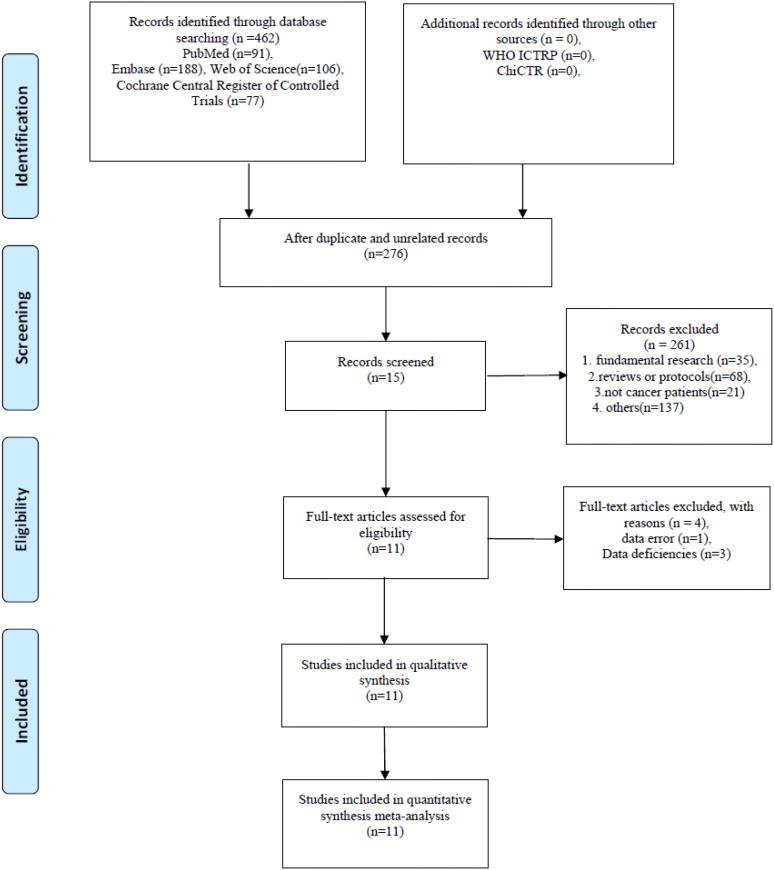
We searched six databases from their inception to August 2024 to identify eligible randomized controlled trials (RCTs). Primary outcome were pain scores. Secondary outcomes were quality of life including FACT/GOG-Ntx and EORTC QLQ-C30. The robust error meta-regression (REMR) method was used to evaluate the dose-response relationship across treatment parameters, including number of sessions, frequency, and duration.
RESULTS
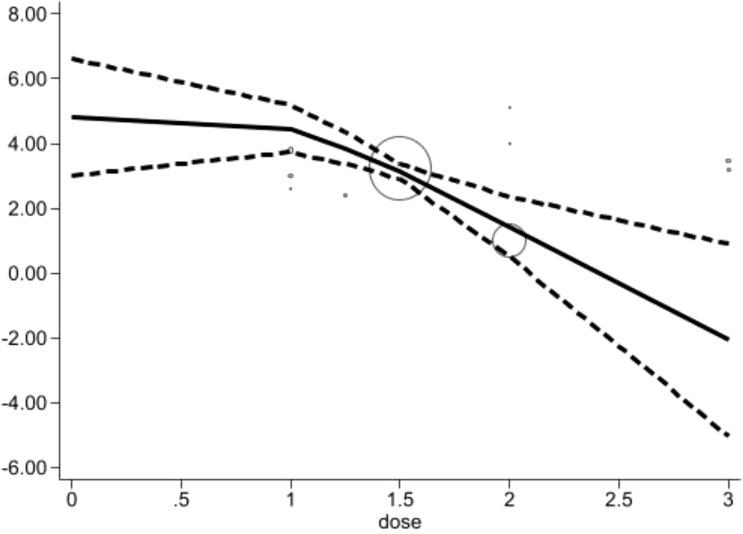
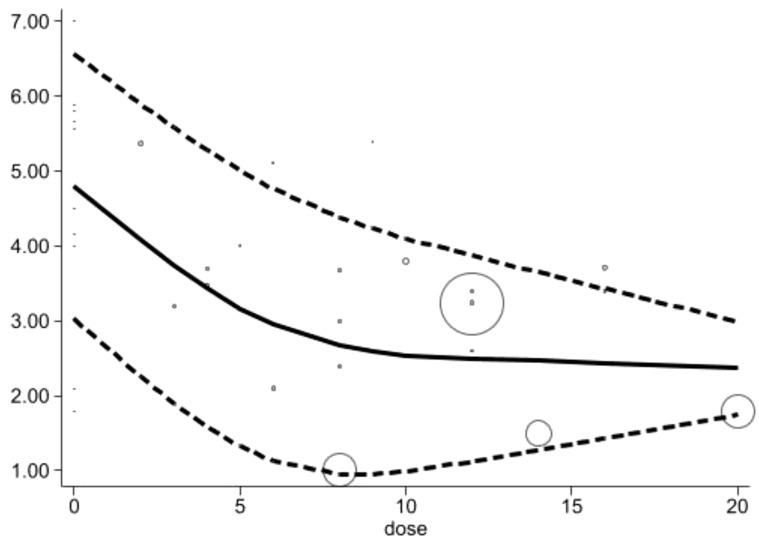
In total, 11 RCTs featuring 740 participants were included. The meta-analysis demonstrated that the primary analysis achieved a significant reduction in pain scores, with a standardized mean difference of [SMD= -1.23, 95% CI = (-2.22, -0.24); < 0.01; = 95%], improvement quality of life including FACT/GOG-Ntx [SMD = 0.95, 95% CI = (0.02, 1.88); < 0.01; = 93%] and EORTC QLQ-C30 [SMD = 0.36, 95% CI = (0.03, 0.68); = 0.14; = 46%]. The nonlinear dose-response analysis suggests that pain improvement achieves the MCID at 16 treatment sessions, over 8 weeks, with a frequency of twice per week. Furthermore, analysis of the treatment duration chart shows that acupuncture maintains therapeutic effects during the follow-up period. Sensitivity analysis confirmed the robustness of these findings.
CONCLUSION
Acupuncture demonstrates significant potential in managing CIPN, particularly through individualized treatment regimens. The identified time-dose-response relationship suggests that tailoring acupuncture frequency and duration can to optimize pain relief in CIPN patients. Future high-quality studies and large-scale multicenter clinical trials are needed to validate these findings.
背景
化疗引起的周围神经病变(CIPN)是影响癌症幸存者的常见症状之一。本研究评估并比较了针刺治疗CIPN的有效性。
方法
我们检索了六个数据库,从其创建到2024年8月,以确定符合条件的随机对照试验(RCT)。主要结局是疼痛评分。次要结局是生活质量,包括FACT/GOG-Ntx和EORTC QLQ-C30。采用稳健误差元回归(REMR)方法评估治疗参数(包括疗程数、频率和持续时间)之间的剂量反应关系。
结果
共纳入11项RCT,涉及740名参与者。荟萃分析表明,主要分析使疼痛评分显著降低,标准化平均差为[SMD = -1.23,95%置信区间=(-2.22,-0.24);P < 0.01;I² = 95%],改善了包括FACT/GOG-Ntx[SMD = 0.95,95%置信区间=(0.02,1.88);P < 0.01;I² = 93%]和EORTC QLQ-C30[SMD = 0.36,95%置信区间=(0.03,0.68);P = 0.14;I² = 46%]在内的生活质量。非线性剂量反应分析表明,在8周内进行16次治疗,每周两次的频率下,疼痛改善达到最小临床重要差异(MCID)。此外,治疗持续时间图表分析表明,针刺在随访期间保持治疗效果。敏感性分析证实了这些发现的稳健性。
结论
针刺在管理CIPN方面显示出显著潜力,特别是通过个体化治疗方案。确定的时间-剂量反应关系表明,调整针刺频率和持续时间可以优化CIPN患者的疼痛缓解。未来需要高质量研究和大规模多中心临床试验来验证这些发现。





 Zotero 插件