
用于研究孕妇药物药代动力学的数字孪生增强型三器官微生理系统。
Digital twin-enhanced three-organ microphysiological system for studying drug pharmacokinetics in pregnant women.
作者信息
Graf Katja, Murrieta-Coxca José Martin, Vogt Tobias, Besser Sophie, Geilen Daria, Kaden Tim, Bothe Anne-Katrin, Morales-Prieto Diana Maria, Amiri Behnam, Schaller Stephan, Kaufmann Ligaya, Raasch Martin, Ammar Ramy M, Maass Christian
机构信息
Dynamic42 GmbH, Jena, Germany.
Placenta Lab, Department of Obstetrics, Jena University Hospital, Jena, Germany.
出版信息
Front Pharmacol. 2025 Feb 12;16:1528748. doi: 10.3389/fphar.2025.1528748. eCollection 2025.
BACKGROUND
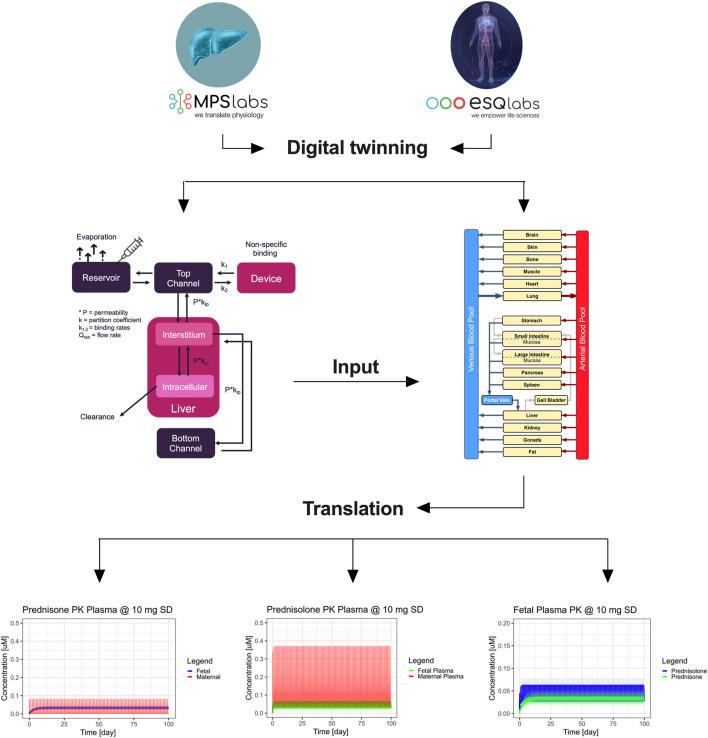
Pregnant women represent a vulnerable group in pharmaceutical research due to limited knowledge about drug metabolism and safety of commonly used corticosteroids like prednisone due to ethical and practical constraints. Current preclinical models, including animal studies, fail to accurately replicate human pregnancy conditions, resulting in gaps in drug safety and pharmacokinetics predictions. To address this issue, we used a three-organ microphysiological system (MPS) combined with a digital twin framework, to predict pharmacokinetics and fetal drug exposure.
METHODS
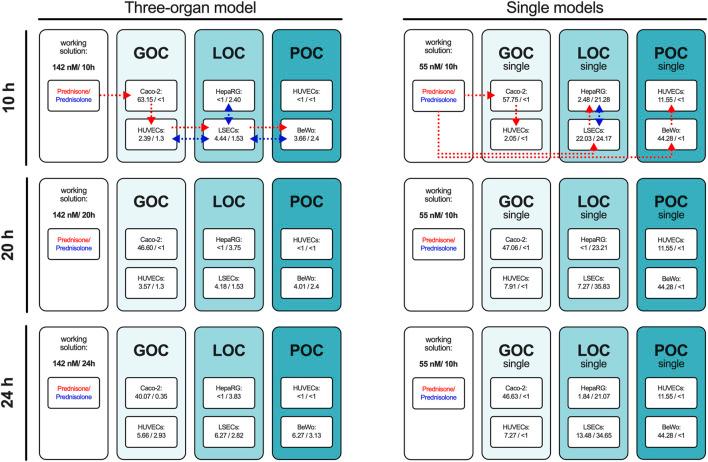
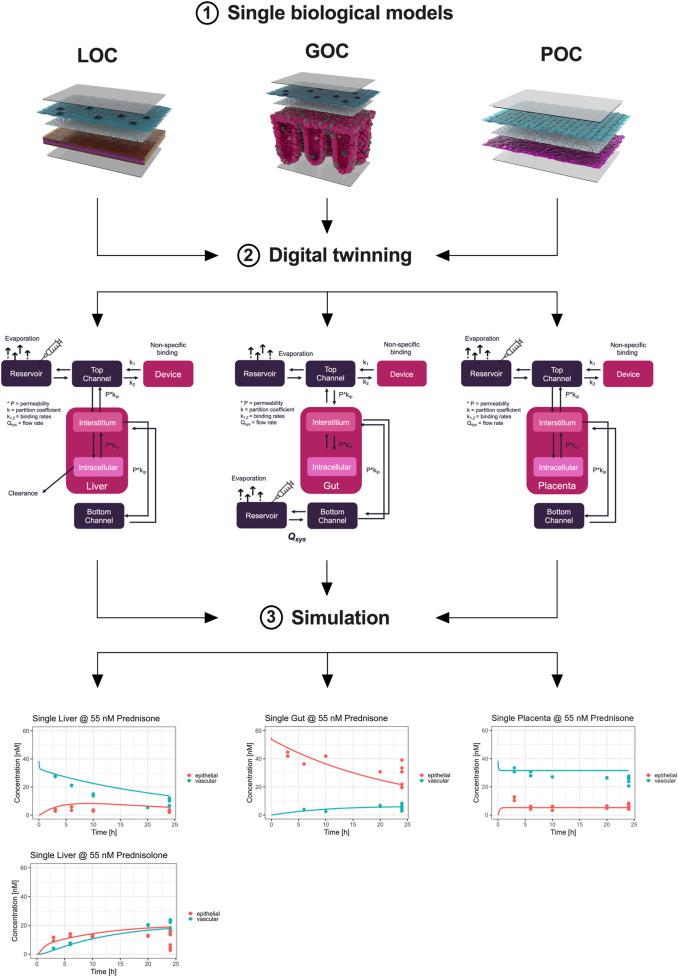
The here shown human MPS integrated gut, liver, and placenta models, interconnected via the corresponding vasculature. Using prednisone as a model compound, we simulate oral drug administration and track its metabolism and transplacental transfer. To translate the generated data from MPS to human physiology, computational modelling techniques were developed.
RESULTS
Our results demonstrate that the system maintains cellular integrity and accurately mimics drug dynamics, with predictions closely matching clinical data from pregnant women. Digital twinning closely aligned with the generated experimental data. Long-term exposure simulations confirmed the value of this integrated system for predicting the non-toxic metabolization of prednisone.
CONCLUSION
This approach may provide a potential non-animal alternative that could contribute to our understanding of drug behavior during pregnancy and may support early-stage drug safety assessment for vulnerable populations.
背景
由于伦理和实际限制,对孕妇常用皮质类固醇(如泼尼松)的药物代谢和安全性了解有限,孕妇在药物研究中是弱势群体。当前的临床前模型,包括动物研究,无法准确复制人类妊娠状况,导致药物安全性和药代动力学预测存在差距。为解决这一问题,我们使用了一种三器官微生理系统(MPS)结合数字孪生框架,来预测药代动力学和胎儿药物暴露情况。
方法
此处展示的人体MPS整合了肠道、肝脏和胎盘模型,并通过相应的脉管系统相互连接。以泼尼松作为模型化合物,我们模拟口服给药并追踪其代谢和经胎盘转运情况。为了将MPS生成的数据转化为人体生理学数据,开发了计算建模技术。
结果
我们的结果表明,该系统保持了细胞完整性并准确模拟了药物动态,预测结果与孕妇的临床数据密切匹配。数字孪生与生成的实验数据紧密对齐。长期暴露模拟证实了这个整合系统在预测泼尼松无毒代谢方面的价值。
结论
这种方法可能提供一种潜在的非动物替代方案,有助于我们了解孕期药物行为,并可能支持对弱势群体进行早期药物安全性评估。



 Zotero 插件