
揭示心律失常死亡率:美国25年趋势与差异分析(1999 - 2023年)
Unmasking Arrhythmia Mortality: A 25-Year Analysis of Trends and Disparities in the United States (1999-2023).
作者信息
Azeem Bazil, Khurram Laiba, Sharaf Bakhtawar, Khan Arwa, Habiba Ayesha, Asim Rabia, Khelani Muskan, Ali Hamza, Ansari Abdul Hadi, Muhammad Tazheen Saleh, Naveed Muhammad Abdullah, Dogar Mata-E-Alla, Saleh Aalaa, Ashraf Hamza
机构信息
Department of Internal Medicine, Shaheed Mohtarma Benazir Bhutto Medical College Lyari, Karachi, Pakistan.
Department of Internal Medicine, Dow Medical College, Dow University of Health Sciences, Karachi, Pakistan.
出版信息
Clin Cardiol. 2025 Mar;48(3):e70109. doi: 10.1002/clc.70109.
BACKGROUND
Arrhythmias are a significant cause of cardiovascular mortality in the U.S. This study examines trends in arrhythmia-related mortality from 1999 to 2023, focusing on gender, racial, regional disparities, and specific arrhythmic conditions.
OBJECTIVE
To analyze trends and disparities in arrhythmia-related mortality among U.S. adults aged ≥ 35 years from 1999 to 2023, with a focus on the impact of sex, race, geographic location, and urbanization.
METHODS
We analyzed mortality data from the CDC WONDER database, focusing on deaths where arrhythmias were a contributing cause. Age-adjusted mortality rates (AAMRs) were calculated and stratified by sex, race/ethnicity, state, and region. The annual percentage change (APC) and average annual percentage change (AAPC) were estimated using Joinpoint regression.
RESULTS
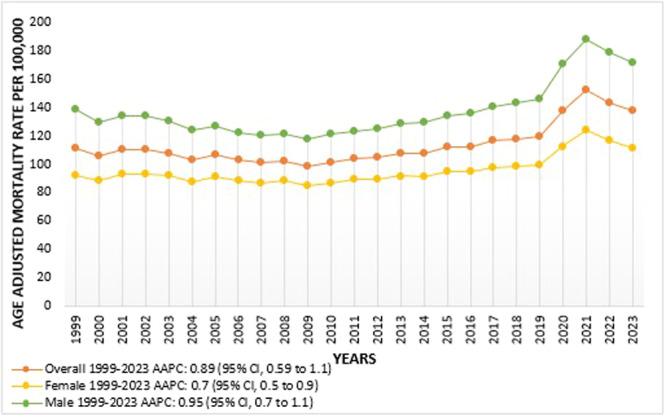
A total of 5,050,271 arrhythmia-related deaths were recorded, with the overall AAMR increasing from 111.4 in 1999 to 137.3 in 2023. Mortality rates declined significantly from 1999 to 2009 (APC: -1.04%; p = 0.003) but rose sharply from 2009 to 2018 (APC: 1.69%; p = 0.003), peaking in 2021 during the COVID-19 pandemic (APC: 8.63%; p < 0.001). A subsequent decline was observed from 2021 to 2023 (APC: -3.91%; p = 0.044). Males consistently exhibited higher AAMRs than females (137.2 vs. 95.3), as did non-Hispanic White individuals compared to other racial groups. Geographic disparities revealed higher mortality rates in Nonmetropolitan areas and the Midwest, with the highest AAMR observed in Oregon and the lowest in Hawaii.
CONCLUSION
Despite an overall decline in arrhythmia-related mortality, recent increases, especially in West Virginia and among certain racial groups, highlight the need for targeted public health interventions.
背景
在美国,心律失常是心血管疾病死亡的一个重要原因。本研究调查了1999年至2023年与心律失常相关的死亡率趋势,重点关注性别、种族、地区差异以及特定的心律失常情况。
目的
分析1999年至2023年美国35岁及以上成年人中与心律失常相关的死亡率趋势和差异,重点关注性别、种族、地理位置和城市化的影响。
方法
我们分析了疾病控制与预防中心(CDC)的WONDER数据库中的死亡率数据,重点关注心律失常作为一个促成死因的死亡情况。计算年龄调整死亡率(AAMR),并按性别、种族/族裔、州和地区进行分层。使用Joinpoint回归估计年度百分比变化(APC)和平均年度百分比变化(AAPC)。
结果
共记录了5,050,271例与心律失常相关的死亡,总体AAMR从1999年的111.4上升至2023年的137.3。从1999年到2009年死亡率显著下降(APC:-1.04%;p = 0.003),但从2009年到2018年急剧上升(APC:1.69%;p = 0.003),在2021年新冠疫情期间达到峰值(APC:8.63%;p < 0.001)。随后在2021年至2023年观察到下降(APC:-3.91%;p = 0.044)。男性的AAMR始终高于女性(137.2对95.3),非西班牙裔白人个体与其他种族群体相比也是如此。地理差异显示非都市地区和中西部地区的死亡率较高,俄勒冈州的AAMR最高,夏威夷州最低。
结论
尽管与心律失常相关的死亡率总体呈下降趋势,但近期的上升,特别是在西弗吉尼亚州和某些种族群体中,凸显了有针对性的公共卫生干预措施的必要性。


 Zotero 插件