
人赖氨酰 - tRNA合成酶对细胞修饰的tRNALys3进行氨酰化的结构基础。
Structural basis for aminoacylation of cellular modified tRNALys3 by human lysyl-tRNA synthetase.
作者信息
Devarkar Swapnil C, Budding Christina R, Pathirage Chathuri, Kavoor Arundhati, Herbert Cassandra, Limbach Patrick A, Musier-Forsyth Karin, Xiong Yong
机构信息
Department of Molecular Biophysics and Biochemistry, Yale University, New Haven, CT 06511, United States.
Department of Chemistry and Biochemistry, Center for RNA Biology, and Center for Retrovirus Research, Ohio State University, Columbus, OH 43210, United States.
出版信息
Nucleic Acids Res. 2025 Feb 27;53(5). doi: 10.1093/nar/gkaf114.
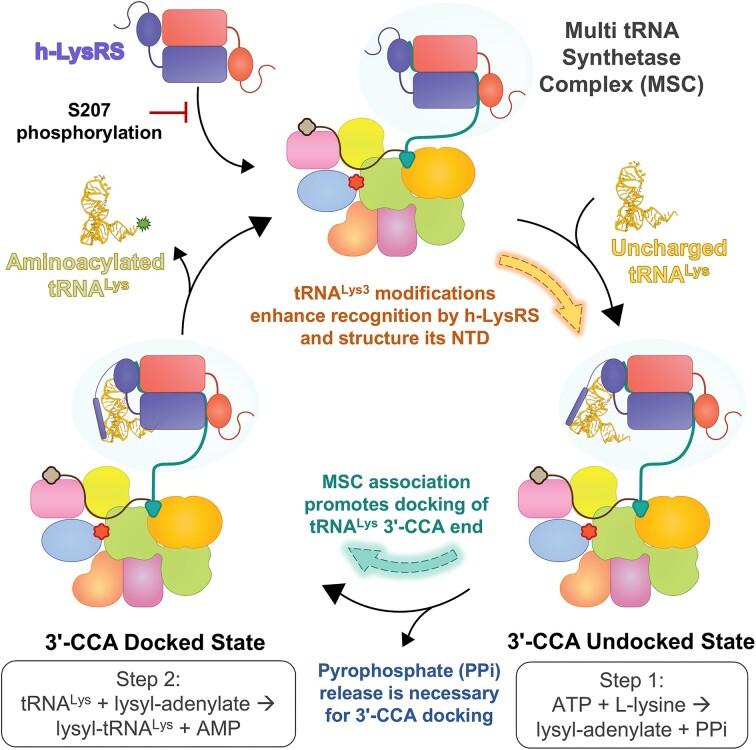
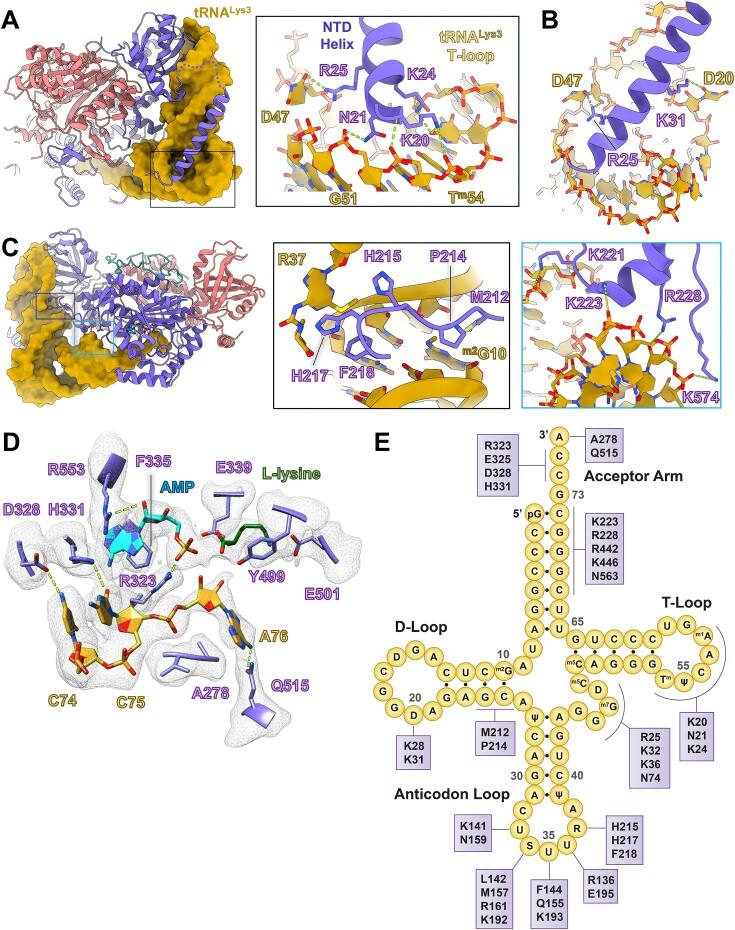
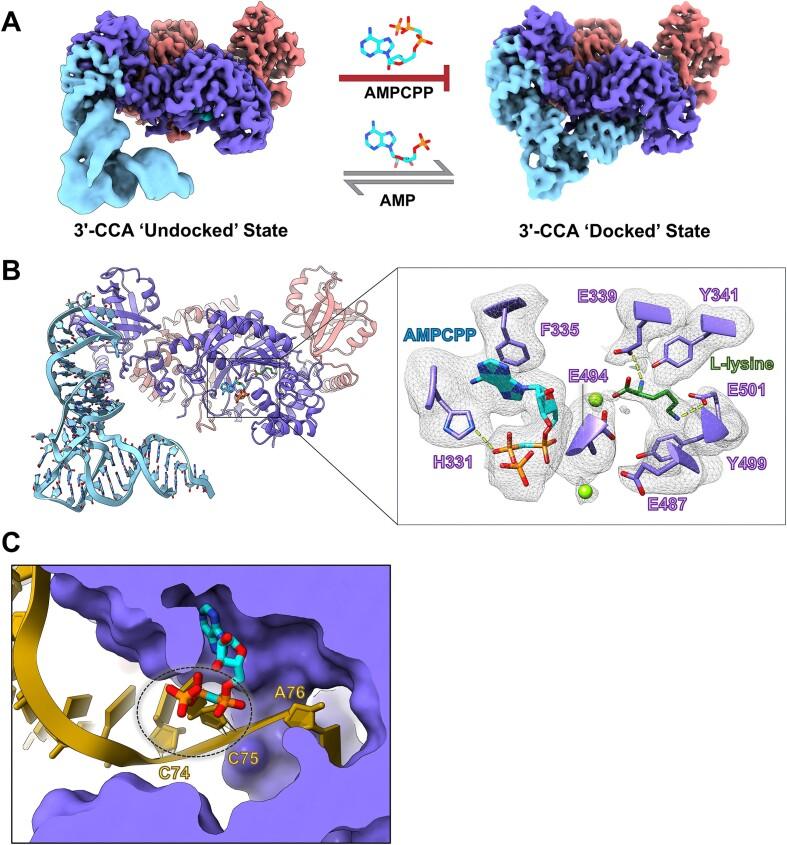
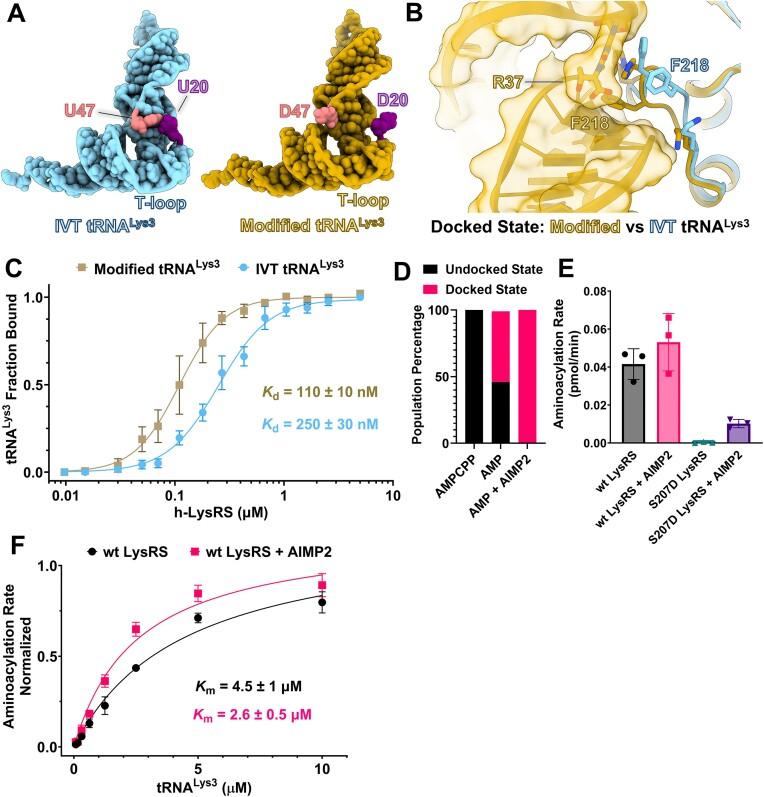
The average eukaryotic transfer ribonucleic acid (tRNA) contains 13 post-transcriptional modifications; however, their functional impact is largely unknown. Our understanding of the complex tRNA aminoacylation machinery in metazoans also remains limited. Herein, using a series of high-resolution cryo-electron microscopy (cryo-EM) structures, we provide the mechanistic basis for recognition and aminoacylation of fully modified cellular tRNALys3 by human lysyl-tRNA synthetase (h-LysRS). The tRNALys3 anticodon loop modifications S34 (mcm5s2U) and R37 (ms2t6A) play an integral role in recognition by h-LysRS. Modifications in the T-, variable-, and D-loops of tRNALys3 are critical for ordering the metazoan-specific N-terminal domain of LysRS. The two catalytic steps of tRNALys3 aminoacylation are structurally ordered; docking of the 3'-CCA end in the active site cannot proceed until the lysyl-adenylate intermediate is formed and the pyrophosphate byproduct is released. Association of the h-LysRS-tRNALys3 complex with a multi-tRNA synthetase complex-derived peptide shifts the equilibrium toward the 3'-CCA end "docked" conformation and allosterically increases h-LysRS catalytic efficiency. The insights presented here have broad implications for understanding the role of tRNA modifications in protein synthesis, the human aminoacylation machinery, and the growing catalog of metabolic and neurological diseases linked to it.
真核生物的平均转运核糖核酸(tRNA)含有13种转录后修饰;然而,它们的功能影响在很大程度上尚不清楚。我们对后生动物中复杂的tRNA氨酰化机制的理解也仍然有限。在此,我们利用一系列高分辨率冷冻电子显微镜(cryo-EM)结构,为人类赖氨酰-tRNA合成酶(h-LysRS)对完全修饰的细胞tRNALys3的识别和氨酰化提供了机制基础。tRNALys3反密码子环修饰S34(mcm5s2U)和R37(ms2t6A)在h-LysRS的识别中起着不可或缺的作用。tRNALys3的T环、可变环和D环中的修饰对于使后生动物特有的LysRS N端结构域有序排列至关重要。tRNALys3氨酰化的两个催化步骤在结构上是有序的;在赖氨酰-腺苷酸中间体形成且焦磷酸副产物释放之前,3'-CCA末端无法在活性位点对接。h-LysRS-tRNALys3复合物与多tRNA合成酶复合物衍生肽的结合将平衡向3'-CCA末端“对接”构象移动,并变构提高h-LysRS的催化效率。本文提出的见解对于理解tRNA修饰在蛋白质合成、人类氨酰化机制以及与之相关的越来越多的代谢和神经疾病中的作用具有广泛的意义。


 Zotero 插件