
不变自然杀伤T细胞能驱动B细胞命运吗?审视体液免疫反应。
Can invariant Natural Killer T cells drive B cell fate? a look at the humoral response.
作者信息
Palacios Pablo A, Santibañez Álvaro, Aguirre-Muñoz Fernanda, Gutiérrez-Vera Cristián, Niño de Zepeda-Carrizo Valentina, Góngora-Pimentel Martín, Müller Marioly, Cáceres Mónica, Kalergis Alexis M, Carreño Leandro J
机构信息
Millennium Institute on Immunology and Immunotherapy, Instituto de Ciencias Biomédicas, Facultad de Medicina, Universidad de Chile, Santiago, Chile.
Departamento de Tecnología Médica, Facultad de Medicina, Universidad de Chile, Santiago, Chile.
出版信息
Front Immunol. 2025 Feb 18;16:1505883. doi: 10.3389/fimmu.2025.1505883. eCollection 2025.
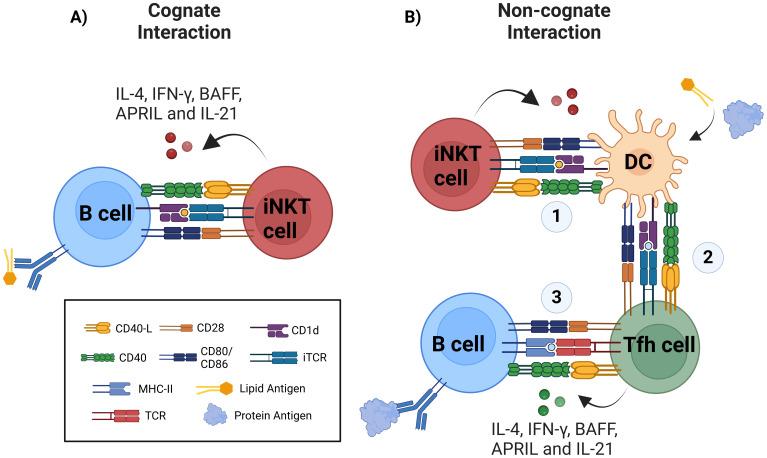
Invariant Natural Killer T (NKT) cells represent a unique subset of innate-like T cells that express both NK cell and T cell receptors. These cells are rapidly activated by glycolipid antigens presented via CD1d molecules on antigen-presenting cells (APCs), including B cells, dendritic cells (DCs), and macrophages, or through cytokine-dependent mechanisms. Their ability to produce a wide range of cytokines and express costimulatory molecules underscores their critical role in bridging innate and adaptive immunity. B cells, traditionally recognized for their role in antibody production, also act as potent APCs due to their high expression of CD1d, enabling direct interactions with iNKT cells. This interaction has significant implications for humoral immunity, influencing B cell activation, class-switch recombination (CSR), germinal center formation, and memory B cell differentiation, thus expanding the conventional paradigm of T cell-B cell interactions. While the influence of iNKT cells on B cell biology and humoral responses is well-supported, many aspects of their interaction remain unresolved. Key questions include the roles of different iNKT cell subsets, the diversity of APCs, the spatiotemporal dynamics of these interactions, especially during early activation, and the potential for distinct glycolipid ligands to modulate immune outcomes. Understanding these factors could provide valuable insights into how iNKT cells regulate B cell-mediated immunity and offer opportunities to harness these interactions in immunotherapeutic applications, such as vaccine development. In this review, we examine these unresolved aspects and propose a novel perspective on the regulatory potential of iNKT cells in humoral immunity, emphasizing their promise as a target for innovative vaccine strategies.
不变自然杀伤T(NKT)细胞是一类独特的固有样T细胞亚群,同时表达自然杀伤(NK)细胞受体和T细胞受体。这些细胞可被抗原呈递细胞(APC)(包括B细胞、树突状细胞(DC)和巨噬细胞)表面通过CD1d分子呈递的糖脂抗原迅速激活,也可通过细胞因子依赖机制激活。它们产生多种细胞因子和表达共刺激分子的能力突出了其在连接固有免疫和适应性免疫中的关键作用。B细胞传统上因在抗体产生中的作用而被认可,由于其高表达CD1d,也可作为有效的抗原呈递细胞,能够与iNKT细胞直接相互作用。这种相互作用对体液免疫有重要影响,影响B细胞激活、类别转换重组(CSR)、生发中心形成和记忆B细胞分化,从而扩展了T细胞 - B细胞相互作用的传统模式。虽然iNKT细胞对B细胞生物学和体液反应的影响有充分支持,但它们相互作用的许多方面仍未解决。关键问题包括不同iNKT细胞亚群的作用、抗原呈递细胞的多样性、这些相互作用的时空动态,尤其是在早期激活期间,以及不同糖脂配体调节免疫结果的潜力。了解这些因素可为iNKT细胞如何调节B细胞介导的免疫提供有价值的见解,并为在免疫治疗应用(如疫苗开发)中利用这些相互作用提供机会。在本综述中,我们研究了这些未解决的方面,并提出了关于iNKT细胞在体液免疫中的调节潜力的新观点,强调它们作为创新疫苗策略靶点的前景。


 Zotero 插件