
邻苯二甲酸二异癸酯内分泌干扰潜力评估
Evaluation of the endocrine disrupting potential of Di-isodecyl phthalate.
作者信息
Lea I A, Feifarek D, Mihalchik A, Heintz M, Haws L, Nyambego H, Goyak K, Palermo C, Borghoff S J
机构信息
ToxStrategies LLC, 31 College Place Suite B118, Asheville, NC 28801, USA.
ExxonMobil Biomedical Sciences, Inc., Health and Environmental Sciences Division, Annandale, NJ, USA.
出版信息
Curr Res Toxicol. 2025 Feb 2;8:100221. doi: 10.1016/j.crtox.2025.100221. eCollection 2025.
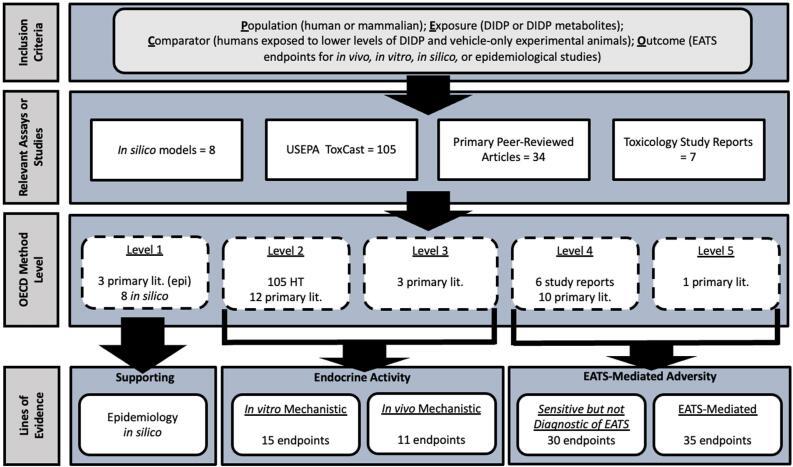
Low molecular weight -phthalates have been implicated in perturbing androgen pathways when administered during the masculinization programming window. Di-isodecyl phthalate (DIDP) is a high molecular weight phthalate and as a high production volume chemical, its ability to disrupt endocrine pathways is important to understand its potential hazard. Both DIDP (and its metabolites) were evaluated to determine the potential to perturb endocrine pathways through a weight of evidence (WoE) assessment in accordance with the European Chemicals Agency (ECHA)/European Food Safety Authority (EFSA) Endocrine Disruptor Guidance (2018). A literature review was performed of toxicological data for DIDP related to estrogen, androgen, thyroid, or steroidogenesis pathways. Literature searches returned 41 relevant articles from which data were extracted and assessed in conjunction with data from 105 high-throughput assays. Because some of the assays lack metabolic capabilities, an assessment of estrogen (E), androgen (A), thyroid (T) or steroidogenesis (S) activity was conducted. Based on the available evidence for the T pathway, DIDP did not elicit adverse thyroid outcomes . When considering the T mechanistic data, there was evidence that DIDP induced the liver pregnane X receptor (PXR) and some indication that DIDP increased iodide uptake in the thyroid. As there were no studies evaluating thyroid hormone levels , a data gap was identified because per the ECHA/EFSA guidance, the lack of this information prevents drawing a conclusion on the T pathway. However, the E, A and S pathways were sufficiently assessed to conclude a limited or lack of E, A or S related apical outcomes in studies; there was also a lack of endocrine activity in or mechanistic studies. These results suggest that DIDP does not meet the ECHA/EFSA criteria for an endocrine disruptor, therefore DIDP is unlikely to disrupt the androgen pathway during development.
低分子量邻苯二甲酸盐在雄性化编程窗口期给药时,被认为会干扰雄激素途径。邻苯二甲酸二异癸酯(DIDP)是一种高分子量邻苯二甲酸盐,作为一种高产量化学品,了解其破坏内分泌途径的能力对于评估其潜在危害很重要。根据欧洲化学品管理局(ECHA)/欧洲食品安全局(EFSA)内分泌干扰物指南(2018年),通过证据权重(WoE)评估对DIDP(及其代谢物)进行了评估,以确定其干扰内分泌途径的可能性。对与雌激素、雄激素、甲状腺或类固醇生成途径相关的DIDP毒理学数据进行了文献综述。文献检索返回了41篇相关文章,从中提取数据并与105项高通量试验的数据一起进行评估。由于部分试验缺乏代谢能力,因此对雌激素(E)、雄激素(A)、甲状腺(T)或类固醇生成(S)活性进行了评估。基于T途径的现有证据,DIDP未引发不良甲状腺结果。在考虑T机制数据时,有证据表明DIDP诱导肝脏孕烷X受体(PXR),并有迹象表明DIDP增加甲状腺对碘的摄取。由于没有研究评估甲状腺激素水平,因此确定存在数据缺口,因为根据ECHA/EFSA指南,缺乏该信息妨碍对T途径得出结论。然而,对E、A和S途径进行了充分评估,得出研究中与E、A或S相关的顶端结果有限或缺乏的结论;在体外或体内机制研究中也缺乏内分泌活性。这些结果表明,DIDP不符合ECHA/EFSA内分泌干扰物标准,因此DIDP在发育过程中不太可能干扰雄激素途径。


 Zotero 插件