
对嗜水气单胞菌生物膜的靶向洞察:表面偏好、抗性机制和基因表达。
Targeted insights into Aeromonas hydrophila biofilms: Surface preferences, resistance mechanisms, and gene expression.
作者信息
Rahman Md Ashikur, Akter Shirin, Ashrafudoulla Md, Rapak Meidistria Tandi, Lee Kyung Ok, Ha Sang-Do
机构信息
Food Safety and Regulatory Science, Chung-Ang University, Anseong-Si, Republic of Korea; GreenTech-based Food Safety Research Group, BK21 Four, Chung-Ang University, 4726 Seodong-daero, Anseong, Gyeonggido 17546, Republic of Korea; Bangladesh Fisheries Research Institute, Mymensingh 2201, Bangladesh.
Food Safety and Regulatory Science, Chung-Ang University, Anseong-Si, Republic of Korea; GreenTech-based Food Safety Research Group, BK21 Four, Chung-Ang University, 4726 Seodong-daero, Anseong, Gyeonggido 17546, Republic of Korea; Department of Fisheries and Marine Bioscience, Bangabandhu Sheikh Mujibur Rahman Science and Technology University, Gopalganj 8100, Bangladesh.
出版信息
Poult Sci. 2025 Apr;104(4):104851. doi: 10.1016/j.psj.2025.104851. Epub 2025 Jan 25.
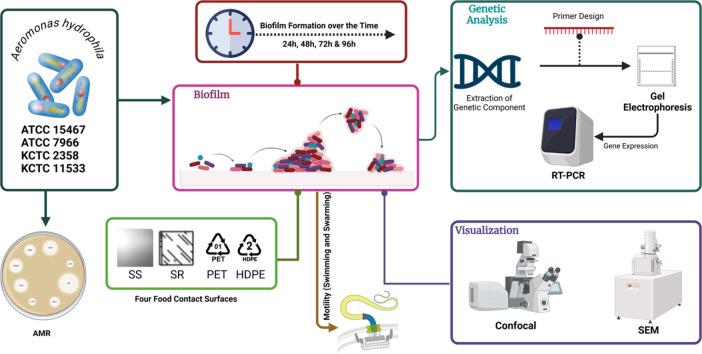
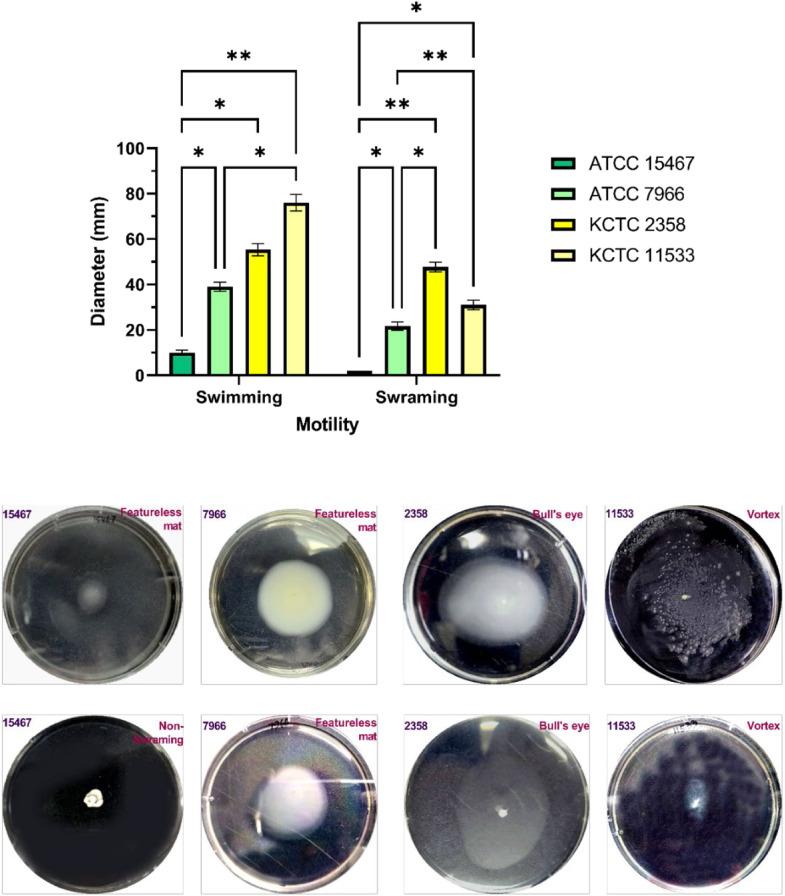
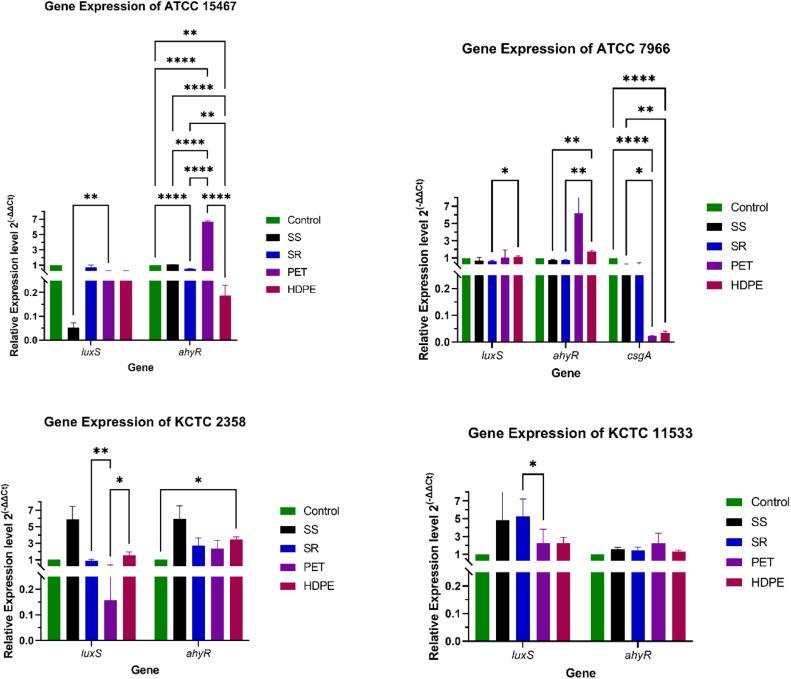
This study provides a comprehensive analysis of biofilm formation, antibiotic resistance, motility, and gene expression in four Aeromonas hydrophila strains-ATCC 15467, ATCC 7966, KCTC 2358, and KCTC 11533-on stainless steel (SS), silicon rubber (SR), polyethylene terephthalate (PET), and high-density polyethylene (HDPE) surfaces over 24, 48, 72, and 96 h. Biofilm formation peaked at 72 h, with ATCC 7966 demonstrating the highest biofilm density on PET (6.50 ± 0.08 log CFU/cm²), underscoring PET's role as a favorable substrate for biofilm development. In contrast, HDPE consistently exhibited the lowest biofilm levels, reflecting its potential as a biofilm-resistant material. Antibiotic susceptibility profiling revealed multidrug resistance (MDR) in ATCC 15467 and KCTC 11533 (MARI = 0.80), particularly against beta-lactams, aminoglycosides, and fluoroquinolones while ATCC 7966 and KCTC 2358 displayed moderate resistance. Motility assays highlighted strain-specific capabilities, with KCTC 11533 exhibiting the highest swimming motility (76.0 ± 6.6 mm) and KCTC 2358 excelling in swarming (47.7 ± 3.5 mm). Genetic analysis confirmed the presence of luxS and ahyR in all strains, while csgA was exclusive to ATCC 7966, correlating with its superior biofilm formation. Confocal microscopy revealed biofilm maturation dynamics, with red fluorescence indicating cell death and aging at 96 h, while SEM images captured intricate surface-specific biofilm architectures. These findings elucidate the critical interplay between strain characteristics, surface properties, and incubation time, providing a foundation for developing targeted strategies to control A. hydrophila biofilms in food processing environments.
本研究全面分析了四种嗜水气单胞菌菌株(ATCC 15467、ATCC 7966、KCTC 2358和KCTC 11533)在不锈钢(SS)、硅橡胶(SR)、聚对苯二甲酸乙二酯(PET)和高密度聚乙烯(HDPE)表面上24、48、72和96小时内的生物膜形成、抗生素抗性、运动性和基因表达情况。生物膜形成在72小时达到峰值,ATCC 7966在PET上表现出最高的生物膜密度(6.50±0.08 log CFU/cm²),突出了PET作为生物膜发育有利基质的作用。相比之下,HDPE始终表现出最低的生物膜水平,反映出其作为抗生物膜材料的潜力。抗生素敏感性分析显示ATCC 15467和KCTC 11533存在多重耐药性(MDR,MARI = 0.80),特别是对β-内酰胺类、氨基糖苷类和氟喹诺酮类药物,而ATCC 7966和KCTC 2358表现出中度耐药性。运动性测定突出了菌株特异性能力,KCTC 11533表现出最高的游泳运动性(76.0±6.6毫米),KCTC 2358在群游方面表现出色(47.7±3.5毫米)。基因分析证实所有菌株中都存在luxS和ahyR,而csgA仅存在于ATCC 7966中,这与其卓越的生物膜形成相关。共聚焦显微镜揭示了生物膜成熟动态,红色荧光表明在96小时时细胞死亡和老化,而扫描电子显微镜图像捕捉到了复杂的表面特异性生物膜结构。这些发现阐明了菌株特征、表面性质和培养时间之间的关键相互作用,为制定针对性策略以控制食品加工环境中的嗜水气单胞菌生物膜提供了基础。



 Zotero 插件