
成年人心脏代谢指数与生物衰老之间的关联:一项基于人群的研究。
Association between cardiometabolic index and biological ageing among adults: a population-based study.
作者信息
Liu Na, Peng Shanshan, Wei Kai, Chen Qiudan, Chen Xiaotong, He Leqi, Wu Biying, Lin Yong
机构信息
Department of Laboratory Medicine, Huashan Hospital, Fudan University, Shanghai, China.
Department of Forensic Medicine and Laboratory Medicine, Jining Medical University, Jining, China.
出版信息
BMC Public Health. 2025 Mar 5;25(1):879. doi: 10.1186/s12889-025-22053-3.
BACKGROUND
Cardiovascular health (CVH) is closely associated with ageing. This study aimed to investigate the association between cardiometabolic index (CMI), a novel indicator of cardiometabolic status, and biological ageing.
METHODS
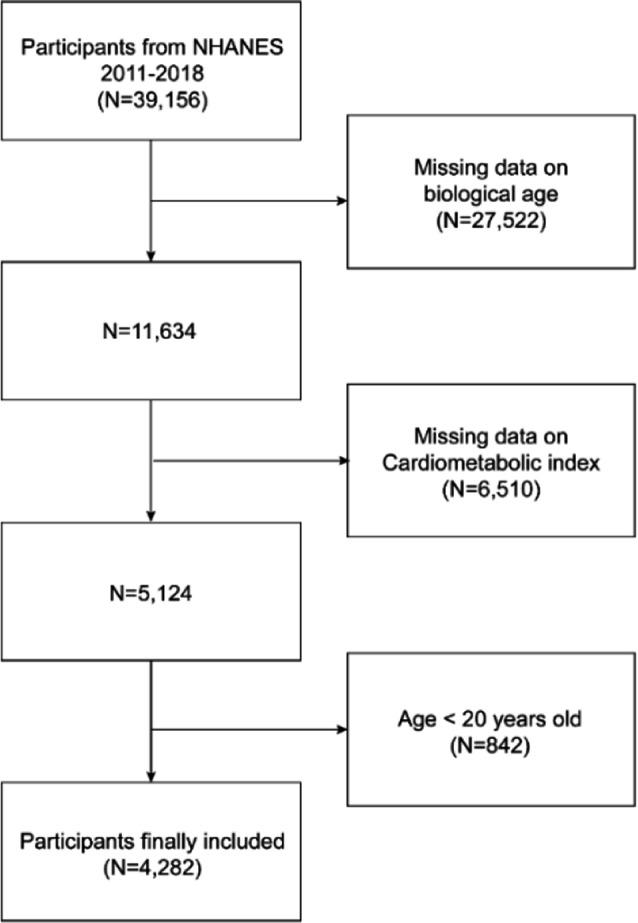
Cross-sectional data were obtained from participants with comprehensive CMI and biological age data in the National Health and Nutrition Examination Survey from 2011 to 2018. Biological age acceleration (BioAgeAccel) is calculated as the differences between biological age and chronological age, and that biological age is derived from a model incorporating eight biomarkers. Weighted multivariable regression, sensitivity analysis, and smoothing curve fitting were performed to explore the independent association between CMI and the acceleration of biological age. Subgroup and interaction analyses were performed to investigate whether this association was consistent across populations.
RESULTS
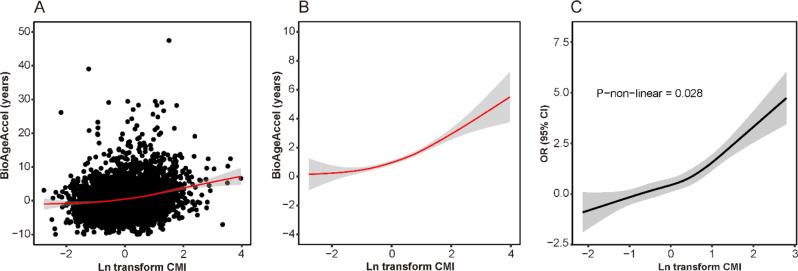
In 4282 subjects ≥ 20 years of age, there was a positive relationship between CMI and biological age. The BioAgeAccel increased 1.16 years for each unit CMI increase [1.16 (1.02, 1.31)], and increased 0.99 years for per SD increase in CMI [0.99 (0.87, 1.11)]. Participants in the highest CMI quartile had a BioAgeAccel that was 2.49 years higher than participants in the lowest CMI quartile [2.49 (2.15, 2.83)]. In stratified studies, the positive correlation between CMI and biological age acceleration was not consistent across strata. This positive correlation was stronger in female, diabetes, and non-hypertension populations.
CONCLUSIONS
CMI is positively correlated with biological ageing in adults in the United States. Prospective studies with larger sample sizes are required to validate our findings.
背景
心血管健康(CVH)与衰老密切相关。本研究旨在调查心脏代谢指数(CMI)这一心脏代谢状态的新指标与生物学衰老之间的关联。
方法
横断面数据来自2011年至2018年美国国家健康与营养检查调查中具有全面CMI和生物学年龄数据的参与者。生物学年龄加速(BioAgeAccel)计算为生物学年龄与实际年龄之差,且生物学年龄由包含八个生物标志物的模型得出。进行加权多变量回归、敏感性分析和平滑曲线拟合,以探索CMI与生物学年龄加速之间的独立关联。进行亚组和交互分析,以调查这种关联在不同人群中是否一致。
结果
在4282名年龄≥20岁的受试者中,CMI与生物学年龄之间存在正相关关系。CMI每增加一个单位,BioAgeAccel增加1.16岁[1.16(1.02,1.31)],CMI每增加一个标准差,BioAgeAccel增加0.99岁[0.99(0.87,1.11)]。CMI最高四分位数的参与者的BioAgeAccel比CMI最低四分位数的参与者高2.49岁[2.49(2.15,2.83)]。在分层研究中,CMI与生物学年龄加速之间的正相关在各层中不一致。这种正相关在女性、糖尿病和非高血压人群中更强。
结论
在美国成年人中,CMI与生物学衰老呈正相关。需要更大样本量的前瞻性研究来验证我们的发现。
 Zotero 插件