
三阳性乳腺癌:应对异质性并推进多模式疗法以改善患者预后。
Triple-positive breast cancer: navigating heterogeneity and advancing multimodal therapies for improving patient outcomes.
作者信息
Xie Jie, Yang Zhihui, Li Zhuolin, Zhang Tianyu, Chen Huan, Chen Xueru, Dai Zehua, Chen Tao, Hou Jing
机构信息
GuiZhou University Medical College, Guiyang, 550025, Guizhou Province, China.
Zunyi Medical University, No.6 Xuefu West Road, Zunyi, 563006, Guizhou Province, China.
出版信息
Cancer Cell Int. 2025 Mar 5;25(1):77. doi: 10.1186/s12935-025-03680-7.
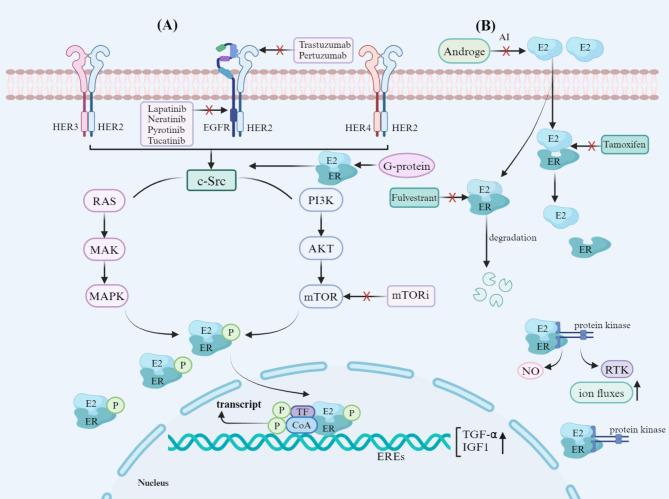
Triple-positive breast cancer (TPBC), a unique subtype of luminal breast cancer, is characterized by concurrent positivity for estrogen receptor (ER), progesterone receptor (PR), and human epidermal growth factor receptor 2 (HER2). Owing to the crosstalk between the ER and HER2 signaling pathways, the standard of care and drug resistance of this particular subtype are difficult challenges. Recent research and clinical trials have indicated a shift in the treatment paradigm for TPBC from single-target therapies to multi-pathway, multitarget strategies aiming to comprehensively modulate intricate signaling networks, thereby overcoming resistance and enhancing therapeutic outcomes. Among multiple strategies, triple-drug therapy has emerged as a promising treatment modality, demonstrating potential efficacy in patients with TPBC. Moving forward, there is a critical need to perform in-depth analyses of specific mechanisms of cancer pathogenesis and metastasis, decipher the complex interactions between different genes or proteins, and identify concrete molecular targets, thus paving the way for the development of tailored therapeutic strategies to combat TPBC effectively.
三阳性乳腺癌(TPBC)是一种独特的管腔型乳腺癌亚型,其特征为雌激素受体(ER)、孕激素受体(PR)和人表皮生长因子受体2(HER2)同时呈阳性。由于ER和HER2信号通路之间的相互作用,这种特殊亚型的治疗标准和耐药性是艰巨的挑战。最近的研究和临床试验表明,TPBC的治疗模式已从单靶点治疗转向多途径、多靶点策略,旨在全面调节复杂的信号网络,从而克服耐药性并提高治疗效果。在多种策略中,三联药物治疗已成为一种有前景的治疗方式,在TPBC患者中显示出潜在疗效。展望未来,迫切需要对癌症发病机制和转移的具体机制进行深入分析,解读不同基因或蛋白质之间的复杂相互作用,并确定具体的分子靶点,从而为有效对抗TPBC的定制治疗策略的开发铺平道路。
 Zotero 插件