
转录因子ClWRKY61与ClLEA55相互作用以增强西瓜的耐盐性。
The transcription factor ClWRKY61 interacts with ClLEA55 to enhance salt tolerance in watermelon.
作者信息
Lan Guangpu, Xuan Changqing, Guo Yidong, Huang Xin, Feng Mengjiao, Yuan Li, Li Hao, Ma Jianxiang, Zhang Yong, Wang Zhongyuan, Yang Jianqiang, Yu Rong, Luan Feishi, Zhang Xian, Wei Chunhua
机构信息
State Key Laboratory of Crop Stress Biology for Arid Areas, College of Horticulture, Northwest A&F University, Yangling 712100, Shaanxi, China.
Institute of Horticultural Research, Ningxia Academy of Agriculture and Forestry Sciences, Yinchuan 750002, Ningxia, China.
出版信息
Hortic Res. 2024 Nov 11;12(3):uhae320. doi: 10.1093/hr/uhae320. eCollection 2025 Mar.
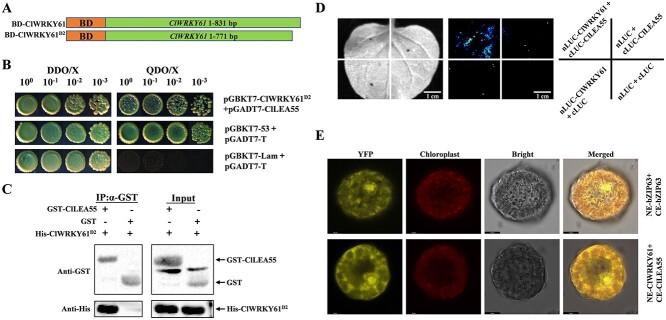
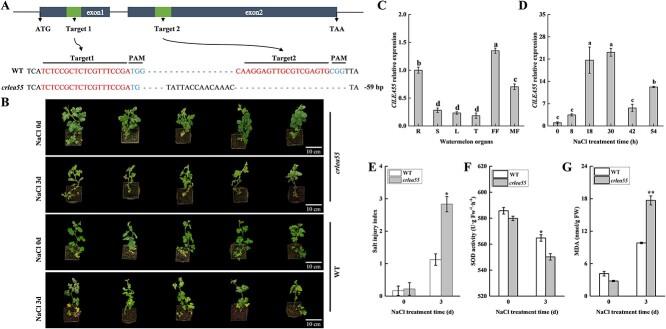
High salinity can severely inhibit the growth and development of watermelon ( L.). WRKY proteins are believed to mediate the adaptation of plants to abiotic stresses. Here, we identified the gene, which positively regulates the tolerance of watermelon to salt stress. Knockout of the reduced salt tolerance, while overexpression of the enhanced salt tolerance in watermelon according to phenotypic and physiological analyses. Yeast two-hybrid assays revealed that ClWRKY61 interacts with the ClLEA55 protein, and this interaction was further confirmed by luciferase complementation imaging, transient bimolecular fluorescence complementation, and GST pull-down assays. Knockout of the resulted in lower salt tolerance compared to the wild-type plants. RNA-seq analysis indicated 421 up-regulated and 133 down-regulated genes in the knockout line under salt stress, containing 293 differentially expressed genes with W-box in their promoters. Thirteen genes encoding phytoene synthase, MYB transcription factor, sucrose synthase, alpha/beta-hydrolases superfamily protein, glutathione reductase, sugar transporter, LEA protein, WRKY transcription factor, ERF transcription factor, alpha-glucan water dikinase, and calcium-dependent protein kinase showed transcriptional changes in knockout line, overexpression line, and knockout line under salt stress. These results provide an opportunity to mediate the regulation of salt stress in watermelon with WRKY proteins.
高盐度会严重抑制西瓜(Citrullus lanatus (Thunb.) Matsum. & Nakai)的生长发育。WRKY蛋白被认为介导植物对非生物胁迫的适应性。在此,我们鉴定了ClWRKY61基因,其正向调控西瓜对盐胁迫的耐受性。根据表型和生理分析,敲除ClWRKY61降低了耐盐性,而在西瓜中过表达ClWRKY61增强了耐盐性。酵母双杂交试验表明ClWRKY61与ClLEA55蛋白相互作用,荧光素酶互补成像、瞬时双分子荧光互补和GST下拉试验进一步证实了这种相互作用。与野生型植株相比,敲除ClWRKY61导致耐盐性降低。RNA测序分析表明,在盐胁迫下,ClWRKY61敲除系中有421个基因上调,133个基因下调,其中293个差异表达基因的启动子中含有W-box。13个编码八氢番茄红素合成酶、MYB转录因子、蔗糖合成酶、α/β-水解酶超家族蛋白、谷胱甘肽还原酶、糖转运蛋白、胚胎发育晚期丰富蛋白、WRKY转录因子、ERF转录因子、α-葡聚糖水二激酶和钙依赖性蛋白激酶的基因在ClWRKY61敲除系、ClWRKY61过表达系和野生型植株盐胁迫下表现出转录变化。这些结果为利用WRKY蛋白介导西瓜盐胁迫调控提供了契机。



 Zotero 插件