
健康女性和孕妇的微生物群结构以及阴道生态失调在自然流产中的重要性。
Microbiome structure in healthy and pregnant women and importance of vaginal dysbiosis in spontaneous abortion.
作者信息
Eslami Majid, Naderian Ramtin, Ahmadpour Ariyan, Shushtari Ali, Maleki Sahar, Mohammadian Parham, Amiri Arvin, Janbazi Maryam, Memarian Mohammad, Yousefi Bahman
机构信息
Department of Bacteriology and Virology, Semnan University of Medical Sciences, Semnan, Iran.
Health Policy Research Center, Institute of Health, Shiraz University of Medical Sciences, Shiraz, Iran.
出版信息
Front Cell Infect Microbiol. 2025 Feb 17;14:1401610. doi: 10.3389/fcimb.2024.1401610. eCollection 2024.
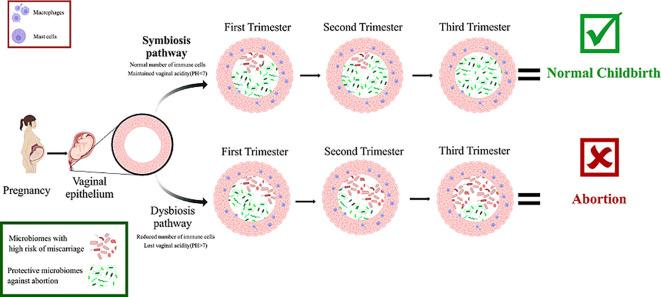
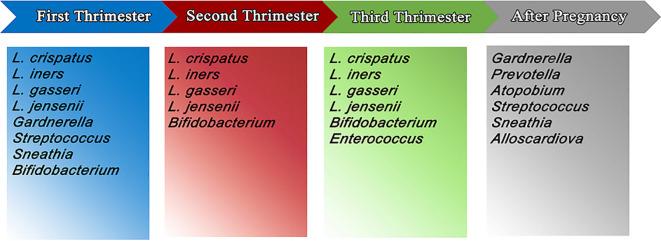
The vaginal microbiome of healthy women is dominated by spp. A variety of illnesses, such as vaginosis, sexually transmitted infections (STIs), failed implantation, premature birth (PTB), and preterm pre-labor membrane rupture, are brought on by an unbalanced microbiota. Pregnancy is associated with a decrease in the metabolic capacity of the vaginal resident microbiome, which is consistent with a change to a less complex -dominated microbiome. Age, race, sexual intercourse, smoking, IUD, contraception, lifestyle, and diet all affect the makeup of the vaginal microbiome. Moreover, physiological events including menarche, the menstrual cycle, pregnancy, menopause, and other hormonal changes have an impact on the vaginal microbiome. The vaginal microbiome is significantly disrupted by the menstrual cycle, with significant changes toward a more varied microbiota occurring around menstruation. Several major factors maintain or disrupt the vaginal microbiome including ethnic group, menstruation cycle, and pregnancy which are discussed in this section. In the index pregnancy, the vaginal microbiota of women who had already given birth, or had just experienced an induced or spontaneous abortion, was qualitatively and quantitatively different from that of women who were having their first child. Early pregnancy vaginal microbiome depletion is a risk factor for early pregnancy miscarriage. Although, early pregnancy miscarriage is not always caused by a high bacterial diversity and quantity of . protects against pathogens through the production of antibacterial compounds such as lactic acid and bacteriocins.
健康女性的阴道微生物群以[具体菌种]为主。多种疾病,如细菌性阴道病、性传播感染(STIs)、着床失败、早产(PTB)和胎膜早破,都是由微生物群失衡引起的。怀孕与阴道常驻微生物群代谢能力的下降有关,这与向以不太复杂的[具体菌种]为主的微生物群的转变是一致的。年龄、种族、性交、吸烟、宫内节育器、避孕、生活方式和饮食都会影响阴道微生物群的组成。此外,包括初潮、月经周期、怀孕、更年期和其他激素变化在内的生理事件都会对阴道微生物群产生影响。月经周期会显著破坏阴道微生物群,在月经期间会朝着更多样化的微生物群发生显著变化。几个主要因素维持或破坏阴道微生物群,包括种族、月经周期和怀孕,本节将对此进行讨论。在本次妊娠中,已生育或刚刚经历人工流产或自然流产的女性的阴道微生物群在质量和数量上与初产妇不同。妊娠早期阴道微生物群耗竭是早期妊娠流产的一个危险因素。虽然,早期妊娠流产并不总是由[具体菌种]的高细菌多样性和数量引起的。[具体菌种]通过产生抗菌化合物如乳酸和细菌素抵御病原体。

 Zotero 插件