
1990年至2021年全球、区域和国家成人超重和肥胖患病率及到2050年的预测:全球疾病负担研究2021的一项预测研究
Global, regional, and national prevalence of adult overweight and obesity, 1990-2021, with forecasts to 2050: a forecasting study for the Global Burden of Disease Study 2021.
出版信息
Lancet. 2025 Mar 8;405(10481):813-838. doi: 10.1016/S0140-6736(25)00355-1. Epub 2025 Mar 3.
BACKGROUND
Overweight and obesity is a global epidemic. Forecasting future trajectories of the epidemic is crucial for providing an evidence base for policy change. In this study, we examine the historical trends of the global, regional, and national prevalence of adult overweight and obesity from 1990 to 2021 and forecast the future trajectories to 2050.
METHODS
Leveraging established methodology from the Global Burden of Diseases, Injuries, and Risk Factors Study, we estimated the prevalence of overweight and obesity among individuals aged 25 years and older by age and sex for 204 countries and territories from 1990 to 2050. Retrospective and current prevalence trends were derived based on both self-reported and measured anthropometric data extracted from 1350 unique sources, which include survey microdata and reports, as well as published literature. Specific adjustment was applied to correct for self-report bias. Spatiotemporal Gaussian process regression models were used to synthesise data, leveraging both spatial and temporal correlation in epidemiological trends, to optimise the comparability of results across time and geographies. To generate forecast estimates, we used forecasts of the Socio-demographic Index and temporal correlation patterns presented as annualised rate of change to inform future trajectories. We considered a reference scenario assuming the continuation of historical trends.
FINDINGS
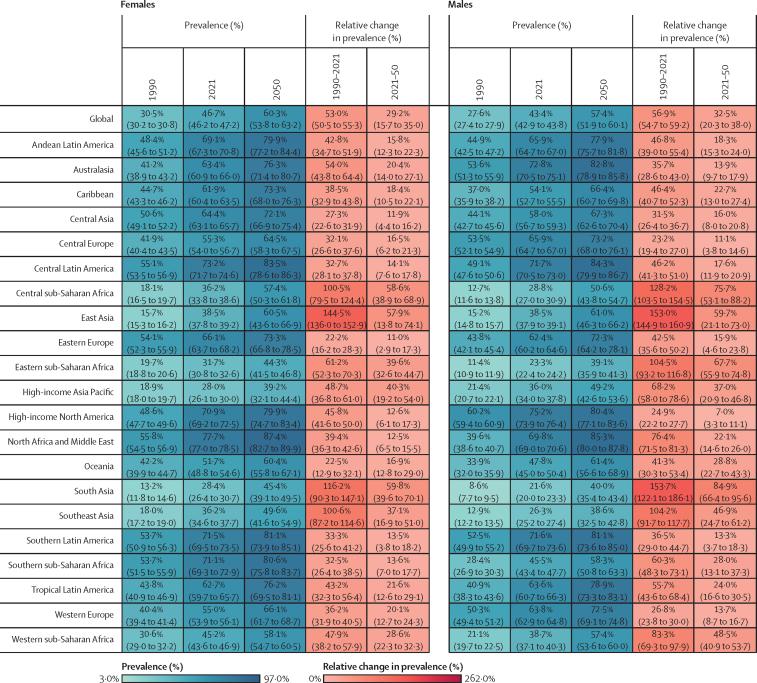
Rates of overweight and obesity increased at the global and regional levels, and in all nations, between 1990 and 2021. In 2021, an estimated 1·00 billion (95% uncertainty interval [UI] 0·989-1·01) adult males and 1·11 billion (1·10-1·12) adult females had overweight and obesity. China had the largest population of adults with overweight and obesity (402 million [397-407] individuals), followed by India (180 million [167-194]) and the USA (172 million [169-174]). The highest age-standardised prevalence of overweight and obesity was observed in countries in Oceania and north Africa and the Middle East, with many of these countries reporting prevalence of more than 80% in adults. Compared with 1990, the global prevalence of obesity had increased by 155·1% (149·8-160·3) in males and 104·9% (95% UI 100·9-108·8) in females. The most rapid rise in obesity prevalence was observed in the north Africa and the Middle East super-region, where age-standardised prevalence rates in males more than tripled and in females more than doubled. Assuming the continuation of historical trends, by 2050, we forecast that the total number of adults living with overweight and obesity will reach 3·80 billion (95% UI 3·39-4·04), over half of the likely global adult population at that time. While China, India, and the USA will continue to constitute a large proportion of the global population with overweight and obesity, the number in the sub-Saharan Africa super-region is forecasted to increase by 254·8% (234·4-269·5). In Nigeria specifically, the number of adults with overweight and obesity is forecasted to rise to 141 million (121-162) by 2050, making it the country with the fourth-largest population with overweight and obesity.
INTERPRETATION
No country to date has successfully curbed the rising rates of adult overweight and obesity. Without immediate and effective intervention, overweight and obesity will continue to increase globally. Particularly in Asia and Africa, driven by growing populations, the number of individuals with overweight and obesity is forecast to rise substantially. These regions will face a considerable increase in obesity-related disease burden. Merely acknowledging obesity as a global health issue would be negligent on the part of global health and public health practitioners; more aggressive and targeted measures are required to address this crisis, as obesity is one of the foremost avertible risks to health now and in the future and poses an unparalleled threat of premature disease and death at local, national, and global levels.
FUNDING
Bill & Melinda Gates Foundation.
背景
超重和肥胖是一种全球流行病。预测该流行病未来的发展轨迹对于为政策变革提供证据基础至关重要。在本研究中,我们考察了1990年至2021年全球、区域和国家层面成人超重和肥胖患病率的历史趋势,并预测了到2050年的未来发展轨迹。
方法
利用全球疾病、伤害及风险因素负担研究中的既定方法,我们估计了1990年至2050年204个国家和地区25岁及以上人群按年龄和性别的超重和肥胖患病率。回顾性和当前患病率趋势是根据从1350个独特来源提取的自我报告和测量的人体测量数据得出的,这些来源包括调查微观数据和报告以及已发表的文献。应用了特定调整以校正自我报告偏差。时空高斯过程回归模型用于综合数据,利用流行病学趋势中的空间和时间相关性,以优化不同时间和地域结果的可比性。为了生成预测估计值,我们使用了社会人口指数预测以及以年化变化率表示的时间相关模式来为未来轨迹提供信息。我们考虑了一个假设历史趋势持续的参考情景。
结果
1990年至2021年期间,全球、区域及所有国家的超重和肥胖率均有所上升。2021年,估计有10.0亿(95%不确定区间[UI]0.989 - 1.01)成年男性和11.1亿(1.10 - 1.12)成年女性超重和肥胖。中国超重和肥胖的成年人口最多(4.02亿[3.97 - 4.07]人),其次是印度(1.80亿[1.67 - 1.94])和美国(1.72亿[1.69 - 1.74])。超重和肥胖年龄标准化患病率最高的是大洋洲以及北非和中东地区的国家,其中许多国家报告成年人患病率超过80%。与1990年相比,全球男性肥胖患病率增加了155.1%(149.8 - 160.3),女性增加了104.9%(95% UI 100.9 - 108.8)。肥胖患病率上升最快的是北非和中东超级地区,该地区男性年龄标准化患病率增长了两倍多,女性增长了一倍多。假设历史趋势持续,到2050年,我们预测超重和肥胖的成年人口总数将达到38.0亿(95% UI 33.9 - 40.4),超过届时全球成年人口的一半。虽然中国、印度和美国仍将在全球超重和肥胖人口中占很大比例,但撒哈拉以南非洲超级地区的人数预计将增加254.8%(234.4 - 269.5)。特别是在尼日利亚,预计到2050年超重和肥胖的成年人口将增至1.41亿(1.21 - 1.62),使其成为超重和肥胖人口第四多的国家。
解读
迄今为止,没有一个国家成功遏制成年超重和肥胖率的上升。如果不立即采取有效干预措施,超重和肥胖将在全球继续增加。特别是在亚洲和非洲,受人口增长推动,超重和肥胖人数预计将大幅上升。这些地区将面临与肥胖相关疾病负担的大幅增加。全球卫生和公共卫生从业者仅仅将肥胖视为一个全球健康问题是失职的;需要采取更积极、更有针对性的措施来应对这一危机,因为肥胖是当前和未来健康的首要可避免风险之一,在地方、国家和全球层面都构成了前所未有的过早患病和死亡威胁。
资助
比尔及梅琳达·盖茨基金会




 Zotero 插件