
快餐广告曝光期间全脑连接组特征可预测两年后的体重指数。
Connectome-wide brain signature during fast-food advertisement exposure predicts BMI at 2 years.
作者信息
Papantoni Afroditi, Gearhardt Ashley N, Yokum Sonja, Hoover Lindzey V, Finn Emily S, Shearrer Grace E, Smith Taillie Lindsey, Shaikh Saame Raza, Meyer Katie A, Burger Kyle S
机构信息
Department of Nutrition, Gillings School of Global Public Health, University of North Carolina at Chapel Hill, Chapel Hill, NC 27599, United States.
Monell Chemical Senses Center, Philadelphia, PA 19104, United States.
出版信息
Soc Cogn Affect Neurosci. 2025 Mar 10;20(1). doi: 10.1093/scan/nsaf018.
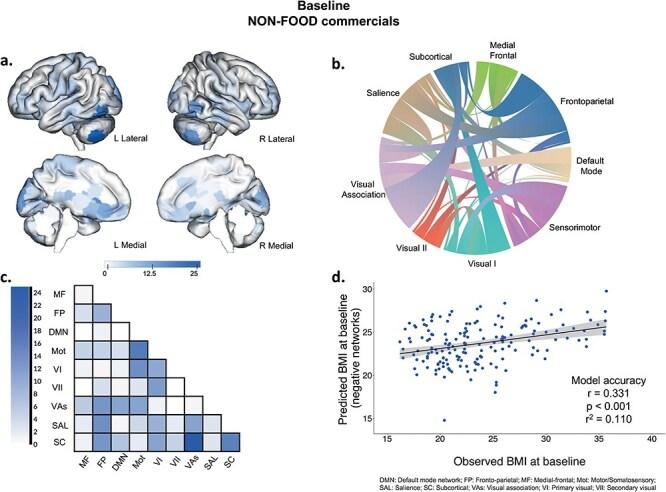
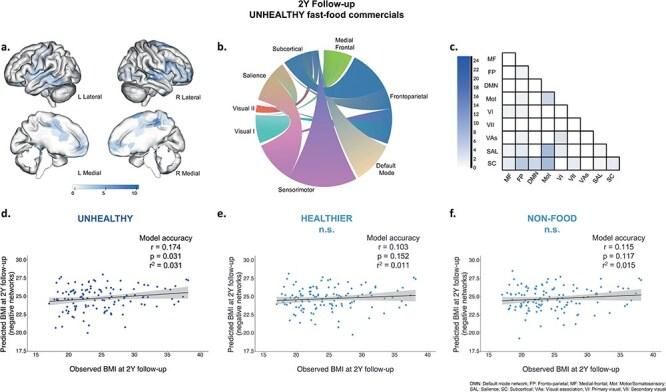
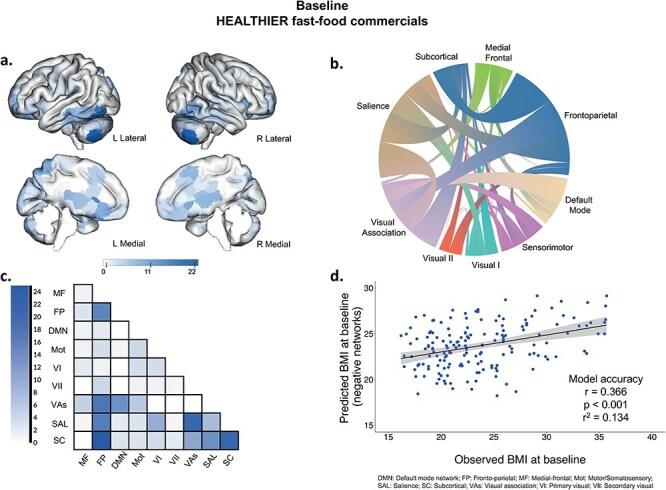
Food advertisements target adolescents, contributing to weight gain and obesity. However, whether brain connectivity during those food advertisements can predict weight gain is unknown. Here, 121 adolescents [14.1 ± 1.0 years; 50.4% female; body mass index (BMI): 23.4 ± 4.8; 71.9% White] completed both a baseline fMRI paradigm viewing advertisements (unhealthy fast food, healthier fast food, and nonfood) and an anthropometric assessment 2 years later. We used connectome-based predictive modeling to derive brain networks that were associated with BMI both at baseline and the 2-year follow-up. During exposure to unhealthy fast-food commercials, we identified a brain network comprising high-degree nodes in the hippocampus, parahippocampal gyrus, and fusiform gyrus rich with connections to prefrontal and occipital nodes that predicted lower BMI at the 2-year follow-up (r = 0.17; P = .031). A similar network was derived from baseline BMI (n = 168; r = 0.34; P < .001). Functional connectivity networks during exposure to the healthier fast food (P = .152) and nonfood commercials (P = .117) were not significant predictors of 2-year BMI. Key brain regions in our derived networks have been previously shown to encode aspects of memory formation, visual processing, and self-control. As such, the integration of these regions may reflect a mechanism of adolescents' ability to exert self-control toward obesogenic food stimuli.
食品广告以青少年为目标受众,导致体重增加和肥胖。然而,在观看这些食品广告期间大脑的连通性是否能够预测体重增加尚不清楚。在此,121名青少年[年龄14.1±1.0岁;女性占50.4%;体重指数(BMI):23.4±4.8;71.9%为白人]完成了一项基线功能磁共振成像范式,观看广告(不健康快餐、较健康快餐和非食品),并在两年后进行了人体测量评估。我们使用基于连接组的预测模型来推导在基线和两年随访时与BMI相关的大脑网络。在观看不健康快餐广告期间,我们确定了一个大脑网络,该网络由海马体、海马旁回和梭状回中的高度节点组成,这些节点与前额叶和枕叶节点有丰富的连接,该网络预测在两年随访时BMI较低(r = 0.17;P = 0.031)。一个类似的网络是从基线BMI推导出来的(n = 168;r = 0.34;P < 0.001)。在观看较健康快餐广告(P = 0.152)和非食品广告(P = 0.117)期间的功能连接网络不是两年后BMI的显著预测指标。我们推导网络中的关键脑区先前已被证明参与记忆形成、视觉处理和自我控制等方面的编码。因此,这些区域的整合可能反映了青少年对致肥胖食物刺激施加自我控制能力的一种机制。


 Zotero 插件