
黄连素和咖啡因通过抑制α-突触核蛋白聚集和促进多巴胺释放对鱼藤酮诱导的与帕金森病相关的神经炎症和氧化紊乱的神经保护作用。
Neuroprotective efficacy of berberine and caffeine against rotenone-induced neuroinflammatory and oxidative disturbances associated with Parkinson's disease via inhibiting α-synuclein aggregation and boosting dopamine release.
作者信息
Waheeb Tasnim S, Abdulkader Mohammad A, Ghareeb Doaa A, Moustafa Mohamed E
机构信息
Department of Biochemistry, Faculty of Science, Alexandria University, Alexandria, 21511, Egypt.
Bio-Screening and Preclinical Trial Lab, Biochemistry Department, Faculty of Science, Alexandria University, Alexandria, Egypt.
出版信息
Inflammopharmacology. 2025 Apr;33(4):2129-2150. doi: 10.1007/s10787-025-01661-w. Epub 2025 Mar 9.
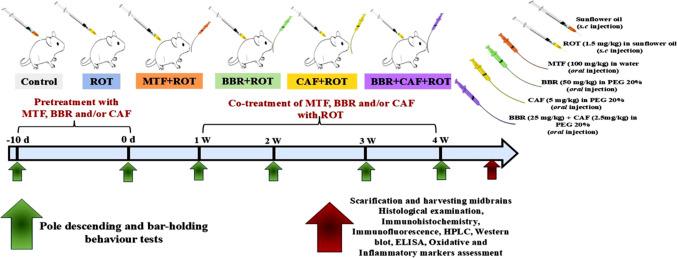
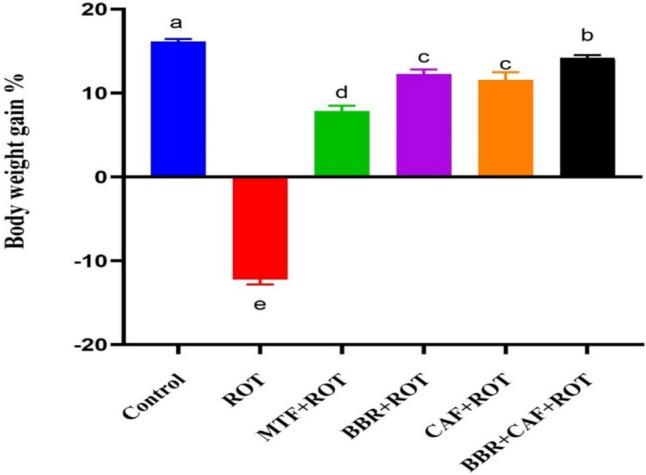
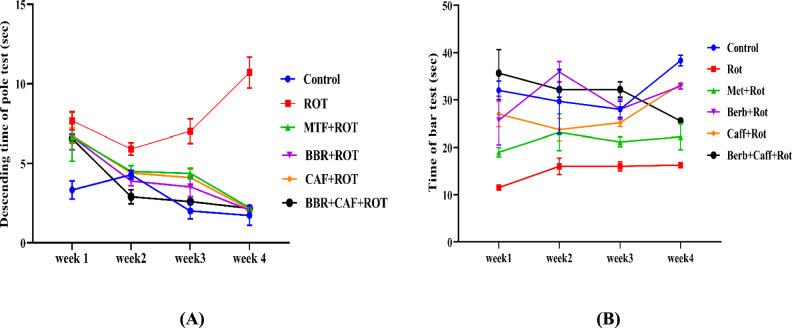
Parkinson's disease (PD) is characterized by motor impairment, glial-mediated inflammation, redox imbalance, and α-synuclein (α-syn) aggregation. Conventional therapies relieve early PD symptoms, but they do not repair dopaminergic neurons. Berberine (BBR) and caffeine (CAF), both natural alkaloids, exhibited neuroprotective effects in many neurodegenerative disorders. Consequently, we hypothesized that the combination of BBR and CAF therapies would offer protection against PD-related impairments in the rotenone (ROT)-induced rat model when compared to the commercial drug, metformin (MTF). Our results showed that the combined administration of BBR (25 mg/kg/day) and CAF (2.5 mg/kg/day) for four weeks prevented motor deficits, weight reduction, dopamine (DA) depletion, and monoamine oxidase (MAO) activity in ROT-induced rats in comparison with monotherapy of BBR and CAF along with MTF. This combination produced a notable neuroprotective effect by reducing tumor necrosis factor (TNF)-α and interleukin-16 (IL-6) in midbrain of rats. BBR and CAF combinations markedly normalized tyrosine hydroxylase (TH) levels and decreased total α-syn and α-syn-p aggregation and increased protein phosphatase 2A (PP2A) levels. Histological analysis indicated that damaged neurons exhibited significant amelioration with the co-administration of BBR and CAF. The molecular docking results indicated that both BBR and CAF had notable binding affinity for the protein pocket surrounding the α-syn, PP2A, and TH in comparison to MTF. They are predicted to serve as effective inhibitors of enzyme-mediated phosphorylation of α-syn-. Conclusively, combined BBR and CAF administration presents a novel strategy for neuroprotection by blocking the initial events in PD incidence, demonstrating considerable anti-oxidative and anti-inflammatory benefits relative to MTF.
帕金森病(PD)的特征是运动障碍、胶质细胞介导的炎症、氧化还原失衡和α-突触核蛋白(α-syn)聚集。传统疗法可缓解早期PD症状,但无法修复多巴胺能神经元。小檗碱(BBR)和咖啡因(CAF)均为天然生物碱,在许多神经退行性疾病中均表现出神经保护作用。因此,我们推测,与商业药物二甲双胍(MTF)相比,BBR和CAF联合治疗可在鱼藤酮(ROT)诱导的大鼠模型中预防与PD相关的损伤。我们的结果表明,与BBR、CAF单药治疗以及MTF相比,联合给予BBR(25 mg/kg/天)和CAF(2.5 mg/kg/天)四周可预防ROT诱导大鼠出现运动功能障碍、体重减轻、多巴胺(DA)耗竭和单胺氧化酶(MAO)活性升高。这种联合用药通过降低大鼠中脑肿瘤坏死因子(TNF)-α和白细胞介素-16(IL-6)产生了显著的神经保护作用。BBR和CAF联合用药显著使酪氨酸羟化酶(TH)水平恢复正常,降低总α-syn和α-syn-p聚集,并提高蛋白磷酸酶2A(PP2A)水平。组织学分析表明,BBR和CAF联合给药可使受损神经元明显改善。分子对接结果表明,与MTF相比,BBR和CAF对α-syn、PP2A和TH周围的蛋白口袋均具有显著的结合亲和力。预计它们可作为酶介导的α-syn磷酸化的有效抑制剂。总之,联合给予BBR和CAF通过阻断PD发病的初始事件,为神经保护提供了一种新策略,相对于MTF显示出相当大的抗氧化和抗炎益处。



 Zotero 插件