
蚯蚓共生体对环境变化的生态和进化响应。
Ecological and evolutionary responses of earthworm holobionts to environmental changes.
作者信息
Adomako Michael Opoku, Wu Jing, Yu Fei-Hai
机构信息
School of Life and Environmental Sciences, Shaoxing University, Shaoxing 312000, Zhejiang, China.
Institute of Wetland Ecology & Clone Ecology/Zhejiang Provincial Key Laboratory of Plant Evolutionary Ecology and Conservation, Taizhou University, Taizhou 318000, Zhejiang, China.
出版信息
ISME J. 2025 Jan 2;19(1). doi: 10.1093/ismejo/wraf044.
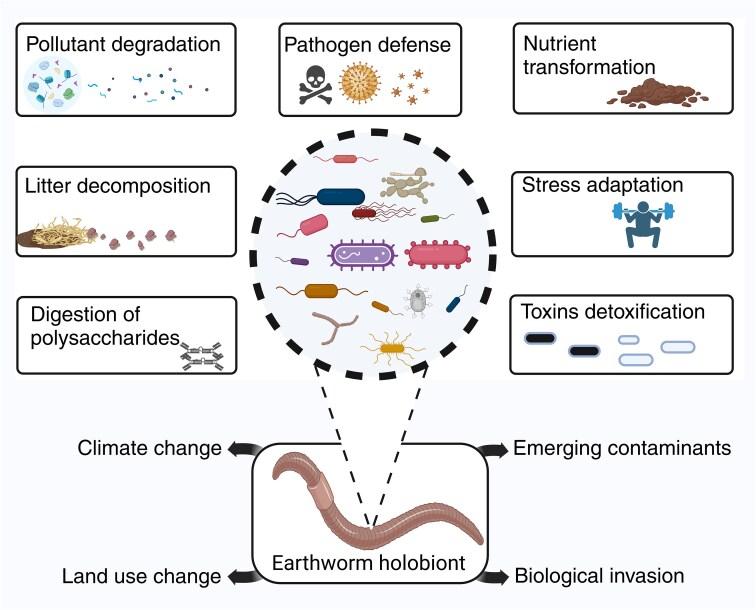
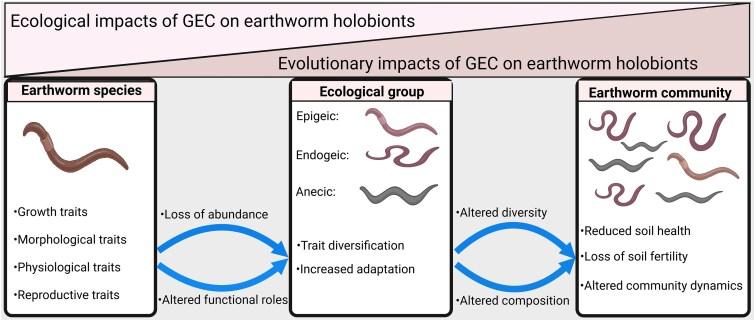
Global environmental change substantially affects soil detritivores, including earthworms, impacting host-microbiota interactions and altering key soil biogeochemical processes such as litter decomposition. As microbial communities are inherently capable of rapid evolution, responses of earthworms and associated microbiota (i.e. earthworm holobionts) to global environmental change may likely involve the interplay of ecological and evolutionary processes and feedback. Although species-level responses of earthworms to global environmental change are well studied, the potential ecological and evolutionary responses of earthworm holobionts to environmental change remain unexplored. Here, we provide a conceptual framework to elaborate on the complex network of earthworm host-microbiota interactions that modify their traits in response to global environmental change, jointly shaping their ecology and evolution. Based on the literature, we synthesize evidence of global environmental change impacts on earthworm host-microbiota and discuss evidence of their ecological and evolutionary responses to environmental change. Lastly, we highlight the agro- and eco-system-level consequences of environmental change-mediated shift in earthworm host-microbiota functions. Soil legacies of environmental change have cascading detrimental impacts on the abundance, diversity, and functional dynamics of earthworm host-microbiota interactions in agriculture and ecosystems. The primary mechanisms driving such responses of earthworm hosts and associated microbial communities to environmental change include altered litter quality and host dietary preferences, competitive interactions and exclusion, habitat homogenization, and a shift in soil physicochemical and biological processes. Therefore, advancing knowledge of the intricate animal-microorganism interactions is crucial for belowground biodiversity management in a changing global environment.
全球环境变化对包括蚯蚓在内的土壤食碎屑动物有重大影响,影响宿主与微生物群的相互作用,并改变诸如凋落物分解等关键土壤生物地球化学过程。由于微生物群落具有快速进化的内在能力,蚯蚓及其相关微生物群(即蚯蚓全生物)对全球环境变化的反应可能涉及生态和进化过程及反馈的相互作用。尽管蚯蚓对全球环境变化的物种水平反应已得到充分研究,但蚯蚓全生物对环境变化的潜在生态和进化反应仍未得到探索。在此,我们提供一个概念框架,以阐述蚯蚓宿主与微生物群相互作用的复杂网络,这些相互作用会改变它们的性状以应对全球环境变化,共同塑造它们的生态和进化。基于文献,我们综合了全球环境变化对蚯蚓宿主与微生物群影响的证据,并讨论了它们对环境变化的生态和进化反应的证据。最后,我们强调了环境变化介导的蚯蚓宿主与微生物群功能转变在农业和生态系统层面的后果。环境变化的土壤遗留效应对农业和生态系统中蚯蚓宿主与微生物群相互作用的丰度、多样性和功能动态产生连锁的有害影响。驱动蚯蚓宿主及其相关微生物群落对环境变化产生这种反应的主要机制包括凋落物质量改变和宿主饮食偏好、竞争相互作用和排斥、栖息地同质化,以及土壤物理化学和生物过程的转变。因此,增进对复杂的动物 - 微生物相互作用的了解对于在不断变化的全球环境中进行地下生物多样性管理至关重要。

 Zotero 插件