
肿瘤药物患者群体的不断演变的建议:定量与定性分析
Evolving Recommendations for Patient Populations Among Oncology Medicines: A Quantitative and Qualitative Analysis.
作者信息
Hogervorst Milou A, Vreman Rick A, Oduol Theresa A, Mantel-Teeuwisse Aukje K, Goettsch Wim G, Kesselheim Aaron S
机构信息
Division of Pharmacoepidemiology and Clinical Pharmacology, Utrecht Institute for Pharmaceutical Sciences (UIPS), Utrecht University, Utrecht, The Netherlands.
Division of Pharmacoepidemiology and Pharmacoeconomics, Department of Medicine, Program On Regulation, Therapeutics, And Law (PORTAL), Brigham and Women's Hospital, Harvard Medical School, Boston, Massachusetts, USA.
出版信息
Clin Pharmacol Ther. 2025 Jul;118(1):95-105. doi: 10.1002/cpt.3628. Epub 2025 Mar 10.
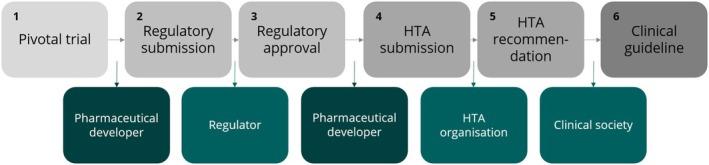
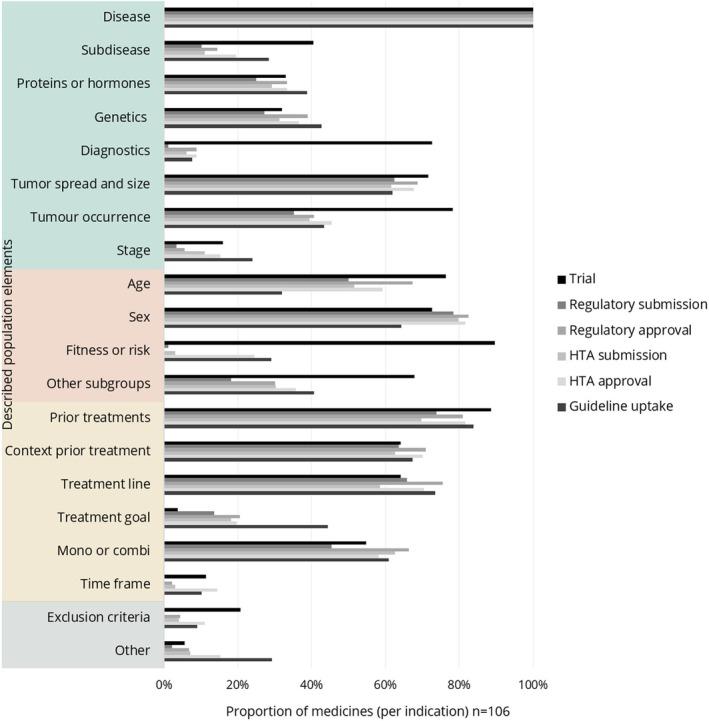
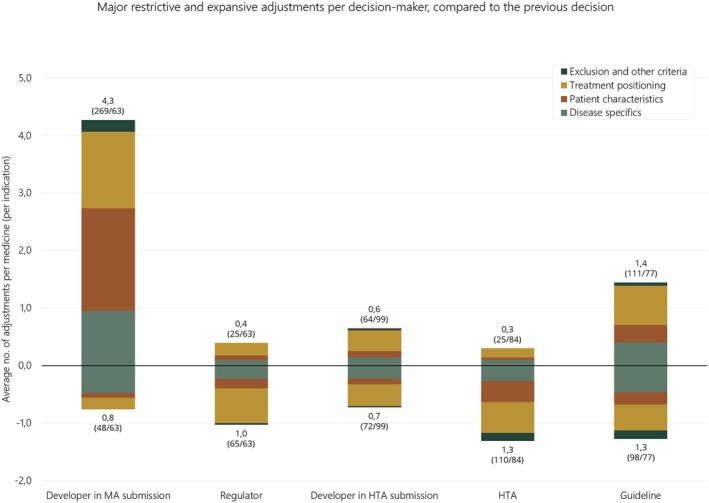
After a medicine has been tested in pivotal trials, regulators, health technology assessment (HTA) organizations, and professional societies make decisions about the patients best served by the medicine. This study assesses how the patient populations for oncology medicines (2010-2023) are defined (1) at trial, (2) regulatory submission, (3) upon approval for marketing authorization, (4) at submission, and (5) recommendation by the HTA, and (6) in clinical guidelines in Australia, Canada, the Netherlands, the United Kingdom, and the United States. Based on 25 populations for oncology medicines, we developed a framework for describing oncology populations consisting of 20 elements in four domains: disease specifications, patient characteristics, treatment position, and exclusion criteria. In exploratory analyses, we tabulated any observed variation in these framework elements throughout the six steps in the lifecycle of a medicine. On average, 10 (95% confidence interval [CI]: 9.2-10.9) potential adjustments were made, 2.3 (95% CI: 2.0-2.5) by each decision-maker. The adjustments by pharmaceutical developers focused mostly on the disease specifications (0.5 of the average 0.8 adjustments, 63%), while adjustments by regulators, HTA organizations, and guideline developers predominantly targeted the treatment's position (range: 0.5/1.3 [36%] in guidelines to 0.6/1.0 [58%] in regulatory approvals). Each decision-maker on average modifies 1.0 element (out of 2.3 [43%]) that was previously adjusted by another decision-maker. The multiple differences observed in the description of patient populations reflect inconsistency in reporting between decision-makers, complicating communication to patients and potentially affecting access to medicines. The developed framework can support consistent reporting across stakeholders and countries.
一种药物在关键试验中经过测试后,监管机构、卫生技术评估(HTA)组织和专业协会会就最适合使用该药物的患者群体做出决策。本研究评估了2010年至2023年肿瘤药物的患者群体在以下六个阶段是如何定义的:(1)试验阶段、(2)监管申报阶段、(3)获得上市许可批准时、(4)提交时、(5)HTA推荐时,以及(6)澳大利亚、加拿大、荷兰、英国和美国的临床指南中。基于25个肿瘤药物患者群体,我们开发了一个描述肿瘤患者群体的框架,该框架由四个领域的20个要素组成:疾病规范、患者特征、治疗地位和排除标准。在探索性分析中,我们将药物生命周期六个步骤中这些框架要素的任何观察到的变化制成表格。平均而言,做出了10次(95%置信区间[CI]:9.2 - 10.9)潜在调整,每个决策制定者进行了2.3次(95% CI:2.0 - 2.5)调整。制药开发商的调整主要集中在疾病规范方面(平均0.8次调整中的0.5次,占63%),而监管机构、HTA组织和指南制定者的调整主要针对治疗地位(范围:指南中为0.5/1.3[36%]至监管批准中为0.6/1.0[58%])。每个决策制定者平均修改了之前由另一个决策制定者调整过的1.0个要素(在2.3个要素中占1.0个[43%])。在患者群体描述中观察到的多重差异反映了决策制定者之间报告的不一致性,这使得与患者的沟通变得复杂,并可能影响药物的可及性。所开发的框架可以支持不同利益相关者和国家之间的一致报告。


 Zotero 插件