
弥漫性大B细胞淋巴瘤的年龄和性别特异性分子特征:来自DSHNHL/GLA临床试验的结果
Age- and gender-specific molecular characteristics of diffuse large B-cell lymphoma: Results from clinical trials of the DSHNHL/GLA.
作者信息
Kurz Katrin S, Steinlein Sophia, Kreuz Markus, Ziepert Marita, Staiger Annette M, Barth Thomas F E, Möller Peter, Bernd Heinz-Wolfram, Feller Alfred C, Richter Julia, Klapper Wolfram, Stein Harald, Hartmann Sylvia, Hansmann Martin-Leo, Trümper Lorenz, Loeffler Markus, Schmitz Norbert, Rosenwald Andreas, Ott German, Horn Heike
机构信息
Department of Clinical Pathology Robert-Bosch-Krankenhaus Stuttgart Germany.
Dr. Margarete Fischer-Bosch-Institute of Clinical Pharmacology Stuttgart and University of Tübingen Tübingen Germany.
出版信息
Hemasphere. 2025 Mar 7;9(3):e70093. doi: 10.1002/hem3.70093. eCollection 2025 Mar.
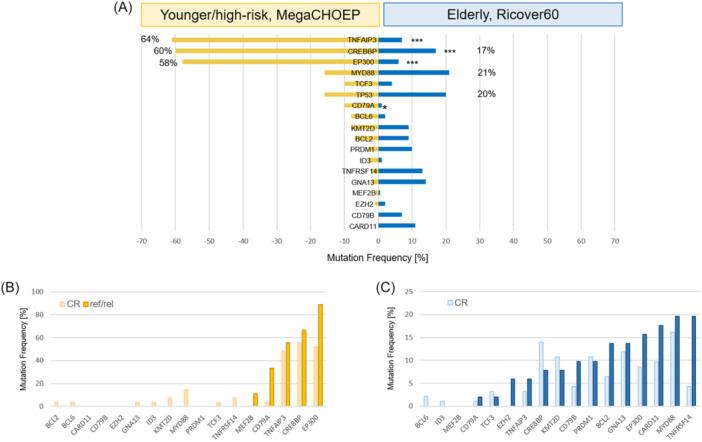
Diffuse large B-cell lymphoma (DLBCL) is the most common non-Hodgkin lymphoma. Despite a high cure rate, too many patients show refractory (ref) or relapsed (rel) disease. This study examines the frequency of recurring gene mutations and their interplay with well-known biomarkers in female and male patients between 18 and 80 years with ref/rel DLBCL compared to patients with complete remission (CR) to identify biological risk factors associated with treatment response, using cohorts of R-CHOP-like treated DLBCL enrolled in clinical trials of the DSHNHL. The biomarker profile of patients differed between younger and elderly patients with ref/rel DLBCL, with a higher frequency of translocations in younger patients, and higher numbers of ABC subtypes and MYC protein expression in the elderly. Amplicon sequencing revealed generally higher mutation frequencies in the younger cohort. Mutations in and were associated with shorter overall survival (OS) only in younger patients. A higher proportion of mutations was detected in female patients of the elderly DLBCL patient cohort, clearly emphasizing the striking differences in biomarker distribution between younger and elderly as well as female and male patients.
弥漫性大B细胞淋巴瘤(DLBCL)是最常见的非霍奇金淋巴瘤。尽管治愈率较高,但仍有太多患者出现难治性(ref)或复发性(rel)疾病。本研究调查了18至80岁患有难治性/复发性DLBCL的女性和男性患者与完全缓解(CR)患者相比,复发基因突变的频率及其与知名生物标志物的相互作用,以确定与治疗反应相关的生物学危险因素,使用了参加DSHNHL临床试验的接受R-CHOP样治疗的DLBCL队列。难治性/复发性DLBCL的年轻患者和老年患者的生物标志物谱不同,年轻患者中易位频率较高,老年患者中ABC亚型和MYC蛋白表达数量较多。扩增子测序显示年轻队列中的突变频率总体较高。仅在年轻患者中, 和 的突变与较短的总生存期(OS)相关。在老年DLBCL患者队列的女性患者中检测到较高比例的 突变,这清楚地强调了年轻与老年以及女性与男性患者之间生物标志物分布的显著差异。


 Zotero 插件