
在基于帕博利珠单抗的晚期非小细胞肺癌治疗期间同时使用苯二氮䓬类药物:监测机构数据的倾向评分匹配分析
Concomitant exposure to benzodiazepines during pembrolizumab-based therapy for advanced non-small-cell lung cancer: a propensity-score matched analysis of monitoring agency data.
作者信息
Nelli Fabrizio, Ruggeri Enzo Maria, Virtuoso Antonella, Giannarelli Diana, Raso Armando, Natoni Federica, Pessina Gloria, Remotti Daniele, Chilelli Mario Giovanni, Signorelli Carlo, Fabbri Agnese
机构信息
Department of Oncology and Hematology, Thoracic Oncology Unit, Central Hospital of Belcolle, 01100 Viterbo, Italy.
Department of Oncology and Hematology, Medical Oncology Unit, Central Hospital of Belcolle, 01100 Viterbo, Italy.
出版信息
Explor Target Antitumor Ther. 2025 Jan 20;6:1002287. doi: 10.37349/etat.2025.1002287. eCollection 2025.
AIM
The interaction of concomitant benzodiazepine (BZD) exposure during immune checkpoint blockade has not been comprehensively investigated to date. This research aimed to determine the influence of BZD intake on the survival outcomes of patients with metastatic non-small-cell lung cancer (NSCLC) receiving pembrolizumab-based therapies.
METHODS
We included consecutive patients with advanced NSCLC who were given frontline pembrolizumab, whether as exclusive therapy or combined with platinum-based chemotherapy. The classification of BZD relied on the molecular composition, distinguishing between -substituted and -unsubstituted compounds.
RESULTS
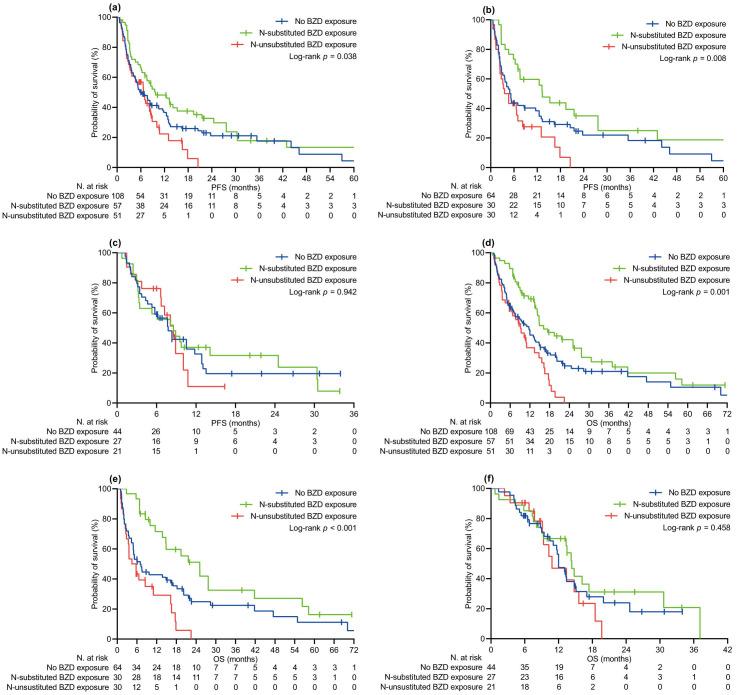
During the time frame from April 2018 to May 2023, we enrolled 258 patients, 156 (60.5%) and 102 (39.5%) of whom received pembrolizumab alone or the combination regimen, respectively. We identified 108 (41.8%) exposed patients (BZD cohort) in comparison to all others (no-BZD cohort). After applying propensity-score matching, 108 cases were relevant for each cohort. After a median follow-up of 16.3 [95% confidence interval (CI) 13.1-19.7] months, univariate analysis revealed no significant differences in terms of progression-free survival (PFS) or overall survival (OS) between BZD cohorts. However, patients exposed to -substituted compounds had significantly longer PFS and OS than those who did not take BZD. Conversely, patients exposed to -unsubstituted compounds experienced significantly shortened OS. Multivariate testing showed that taking unspecified BZD had no impact on PFS or OS, while -substituted BZD exposure correlated independently with longer PFS [hazard ratio (HR) 0.52 (95% CI 0.34-0.79); = 0.002] and OS [HR 0.58 (95% CI 0.38-0.88); < 0.001]. In contrast, -unsubstituted BZD intake had worsening effects on OS [HR 1.92 (95% CI 1.20-3.06); = 0.006].
CONCLUSIONS
BZD exposure may impact the efficacy of immune checkpoint inhibitors in patients with advanced NSCLC. The specific composition may influence the choice among different compounds.
目的
免疫检查点阻断治疗期间同时使用苯二氮䓬类药物(BZD)的相互作用至今尚未得到全面研究。本研究旨在确定服用BZD对接受派姆单抗治疗的转移性非小细胞肺癌(NSCLC)患者生存结局的影响。
方法
我们纳入了接受一线派姆单抗治疗的晚期NSCLC连续患者,无论其为单纯治疗还是联合铂类化疗。BZD的分类依据分子组成,区分α-取代和α-未取代化合物。
结果
在2018年4月至2023年5月期间,我们纳入了258例患者,其中156例(60.5%)和102例(39.5%)分别接受了单纯派姆单抗或联合治疗方案。与所有其他患者(非BZD队列)相比,我们确定了108例(41.8%)暴露患者(BZD队列)。应用倾向评分匹配后,每个队列有108例相关病例。中位随访16.3 [95%置信区间(CI)13.1 - 19.7]个月后,单因素分析显示BZD队列之间在无进展生存期(PFS)或总生存期(OS)方面无显著差异。然而,暴露于α-取代化合物的患者的PFS和OS显著长于未服用BZD的患者。相反,暴露于α-未取代化合物的患者的OS显著缩短。多因素检验显示,服用未指明的BZD对PFS或OS无影响,而α-取代BZD暴露与更长的PFS [风险比(HR)0.52(95% CI 0.34 - 0.79);P = 0.002]和OS [HR 0.58(95% CI 0.38 - 0.88);P < 0.001]独立相关。相比之下,摄入α-未取代BZD对OS有不良影响[HR 1.92(95% CI 1.20 - 3.06);P = 0.006]。
结论
BZD暴露可能影响晚期NSCLC患者免疫检查点抑制剂的疗效。具体组成可能会影响不同化合物之间的选择。

 Zotero 插件