
西达本胺联合地西他滨±维奈克拉治疗复发/难治性急性髓系白血病
Chidamide in Combination With DCAG With or Without Venetoclax for Relapsed/Refractory Acute Myeloid Leukemia.
作者信息
Liu Qingyang, Zhang Xiawei, Lv Lei, Xu Linming, Jing Yu, Gao Wenjing, Wang Lili, Dou Liping
机构信息
State Key Laboratory of Experimental Hematology, Senior Department of Hematology, The Fifth Medical Center of Chinese PLA General Hospital, Beijing, China.
Medical School of Chinese PLA, Beijing, China.
出版信息
Cancer Med. 2025 Mar;14(5):e70734. doi: 10.1002/cam4.70734.
INTRODUCTION
Currently, there are only a few avaailable treatment options for patients with relapsed and refractory acute myeloid leukemia (R/R AML).
METHODS
We conducted a single-center, phase 1 prospective study (ChiCTR2200065634) to evaluate the efficacy and safety of chidamide, demethylating drugs (azacitidine), cytarabine, aclacinomycin, and G-CSF plus venetoclax (CDCAG-VEN) in patients with R/R AML. The previous CDCAG regimen was used as a historical control to compare its efficacy and safety. Thirty and 22 patients received one course of CDCAG with or without a 14-day course of venetoclax, respectively.
RESULTS
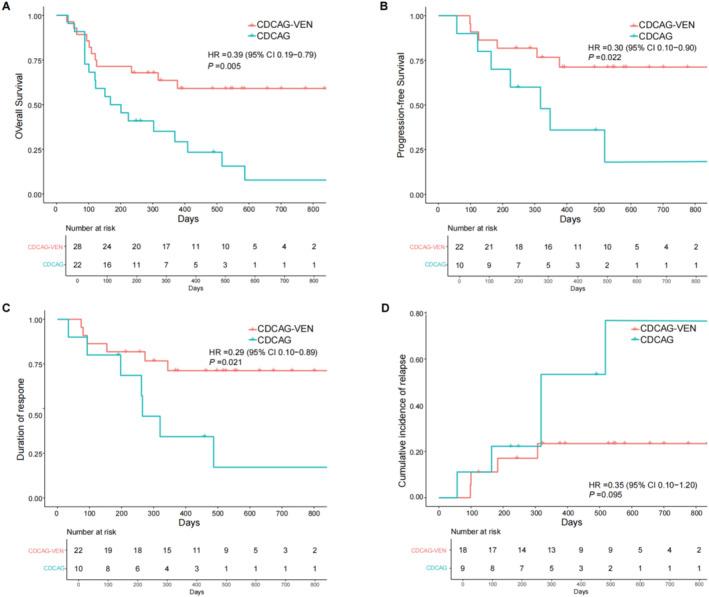
The overall response rate (ORR) was significantly higher in the CDCAG-VEN group than in the CDCAG-treated group (78.6% vs. 45.5%; p = 0.015), and the CDCAG-VEN group achieved a better trend of measurable residual disease-negative response (61.1% vs. 22.2%, p = 0.134). Compared with the CDCAG group, the CDCAG-VEN group exhibited significantly better 1-year overall survival (63.3% vs. 35.1%, p = 0.005) and progression-free survival (76.7% vs. 36.0%, p = 0.022). The duration of response was notably better in the CDCAG-VEN group than in the CDCAG group (71.2% vs. 34.3%, p = 0.021) and had a lower cumulative incidence of relapse (22.2% vs. 48.9%, p = 0.095). The neutrophil and platelet recovery times were similar between the CDCAG-VEN and CDCAG groups (neutrophil: 18 days vs. 19 days, p = 0.293; platelet: 18 days vs. 19 days, p = 0.311). The frequencies of adverse events were comparable between both groups, except for a lower incidence of thrombosis in the CDCAG-VEN group (0% vs. 22.7%, p = 0.006).
DISCUSSION
In conclusion, venetoclax in combination with CDCAG is an effective and safe treatment regimen for R/R AML, thereby rapidly identifying chemosensitive patients and inducing measurable residual disease-negative remission in a high proportion of patients with R/R AML.
引言
目前,复发难治性急性髓系白血病(R/R AML)患者可用的治疗选择很少。
方法
我们开展了一项单中心1期前瞻性研究(ChiCTR2200065634),以评估西达本胺、去甲基化药物(阿扎胞苷)、阿糖胞苷、阿克拉霉素以及G-CSF加维奈托克(CDCAG-VEN)方案治疗R/R AML患者的疗效和安全性。将先前的CDCAG方案用作历史对照,比较其疗效和安全性。30例和22例患者分别接受了一个疗程的含或不含14天维奈托克疗程的CDCAG方案治疗。
结果
CDCAG-VEN组的总缓解率(ORR)显著高于CDCAG治疗组(78.6% 对45.5%;p = 0.015),且CDCAG-VEN组达到了更好的可测量残留病阴性缓解趋势(61.1% 对22.2%,p = 0.134)。与CDCAG组相比,CDCAG-VEN组的1年总生存率(63.3% 对35.1%,p = 0.005)和无进展生存率(76.7% 对36.0%,p = 0.022)显著更好。CDCAG-VEN组的缓解持续时间明显优于CDCAG组(71.2% 对34.3%,p = 0.021),且复发累积发生率较低(22.2% 对4

 Zotero 插件