
甘油三酯葡萄糖指数可预测2型糖尿病患者的长期死亡率和主要不良心血管事件。
Triglyceride glucose index predicts long-term mortality and major adverse cardiovascular events in patients with type 2 diabetes.
作者信息
Sbriscia Matilde, Colombaretti Dalila, Giuliani Angelica, Di Valerio Silvia, Scisciola Lucia, Rusanova Iryna, Bonfigli Anna Rita, Olivieri Fabiola, Sabbatinelli Jacopo
机构信息
Scientific Direction, IRCCS INRCA, Ancona, Italy.
Department of Clinical and Molecular Sciences, Università Politecnica Delle Marche, Via Tronto 10/A, 60126, Ancona, Italy.
出版信息
Cardiovasc Diabetol. 2025 Mar 10;24(1):115. doi: 10.1186/s12933-025-02671-2.
BACKGROUND
The triglyceride glucose index (TyG index) is a marker of insulin resistance linked to the incidence of major adverse cardiovascular events (MACE) in diverse populations. However, its long-term prognostic role in type 2 diabetes (T2D) remains underexplored. This study evaluated the predictive value of the TyG index for all-cause mortality and MACE in T2D over a period of more than 15 years.
METHODS
A retrospective analysis was conducted on a cohort of 568 patients with T2D (median age: 67 years, IQR 61-72 years; 54% males; median disease duration: 14 years, IQR 7-21 years; median HbA1c: 7.3%, IQR 6.6-8.0%) and 376 presumably healthy controls (CTR, median age: 65 years, IQR 60-71 years) followed for a median period of 16.8 (IQR, 13.1-16.8) years. Routine biomarkers were measured on serum samples using commercially available methods. One-way ANOVA/ANCOVA, logistic regression, and Spearman's correlations were used to compare the TyG index among groups and to assess its correlations with biochemical variables. The association between TyG index and the follow-up endpoints was investigated by Kaplan-Meier curves and Cox proportional hazards analysis.
RESULTS
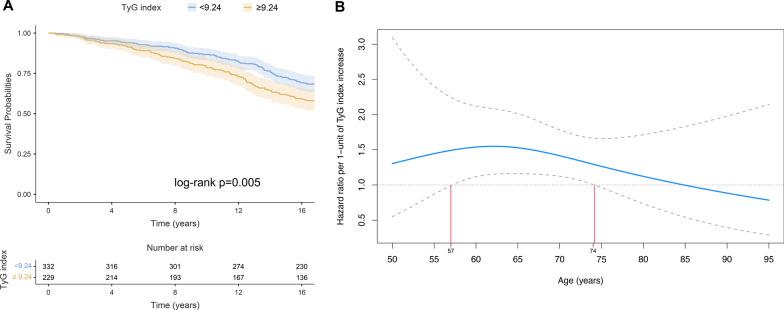
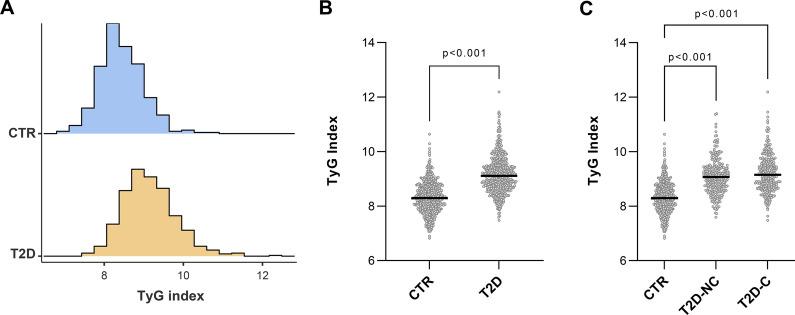
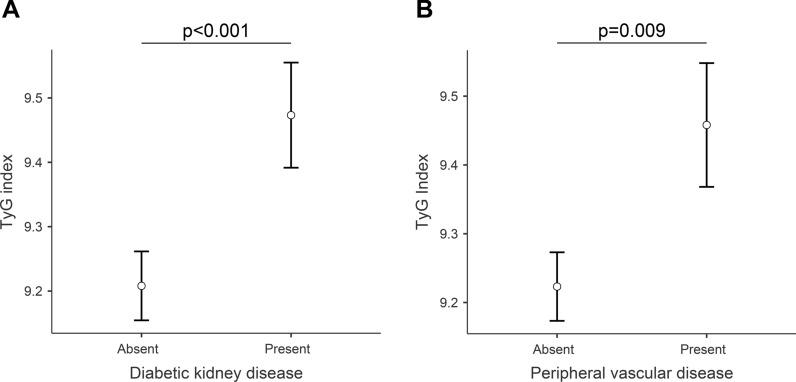
Patients with T2D exhibited higher TyG Index values compared to CTR, with significant correlations between the TyG Index and markers of obesity, glucose metabolism, inflammation, and liver function. Patients with preexisting diabetic kidney disease (DKD) or atherosclerotic vascular disease had higher baseline values of TyG index. Sex-specific differences were observed among CTR but not in T2D patients. The TyG Index was predictive of all-cause mortality (HR = 1.39, 95% CI 1.07-1.79) and associated with the onset of complications MACE, DKD, and neuropathy independent of other conventional predictors. Age modified the TyG Index-mortality association, with the strongest effect in individuals aged 57-74.
CONCLUSION
The TyG index is a valuable prognostic marker for long-term risk of all-cause mortality and MACE in patients with T2D, supporting its use in clinical risk stratification.
背景
甘油三酯葡萄糖指数(TyG指数)是一种胰岛素抵抗标志物,与不同人群中主要不良心血管事件(MACE)的发生率相关。然而,其在2型糖尿病(T2D)中的长期预后作用仍未得到充分探索。本研究评估了TyG指数在超过15年的时间里对T2D患者全因死亡率和MACE的预测价值。
方法
对568例T2D患者(中位年龄:67岁,IQR 61 - 72岁;54%为男性;中位病程:14年,IQR 7 - 21年;中位糖化血红蛋白:7.3%,IQR 6.6 - 8.0%)和376例推测健康对照者(CTR,中位年龄:65岁,IQR 60 - 71岁)进行回顾性分析,随访中位时间为16.8(IQR,13.1 - 16.8)年。使用市售方法对血清样本进行常规生物标志物检测。采用单因素方差分析/协方差分析、逻辑回归和Spearman相关性分析来比较各组间的TyG指数,并评估其与生化变量的相关性。通过Kaplan - Meier曲线和Cox比例风险分析研究TyG指数与随访终点之间的关联。
结果
与CTR相比,T2D患者的TyG指数值更高,且TyG指数与肥胖、糖代谢、炎症和肝功能标志物之间存在显著相关性。患有糖尿病肾病(DKD)或动脉粥样硬化性血管疾病的患者TyG指数基线值更高。在CTR中观察到性别差异,但在T2D患者中未观察到。TyG指数可预测全因死亡率(HR = 1.39,95% CI 1.07 - 1.79),并与并发症MACE、DKD和神经病变的发生相关,独立于其他传统预测因素。年龄改变了TyG指数与死亡率的关联,在57 - 74岁个体中影响最强。
结论
TyG指数是T2D患者全因死亡率和MACE长期风险的有价值预后标志物,支持其在临床风险分层中的应用。
 Zotero 插件