
评估线粒体相关蛋白与肌肉骨骼疾病之间的因果关系:一项孟德尔随机化研究。
Assessing causality between mitochondrial-associated proteins with musculoskeletal diseases: A Mendelian randomization study.
作者信息
Li Jia-Chen, Huang Wei-Sheng, Yang Da-Hang, He Qi-Fei, Sun Wei
机构信息
Department of Orthopedics, Shenzhen Second People's Hospital/First Affiliated Hospital of Shenzhen University, Shenzhen, Guangdong, China.
Shantou University Medical College, Shantou, China.
出版信息
Medicine (Baltimore). 2025 Mar 7;104(10):e41731. doi: 10.1097/MD.0000000000041731.
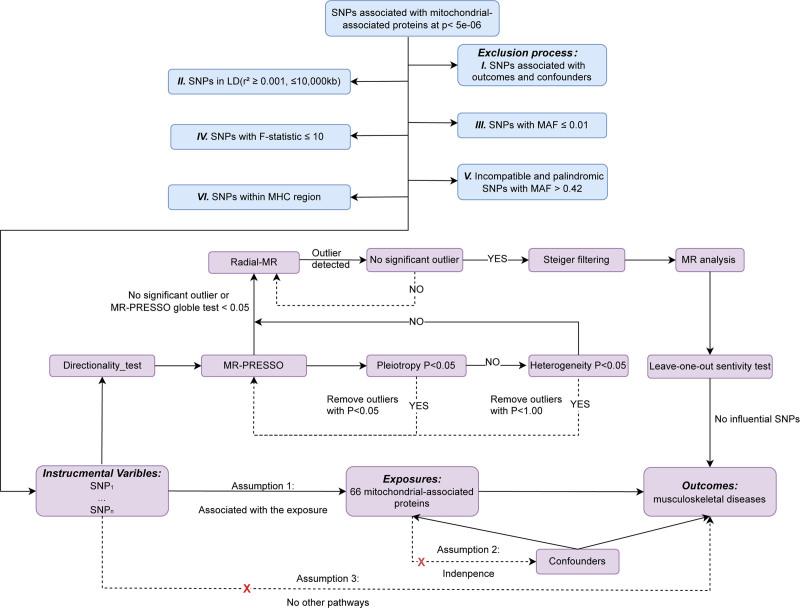
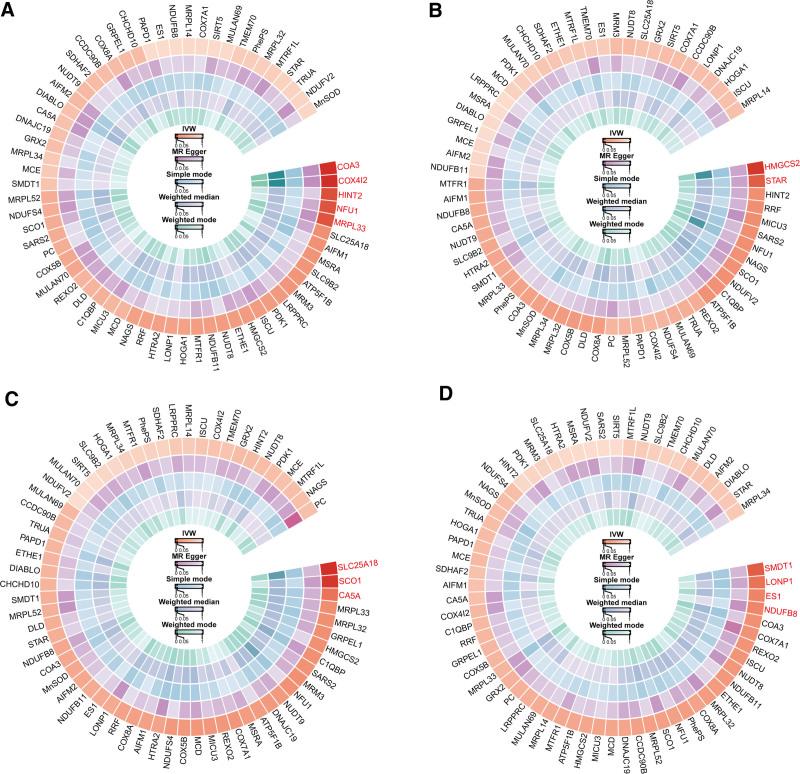
Musculoskeletal diseases are the leading cause of disability-adjusted life years. Mitochondria, often referred to as the "powerhouses" of cells, are believed to play a role in regulating cellular metabolism and differentiation, potentially influencing the occurrence and progression of musculoskeletal diseases. However, the exact causal relationships remain to be defined. This study aimed to investigate the causal relationships between mitochondrial biological functions and musculoskeletal diseases (including osteoarthritis (OA), osteoporosis, rheumatoid arthritis (RA), and ankylosing spondylitis through Mendelian randomization (MR) analysis). We systematically summarized data related to mitochondrial functional proteins and musculoskeletal diseases from the IEU OpenGWAS and UK Biobank databases. We used single nucleotide polymorphisms significantly associated with musculoskeletal diseases as instrumental variables. The inverse variance weighting method performed the main MR analysis. We used Mendelian randomized residual sum of pleiotropy and outliers, MR-Egger regression, Cochran Q statistic, Rucker Q statistic, Radial-MR, weighted median, simple mode, weighted mode, and leave-one-out analysis methods as supplementary analyses. First, 14 positive mitochondrial functional proteins were screened out. After Bonferroni correction, COA3 and COX4I2 were found to be causally related to OA and act as protective factors. We identified a causal relationship between SLC25A18 and RA as a risk factor. This study provides genetic support and offers new evidence regarding the roles of COA3, COX4I2, and SLC25A18 in the pathophysiology of OA and RA. This study paves the way for a deeper understanding of the pathological mechanisms of musculoskeletal diseases and provides information for their prevention strategies and treatments.
肌肉骨骼疾病是导致残疾调整生命年的主要原因。线粒体常被称为细胞的“动力源”,被认为在调节细胞代谢和分化中发挥作用,可能影响肌肉骨骼疾病的发生和发展。然而,确切的因果关系仍有待确定。本研究旨在通过孟德尔随机化(MR)分析,研究线粒体生物学功能与肌肉骨骼疾病(包括骨关节炎(OA)、骨质疏松症、类风湿性关节炎(RA)和强直性脊柱炎)之间的因果关系。我们系统地总结了来自IEU OpenGWAS和英国生物银行数据库中与线粒体功能蛋白和肌肉骨骼疾病相关的数据。我们使用与肌肉骨骼疾病显著相关的单核苷酸多态性作为工具变量。逆方差加权法进行主要的MR分析。我们使用孟德尔随机化多效性和异常值残差和、MR-Egger回归、Cochran Q统计量、Rucker Q统计量、径向MR、加权中位数、简单模式、加权模式和留一法分析方法作为补充分析。首先,筛选出14种正向线粒体功能蛋白。经过Bonferroni校正后,发现COA3和COX4I2与OA存在因果关系,并作为保护因素。我们确定SLC25A18与RA之间存在因果关系,且为危险因素。本研究为COA3、COX4I2和SLC25A18在OA和RA病理生理学中的作用提供了遗传学支持和新证据。本研究为深入了解肌肉骨骼疾病的病理机制铺平了道路,并为其预防策略和治疗提供了信息。

 Zotero 插件