
16S rRNA对早期阿尔茨海默病患者肠道菌群改变及早期诊断的影响
Impact of 16S rRNA on Intestinal Flora Alterations and Early Diagnosis in Early Alzheimer's Disease Patients.
作者信息
Lv Danping, Lin Xiuqin, Zhang Xinyuan, Shen Qundi
机构信息
Department of Laboratory, Shaoxing Seventh People's Hospital, 312000 Shaoxing, Zhejiang, China.
出版信息
Actas Esp Psiquiatr. 2025 Mar;53(2):208-221. doi: 10.62641/aep.v53i2.1682.
BACKGROUND
Alzheimer's Disease (AD), a complex clinical condition, relies on neuropsychological assessments for early diagnosis. Recently, the gut-brain axis has been recognized as crucial in AD development, with dysbiosis in gut microbiota implicated in disease progression. Utilizing 16S rRNA analysis provides comprehensive monitoring of gut microbiota, potentially revealing biological markers for Early Alzheimer's Disease (EAD). Therefore, this study aimed to investigate the diagnostic impact of 16S ribosomal RNA (rRNA) on changes in intestinal flora among EAD patients.
METHODS
This study analyzed stool samples from 50 AD patients and 50 healthy controls between June 2022 and June 2023. Based on the disease stage, patients were categorized into EAD (n = 14) and Late Alzheimer's Disease (LAD) groups (n = 36). The V3-V4 region was sequenced using 16S rRNA quantitative Polymerase Chain Reaction (qPCR) to compare the composition of gut microbiota and differences in abundance among the three experimental groups.
RESULTS
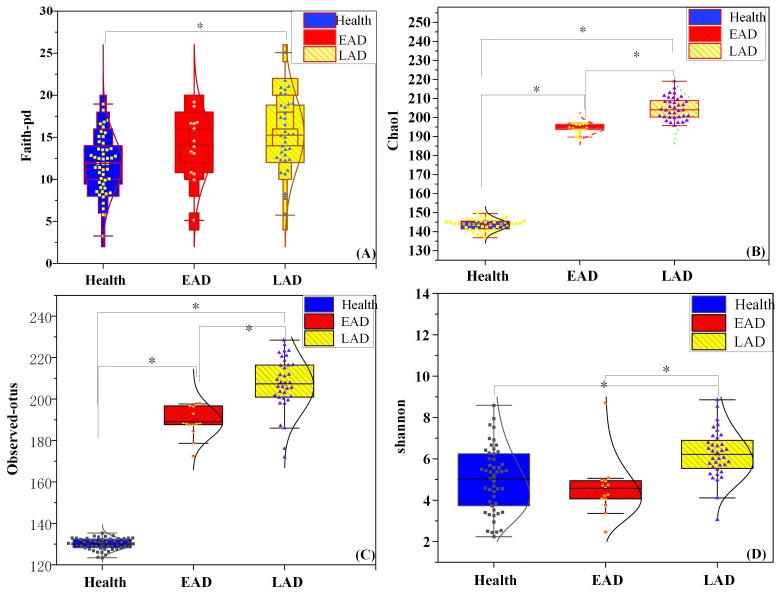
The abundance and diversity of gut microbiota significantly increased in EAD patients compared to the healthy control group. Furthermore, 39 genera showed considerable variations between EAD and LAD patients and healthy controls, with notable increases in the abundance of Bryantella, Gemmiger, Desulfovibrio, Collinsella, and Odoribacter among EAD patients. Additionally, significant differences were observed across the Desulfovibrioales and Verrucomicrobiales, which could help distinguish EAD patients (Area Under the Curve (AUC) range 0.854, 0.966, p < 0.05).
CONCLUSION
16S rRNA technology can be used to identify EAD patients, with the Desulfovibrioales and Verrucomicrobiales indicators serving as potential biological markers.
背景
阿尔茨海默病(AD)是一种复杂的临床病症,早期诊断依赖于神经心理学评估。近年来,肠-脑轴被认为在AD的发展中起着关键作用,肠道微生物群失调与疾病进展有关。利用16S rRNA分析可全面监测肠道微生物群,有可能揭示早期阿尔茨海默病(EAD)的生物标志物。因此,本研究旨在探讨16S核糖体RNA(rRNA)对EAD患者肠道菌群变化的诊断影响。
方法
本研究分析了2022年6月至2023年6月期间50例AD患者和50例健康对照的粪便样本。根据疾病阶段,患者被分为EAD组(n = 14)和晚期阿尔茨海默病(LAD)组(n = 36)。使用16S rRNA定量聚合酶链反应(qPCR)对V3-V4区域进行测序,以比较三个实验组肠道微生物群的组成和丰度差异。
结果
与健康对照组相比,EAD患者肠道微生物群的丰度和多样性显著增加。此外,39个菌属在EAD患者、LAD患者和健康对照之间表现出显著差异,EAD患者中Bryantella、Gemmiger、Desulfovibrio、Collinsella和Odoribacter的丰度显著增加。此外,在脱硫弧菌目和疣微菌目中观察到显著差异,这有助于区分EAD患者(曲线下面积(AUC)范围为0.854,0.966,p < 0.05)。
结论
16S rRNA技术可用于识别EAD患者,脱硫弧菌目和疣微菌目指标可作为潜在的生物标志物。



 Zotero 插件