
计算基因组学及其在人类学问题中的应用。
Computational Genomics and Its Applications to Anthropological Questions.
作者信息
Witt Kelsey E, Villanea Fernando A
机构信息
Department of Genetics and Biochemistry and Center for Human Genetics, Clemson University, Clemson, South Carolina, USA.
Department of Anthropology, University of Colorado Boulder, Boulder, Colorado, USA.
出版信息
Am J Biol Anthropol. 2024 Dec;186 Suppl 78(Suppl 78):e70010. doi: 10.1002/ajpa.70010.
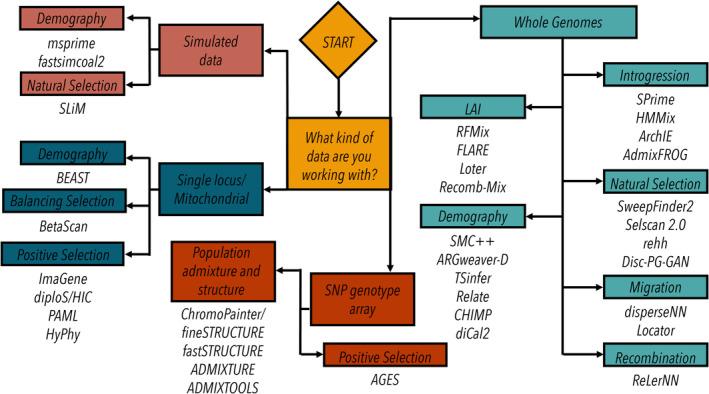
The advent of affordable genome sequencing and the development of new computational tools have established a new era of genomic knowledge. Sequenced human genomes number in the tens of thousands, including thousands of ancient human genomes. The abundance of data has been met with new analysis tools that can be used to understand populations' demographic and evolutionary histories. Thus, a variety of computational methods now exist that can be leveraged to answer anthropological questions. This includes novel likelihood and Bayesian methods, machine learning techniques, and a vast array of population simulators. These computational tools provide powerful insights gained from genomic datasets, although they are generally inaccessible to those with less computational experience. Here, we outline the theoretical workings behind computational genomics methods, limitations and other considerations when applying these computational methods, and examples of how computational methods have already been applied to anthropological questions. We hope this review will empower other anthropologists to utilize these powerful tools in their own research.
经济实惠的基因组测序技术的出现以及新计算工具的开发开启了基因组知识的新时代。已测序的人类基因组数以万计,其中包括数千个古代人类基因组。丰富的数据催生了可用于了解人群人口统计学和进化史的新分析工具。因此,现在存在多种可用于回答人类学问题的计算方法。这包括新颖的似然法和贝叶斯方法、机器学习技术以及大量的种群模拟器。这些计算工具提供了从基因组数据集中获得的强大见解,尽管计算经验较少的人通常无法使用它们。在此,我们概述了计算基因组学方法背后的理论原理、应用这些计算方法时的局限性及其他注意事项,以及计算方法已如何应用于人类学问题的示例。我们希望这篇综述能使其他人类学家在自己的研究中利用这些强大的工具。

 Zotero 插件