
使用金-钛纳米颗粒通过阳光诱导光催化去除对乙酰氨基酚
Sunlight-Induced Photocatalytic Removal of Paracetamol Using Au-TiO Nanoparticles.
作者信息
Aoudjit Lamine, Queirós Joana M, Castro A S, Zioui Djamila, González-Ballesteros Noelia, Lanceros-Mendez S, Martins Pedro M
机构信息
Unité de Développement des Equipements Solaires, UDES/Centre de Développement des Energies Renouvelables, CDER, Bou Ismail 42415, Algeria.
Physics Centre of Minho and Porto Universities (CF-UM-UP) and LaPMET-Laboratory of Physics for Materials and Emergent Technologies, University of Minho, 4710-057 Braga, Portugal.
出版信息
Nanomaterials (Basel). 2025 Feb 26;15(5):358. doi: 10.3390/nano15050358.
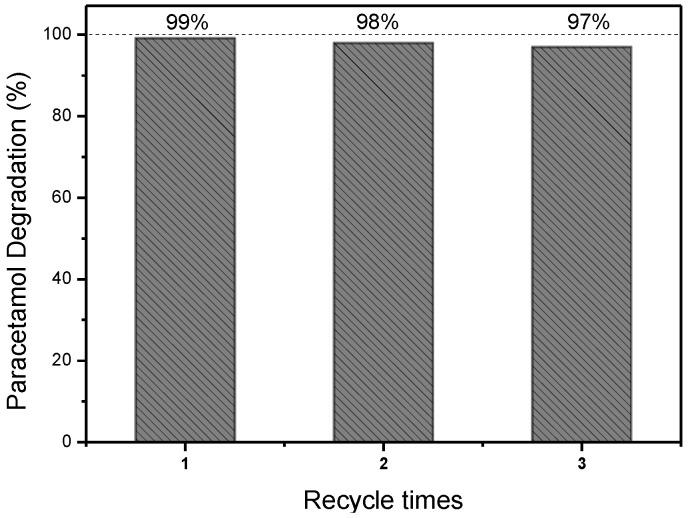
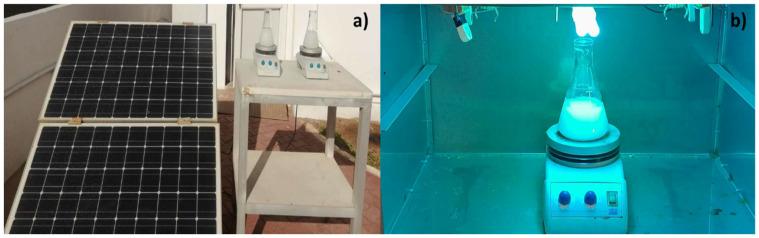
Using sunlight as the driving force for photocatalytic processes holds great promise for sustainability. As a starting point for developing a material capable of degrading aquatic pollutants using solar energy as a stimulus, this work focuses on synthesizing Au-TiO nanocomposites using the deposition-precipitation method. Characterization of Au-TiO nanoparticles was performed by X-ray diffraction (XRD), Fourier transform infrared spectroscopy (FTIR), and Transmission Electron Microscopy (TEM). A model pollutant, paracetamol, was used to test the synergetic effect of Au (0.05 wt%) nanoparticles (NPs) with TiO on photocatalytic activity. The influence of the parameters pH, loading (0.4, 0.8, and 1 g/L), pollutant concentration (20, 30, 40 ppm), and contact time (30, 60, 90, 120, 150, and 180 min) was studied by exposing the NPs to solar radiation. The photocatalytic degradation was most effective at a contact time of 3 h, an initial concentration of 20 ppm, and a pH of 6.8. Under these conditions, paracetamol in 1 g/L of Au-TiO nanocomposites can be degraded by more than 99.17% under solar irradiation. As a result of the Au-TiO composite's ability to successfully serve as a photocatalyst using sun radiation, water purification processes can be more widespread, cost-effective, and environmentally friendly.
利用阳光作为光催化过程的驱动力对可持续性具有巨大的潜力。作为开发一种能够利用太阳能作为刺激来降解水中污染物的材料的起点,这项工作专注于使用沉积沉淀法合成金-二氧化钛纳米复合材料。通过X射线衍射(XRD)、傅里叶变换红外光谱(FTIR)和透射电子显微镜(TEM)对金-二氧化钛纳米颗粒进行了表征。使用一种模型污染物对乙酰氨基酚来测试金(0.05 wt%)纳米颗粒(NPs)与二氧化钛对光催化活性的协同作用。通过将纳米颗粒暴露于太阳辐射下,研究了pH值、负载量(0.4、0.8和1 g/L)、污染物浓度(20、30、40 ppm)和接触时间(30、60、90、120、150和180分钟)等参数的影响。光催化降解在接触时间为3小时、初始浓度为20 ppm和pH值为6.8时最为有效。在这些条件下,1 g/L金-二氧化钛纳米复合材料中的对乙酰氨基酚在太阳辐射下可降解超过99.17%。由于金-二氧化钛复合材料能够成功地利用太阳辐射作为光催化剂,水净化过程可以更加广泛、经济高效且环保。


 Zotero 插件