
辅助生殖技术与不孕不育父母后代患儿童癌症的风险:系统评价与荟萃分析
Assisted Reproductive Technology and Risk of Childhood Cancer Among the Offspring of Parents With Infertility: Systematic Review and Meta-Analysis.
作者信息
Song Gao, Zhang Cai-Qiong, Bai Zhong-Ping, Li Rong, Cheng Meng-Qun
机构信息
Department of Pharmacy, Puer People's Hospital, Puer, China.
Department of Reproductive Medicine, Puer People's Hospital, 44 Zhenxing Avenue, Puer, Yunnan, 665000, China, 86 18082997667, 86 2121114.
出版信息
JMIR Cancer. 2025 Mar 12;11:e65820. doi: 10.2196/65820.
BACKGROUND
The relationship between assisted reproductive technology (ART) and childhood cancer risk has been widely debated. Previous meta-analyses did not adequately account for the impact of infertility, and this study addresses this gap.
OBJECTIVE
Our primary objective was to assess the relative risk (RR) of childhood cancer in infertile populations using ART versus non-ART offspring, with a secondary focus on comparing frozen embryo transfer (FET) and fresh embryo transfer (fresh-ET).
METHODS
A literature review was conducted through PubMed, Embase, Cochrane, and Web of Science, with a cutoff date of July 10, 2024. The study was registered with the International Platform of Registered Systematic Review and Meta-Analysis Protocols (INPLASY 202470119). Inclusion criteria were based on the PICOS (Population, Intervention, Comparison, Outcomes, and Study Design) framework: infertile or subfertile couples (population), ART interventions (in vitro fertilization [IVF], intracytoplasmic sperm injection [ICSI], FET, and fresh-ET), non-ART comparison, and childhood cancer risk outcomes. Data abstraction focused on the primary exposures (ART vs non-ART and FET vs fresh-ET) and outcomes (childhood cancer risk). The risk of bias was assessed using the Newcastle-Ottawa Quality Assessment Scale, and the evidence quality was evaluated with the Grading of Recommendations Assessment, Development, and Evaluation (GRADE). Pooled estimates and 95% CIs were calculated using random effects models.
RESULTS
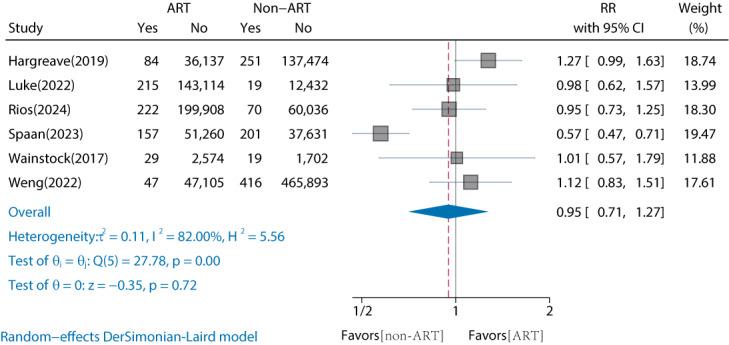
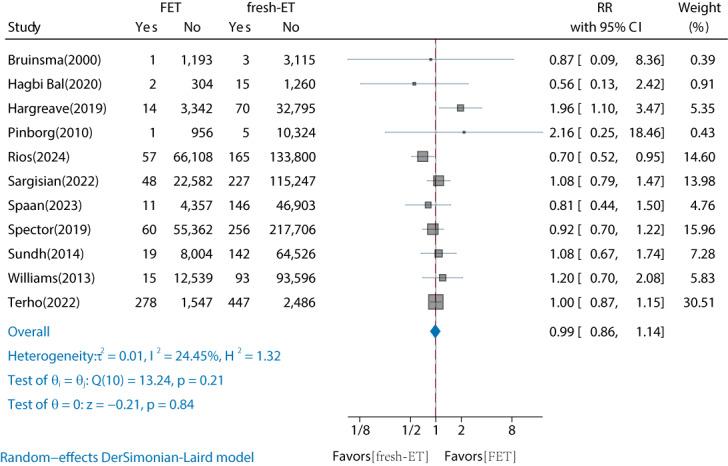
A total of 18 studies were included, published between 2000 and 2024, consisting of 14 (78%) cohort studies and 4 (22%) case-control studies, all of which were of moderate to high quality. The cohort studies had follow-up periods ranging from 3 to 18 years. Compared with non-ART conception, ART conception was not significantly associated with an increased risk of childhood overall cancer (RR 0.95, 95% CI 0.71-1.27; GRADE quality: low to moderate). Subgroup analyses of IVF (RR 0.86, 95% CI 0.59-1.25), ICSI (RR 0.76, 95% CI 0.26-2.2), FET (RR 0.98, 95% CI 0.54-1.76), and fresh-ET (RR 0.75, 95% CI 0.49-1.15) showed similar findings. No significant differences were found for specific childhood cancers, including leukemia (RR 0.99, 95% CI 0.79-1.24), lymphoma (RR 1.22, 95% CI 0.64-2.34), brain cancer (RR 1.22, 95% CI 0.73-2.05), embryonal tumors (RR 1, 95% CI 0.63-1.58), retinoblastoma (RR 1.3, 95% CI 0.73-2.31), and neuroblastoma (RR 1.02, 95% CI 0.48-2.16). Additionally, no significant difference was observed in a head-to-head comparison of FET versus fresh-ET (RR 0.99, 95% CI 0.86-1.14; GRADE quality: moderate).
CONCLUSIONS
In conclusion, this study found no significant difference in the risk of childhood cancer between offspring conceived through ART and those conceived through non-ART treatments (such as fertility drugs or intrauterine insemination) in infertile populations. While infertility treatments may elevate baseline risks, our findings suggest that whether individuals with infertility conceive using ART or non-ART methods, their offspring do not face a significantly higher risk of childhood cancer. Further research, especially comparing infertile populations who conceive naturally, is needed to better understand potential long-term health outcomes.
背景
辅助生殖技术(ART)与儿童癌症风险之间的关系一直存在广泛争议。以往的荟萃分析没有充分考虑不孕的影响,本研究弥补了这一空白。
目的
我们的主要目标是评估使用ART的不孕人群与未使用ART的后代患儿童癌症的相对风险(RR),次要重点是比较冻融胚胎移植(FET)和新鲜胚胎移植(新鲜ET)。
方法
通过PubMed、Embase、Cochrane和Web of Science进行文献综述,截止日期为2024年7月10日。该研究已在国际注册系统评价和荟萃分析方案平台(INPLASY 202470119)注册。纳入标准基于PICOS(人群、干预措施、对照、结局和研究设计)框架:不孕或亚生育夫妇(人群)、ART干预措施(体外受精[IVF]、卵胞浆内单精子注射[ICSI]、FET和新鲜ET)、非ART对照以及儿童癌症风险结局。数据提取重点关注主要暴露因素(ART与非ART以及FET与新鲜ET)和结局(儿童癌症风险)。使用纽卡斯尔-渥太华质量评估量表评估偏倚风险,并采用推荐分级评估、制定和评价(GRADE)对证据质量进行评估。使用随机效应模型计算合并估计值和95%置信区间。
结果
共纳入18项研究,发表于2000年至2024年之间,其中14项(78%)为队列研究,4项(22%)为病例对照研究,所有研究质量均为中到高。队列研究的随访期为3至18年。与非ART受孕相比,ART受孕与儿童总体癌症风险增加无显著关联(RR 0.95,95% CI 0.71-1.27;GRADE质量:低到中等)。IVF(RR 0.86,95% CI 0.59-1.25)、ICSI(RR 0.76,95% CI 0.26-2.2)、FET(RR 0.98,95% CI 0.54-1.76)和新鲜ET(RR 0.75,95% CI 0.49-1.15)的亚组分析显示了类似结果。在特定儿童癌症中未发现显著差异,包括白血病(RR 0.99,95% CI 0.79-1.24)、淋巴瘤(RR 1.22,95% CI 0.64-2.34)、脑癌(RR 1.22,95% CI 0.73-2.05)、胚胎性肿瘤(RR 1,95% CI 0.63-1.58)、视网膜母细胞瘤(RR 1.3,95% CI 0.73-2.31)和神经母细胞瘤(RR 1.02,95% CI 0.48-2.16)。此外,FET与新鲜ET的直接比较未观察到显著差异(RR 0.99,95% CI 0.86-1.14;GRADE质量:中等)。
结论
总之,本研究发现,在不孕人群中,通过ART受孕的后代与通过非ART治疗(如生育药物或宫内人工授精)受孕的后代患儿童癌症的风险无显著差异。虽然不孕治疗可能会提高基线风险,但我们的研究结果表明,无论不孕个体采用ART还是非ART方法受孕,其后代患儿童癌症的风险都不会显著更高。需要进一步研究,尤其是比较自然受孕的不孕人群,以更好地了解潜在的长期健康结局。


 Zotero 插件