
淋巴细胞增多个体中意外发现12号染色体着丝粒减少性增加:一例报告及细胞遗传学检测的临床意义
An Incidental Finding of Gain of a Diminished Chromosome 12 Centromere in an Individual with Lymphocytosis: A Case Report and Clinical Implications in Cytogenetic Testing.
作者信息
Xia Changqing, Cannatella Jeffrey J, Smith Scott C, Althof Pamela A, Koerselman Haley, Hempel Thomas, Jaworski Erin E, Winkler Lisa M, Spaulding Joanna R, Pickering Diane, Khoury Joseph D, Tang Zhenya
机构信息
Department of Pathology, Microbiology and Immunology, University of Nebraska Medical Center, Omaha, NE 68198, USA.
Department of Pathology, Upstate Medical University, Syracuse, NY 13210, USA.
出版信息
Diagnostics (Basel). 2025 Mar 4;15(5):618. doi: 10.3390/diagnostics15050618.
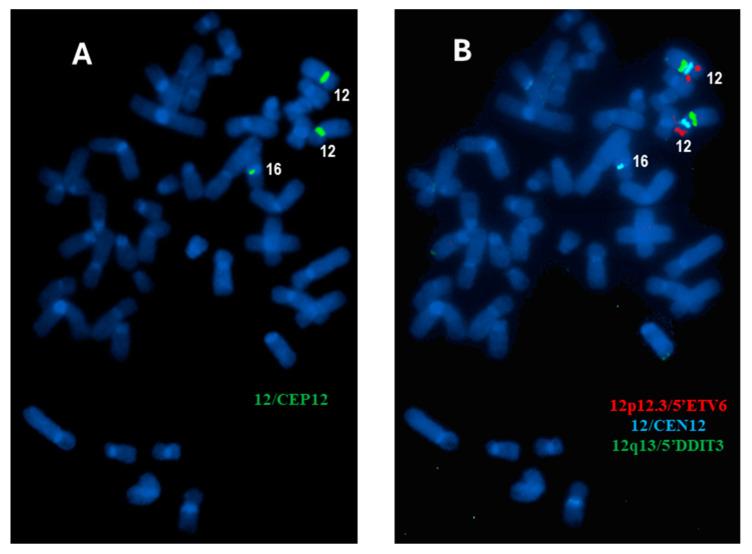
Fluorescence in situ hybridization (FISH) testing against chromosome 12 centromere (CEN12) is routinely included in the work-up of patients with suspected chronic lymphocytic leukemia (CLL) or monoclonal B-cell lymphocytosis (MBL). However, incidental findings can occur and be challenging. : Interphase and metaphase FISH analyses with various probes, including CEN12 probes from different vendors, and conventional cytogenetics were applied. : A CLL FISH panel was performed at the clinician's request on a peripheral blood specimen from a 55-year-old female with fluctuating leukocytosis and lymphocytosis for over six years. An additional diminished CEN12 FISH signal was observed in approximately 70% of the nucleated cells analyzed. Concurrent flow cytometry excluded a diagnosis of CLL or MBL, and karyotyping exhibited a normal female karyotype. Further studies excluded potential cross-hybridization due to limited specificity of the CEN12 probes and revealed the location of the additional diminished CEN12 signal on the centromere of one chromosome 16 homolog (CEN16), without other material from the short arm (12p) or long arm (12q) of chromosome 12 being involved. : This is the first case with an "uncertain" trisomy 12 status, presenting a challenge to clinical cytogenetic diagnosis. Although the mechanism for this mosaic "partial trisomy 12" and its clinical impact remain unknown, this case highlights the importance of further investigation using orthogonal methods to clarify incidental findings during diagnostic practice.
针对12号染色体着丝粒(CEN12)的荧光原位杂交(FISH)检测通常包含在疑似慢性淋巴细胞白血病(CLL)或单克隆B细胞淋巴细胞增多症(MBL)患者的检查工作中。然而,偶然发现可能会出现且具有挑战性。:应用了包括来自不同供应商的CEN12探针在内的各种探针进行间期和中期FISH分析,以及传统细胞遗传学分析。:应临床医生的要求,对一名55岁女性的外周血标本进行了CLL FISH检测,该患者白细胞增多和淋巴细胞增多波动超过六年。在大约70%分析的有核细胞中观察到额外减弱的CEN12 FISH信号。同时进行的流式细胞术排除了CLL或MBL的诊断,核型分析显示为正常女性核型。进一步研究排除了由于CEN12探针特异性有限导致的潜在交叉杂交,并揭示了额外减弱的CEN12信号位于一条16号染色体同源染色体着丝粒(CEN16)上,未涉及12号染色体短臂(12p)或长臂(12q)的其他物质。:这是首例具有“不确定”12三体状态的病例,对临床细胞遗传学诊断构成挑战。尽管这种嵌合型“部分12三体”的机制及其临床影响尚不清楚,但该病例强调了在诊断实践中使用正交方法进一步调查以澄清偶然发现的重要性。


 Zotero 插件