
利用碱性磷酸酶(AP)免疫标记可视化Fms样酪氨酸激酶3(Flt3)和其他神经元蛋白的细胞及亚细胞分布
Visualizing the Cellular and Subcellular Distribution of Fms-like Tyrosine Kinase 3 (Flt3) and Other Neuronal Proteins Using Alkaline Phosphatase (AP) Immunolabeling.
作者信息
Yin Yuqin, He Kathleen Z, Kirby Jane, Haque Ishraq A, Tang Xin
机构信息
Department of Neurosurgery, Boston Children's Hospital, 300 Longwood Ave, Boston, MA 02115, USA.
F. M. Kirby Neurobiology Center, Boston Children's Hospital, 3 Blackfan Circle, Boston, MA 02115, USA.
出版信息
Int J Mol Sci. 2025 Mar 4;26(5):2284. doi: 10.3390/ijms26052284.
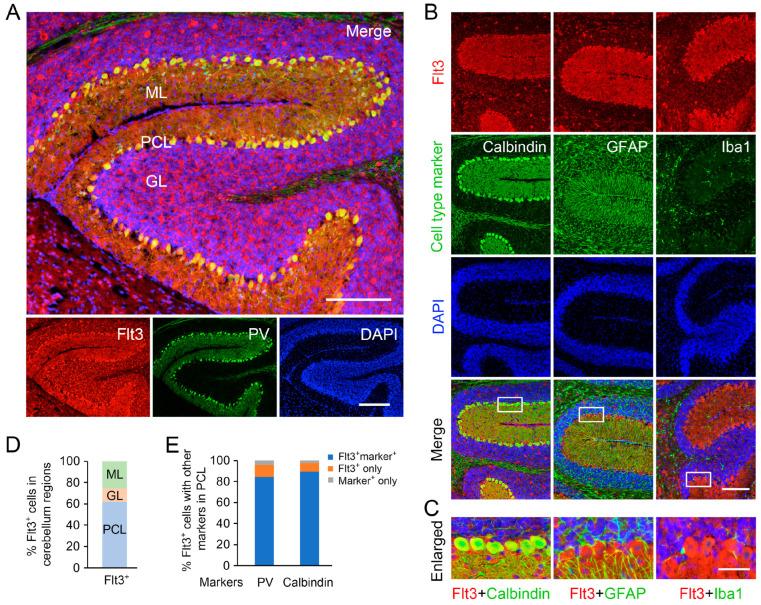
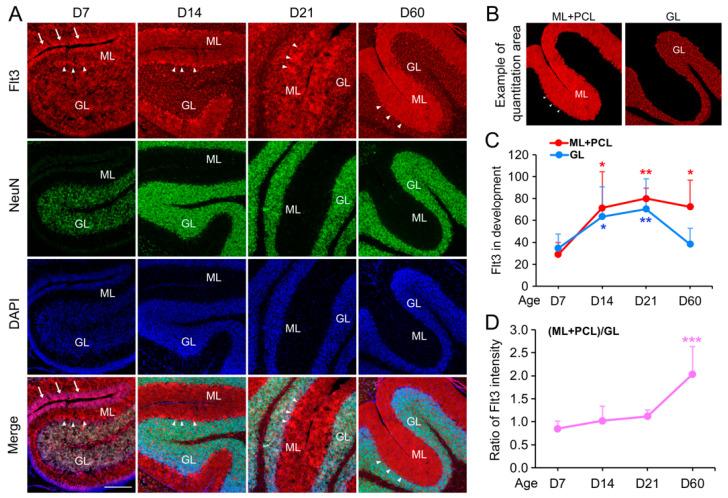
Precisely localizing the spatial distribution of proteins within various brain cell types and subcellular compartments, such as the synapses, is essential for generating and testing hypotheses to elucidate their roles in brain function. While the fms-like tyrosine kinase-3 (Flt3) has been extensively studied in the context of blood cell development and leukemia pathogenesis, its role in the brain remains poorly understood. Previous efforts to address this issue were hindered by the low expression levels of Flt3 and the limited sensitivity of the standard immunolabeling method, which were insufficient to reliably detect Flt3 protein in brain tissue. In this study, we systematically characterized Flt3 protein localization during brain development using a highly sensitive immunolabeling method based on alkaline phosphatase (AP) polymer biochemistry. This approach revealed a previously unrecognized neuron-selective Flt3 expression pattern in both mouse and human cerebella, with a developmental increase in total protein levels accompanied by a shift from a cytosolic to a dendritic subcellular distribution. Combining AP-polymer-based immunohistochemistry (AP-IHC) for Flt3 with conventional immunostaining of cell type marker proteins revealed parvalbumin- and calbindin-positive Purkinje cells to be the main cell type expressing Flt3 in the cerebellum. To validate the versatility of the AP-IHC method for detecting low-abundance neuronal proteins, we demonstrated robust labeling of Kir2.1, a potassium channel protein, in brain tissue sections from mouse, pig, and human samples. We further applied the AP-IHC method to human stem cell-derived neurons, effectively visualizing the postsynaptic density scaffold protein PSD95 within synapses. To our knowledge, this is the first study to employ an AP-IHC method combined with other standard immunofluorescent staining to co-detect weakly expressed neuronal proteins and other cellular markers in brain tissue and cultured neurons. Additionally, our findings uncover a previously unrecognized neuron-specific pattern of Flt3 expression in the cerebellum, laying the foundation for future mechanistic studies on its role in normal brain development and neurological disorders.
精确确定蛋白质在各种脑细胞类型和亚细胞区室(如突触)中的空间分布,对于生成和检验假设以阐明其在脑功能中的作用至关重要。虽然类fms酪氨酸激酶-3(Flt3)在血细胞发育和白血病发病机制方面已得到广泛研究,但其在大脑中的作用仍知之甚少。此前解决这一问题的努力受到Flt3低表达水平以及标准免疫标记方法有限灵敏度的阻碍,这些不足以可靠地检测脑组织中的Flt3蛋白。在本研究中,我们使用基于碱性磷酸酶(AP)聚合物生物化学的高灵敏度免疫标记方法,系统地描述了大脑发育过程中Flt3蛋白的定位。这种方法揭示了小鼠和人类小脑以前未被认识到的神经元选择性Flt3表达模式,总蛋白水平随着发育增加,同时伴随着从胞内分布到树突亚细胞分布的转变。将基于AP聚合物的Flt3免疫组织化学(AP-IHC)与细胞类型标记蛋白的传统免疫染色相结合,发现小白蛋白和钙结合蛋白阳性的浦肯野细胞是小脑中表达Flt3的主要细胞类型。为了验证AP-IHC方法检测低丰度神经元蛋白的通用性,我们在小鼠、猪和人类样本的脑组织切片中证实了钾通道蛋白Kir2.1的强标记。我们进一步将AP-IHC方法应用于人类干细胞衍生的神经元,有效地可视化了突触内的突触后致密支架蛋白PSD95。据我们所知,这是第一项采用AP-IHC方法结合其他标准免疫荧光染色来共同检测脑组织和培养神经元中弱表达的神经元蛋白和其他细胞标记物的研究。此外,我们的发现揭示了小脑中以前未被认识到的Flt3表达的神经元特异性模式,为其在正常脑发育和神经疾病中作用的未来机制研究奠定了基础。




 Zotero 插件